
Snipe Worlds – Plotting the Course – Episode 7
From the Origins to Mahon
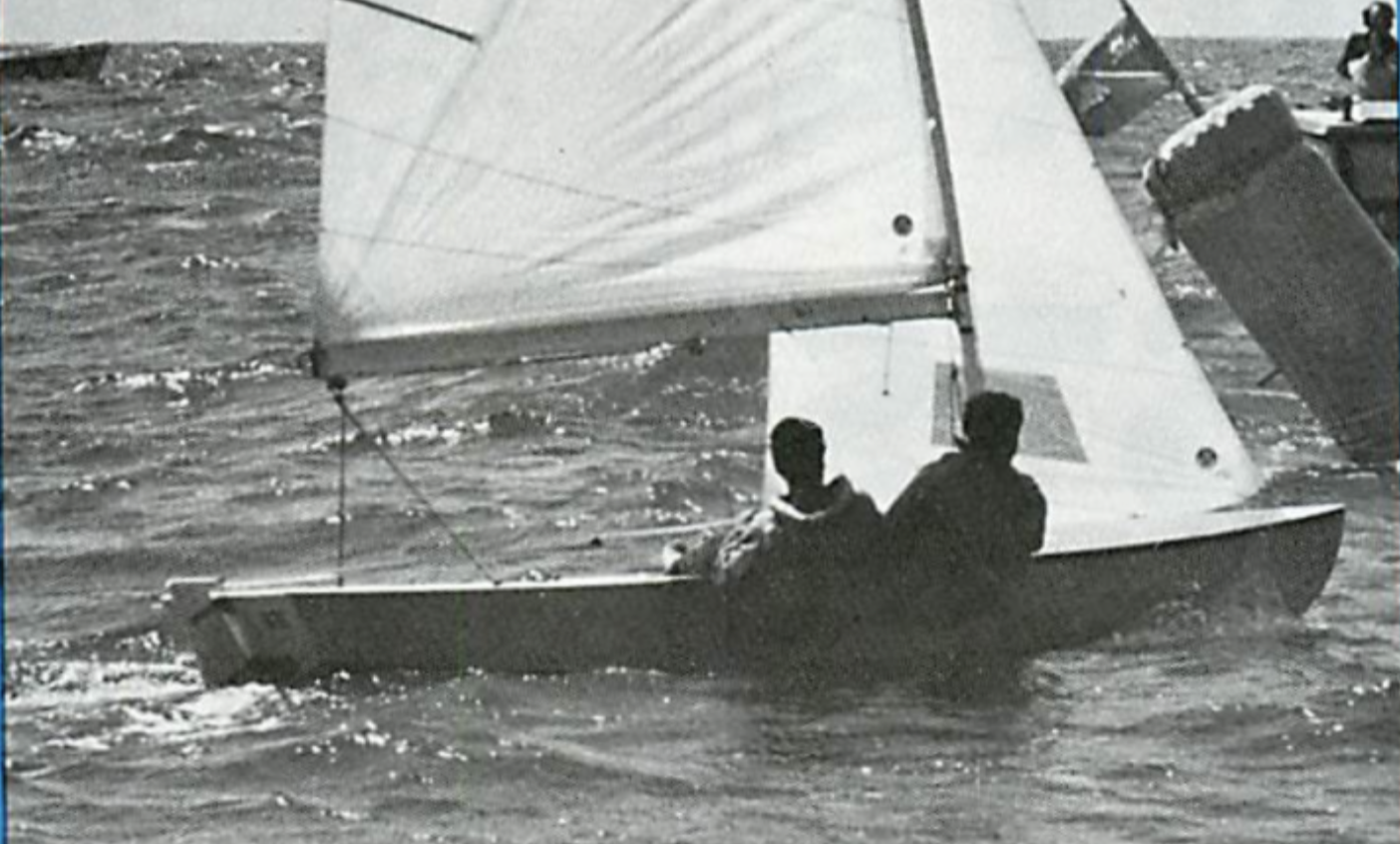
The 1980s and early 1990s marked the dawn of an unprecedented era of South American dominance in the Snipe World Championships. Starting with a historic breakthrough in Portugal and consolidating through a series of tactical masterclasses across the globe, sailors from Brazil, Argentina, and Uruguay transformed the international Snipe landscape. Their success was not merely a matter of individual brilliance, but the result of exceptional wave-handling techniques, innovative rig setups, and an unwavering commitment to high-level preparation.
1983 Snipe Worlds – Porto, Portugal (September 5–11, 1983)
Torben, Lars Grael Are History-Making World Champs – Snipe Bulletin November 1983
Second-generation Worlds winners lead 37-boat fleet.
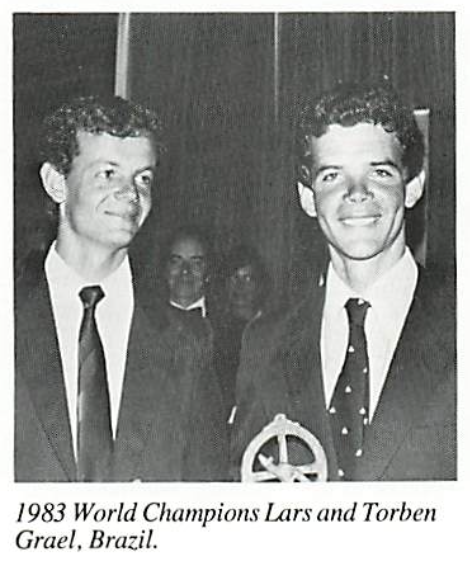
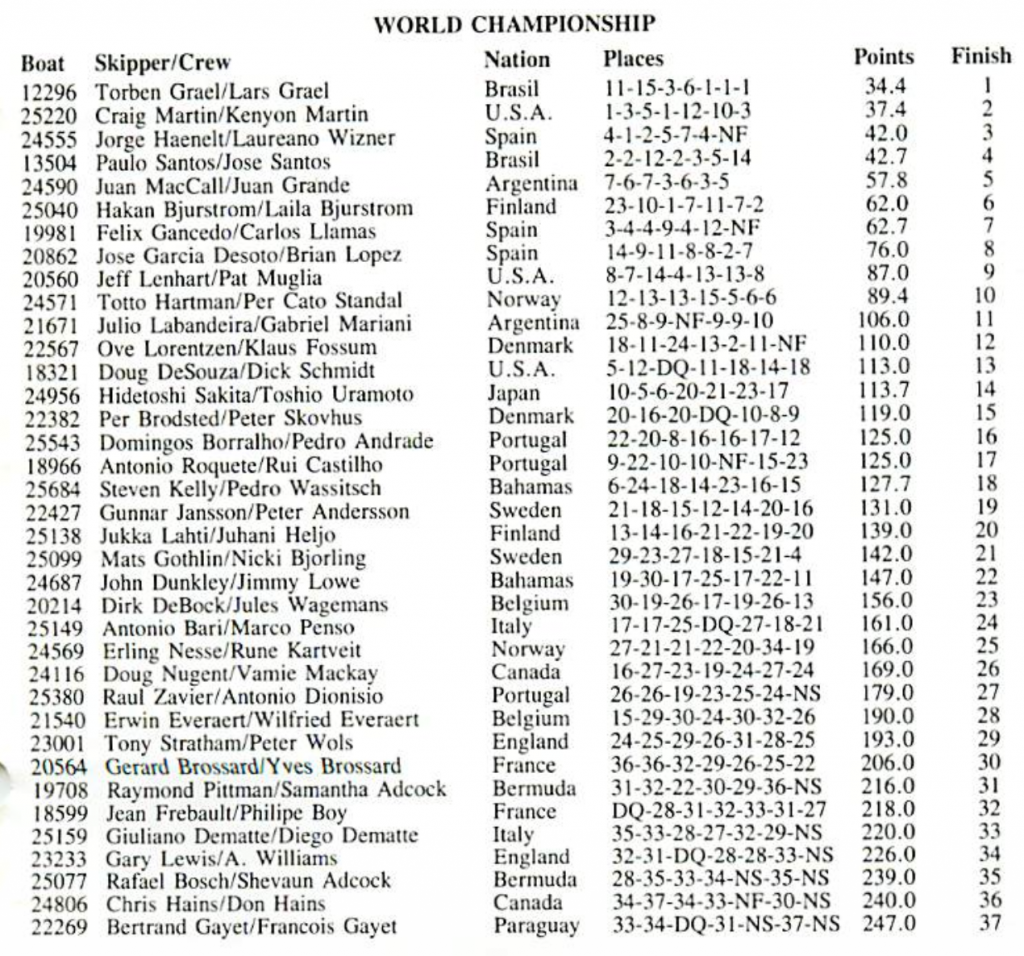
In one of the most exciting finishes in recent Snipe history, Torben and Lars Grael, brilliant young sailors from Brazil, made Snipe history as they came from behind to win the last race and the 1983 Snipe World Championship. The regatta, sponsored by Sport Club do Porto, Porto, Portugal, September 5th through 11th, was decided in the last race, with four boats still in contention for the top position. Torben and Lars, the first Snipe Junior World Champions to win the senior title, are nephews of Axel and Eric Schmidt, three times world champions in the 1960s, thus becoming the first second-generation world champions. Their Snipe, No. 12296, is 25 years old. Torben, 23 and Lars, 20, finished third in the 1981 championship.
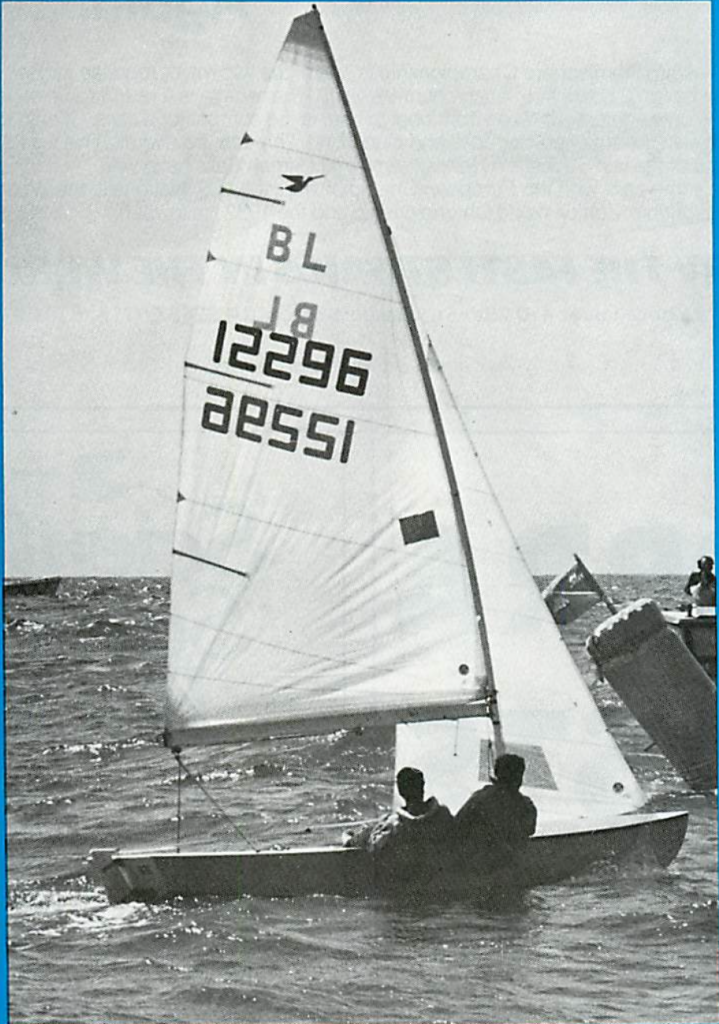
Above: New world champions Torben and Lars Grael cross the finish line first in the last race of the World Championship at Porto, Portugal, September 11, 1983. They are the first to win both Junior and Senior World Championship titles. Photo by Buzz Lamb.
n one of the most exciting finishes in recent Snipe history, Torben and Lars Grael, brilliant young sailors from Brazil, made Snipe history as they came from behind to win the last race and the 1983 Snipe World Championship. The regatta, sponsored by Sport Club do Porto, Porto, Portugal, September 5th through 11th, was decided in the last race, with four boats still in contention for the top position. Torben and Lars, the first Snipe Junior World Champions to win the senior title, are nephews of Axel and Eric Schmidt, three times world champions in the 1960s, thus becoming the first second-generation world champions. Their Snipe, No. 12296, is 25 years old. Torben, 23 and Lars, 20, finished third in the 1981 championship.
Craig and Kenyon Martin of the U.S. finished three points back in second place. Third place went to European champions Jorge Haenelt and Laureano Wizner of Spain. Paulo Santos, with crew Jose Santos, led going into the last race, only to finish a disappointing fourth. Paulo now lives in Brazil, but is a native of Portugal and has also represented Angola in previous championships. Johnny MacCall and Juan Jose Grande from Argentina repeated their 1981 fifth place finish.
Laila and Hakan Bjurstrom, husband and wife team from Finland, finished in sixth place, 7 points ahead of two-time world champion Felix Gancedo and Carlos Llamas of Spain. “Chiqui,” sailed by Garcia DeSoto and Brian Lopez of Spain, was eighth. Defending champions Jeff Lenhart and Pat Muglia of the U.S. were ninth. Totto Hartman and Per Cato Standal, Norway, rounded out the top ten finishers.
The top ten boats ranged from old to new and were built in South America, the U.S., and Europe. While equipment, sails, and rigging also varied as to maker and national origin, a remarkably one-design boat is still the result. The sailing characteristics of all the boats remained remarkably equal, with no area having a “break-through” for any added advantage.
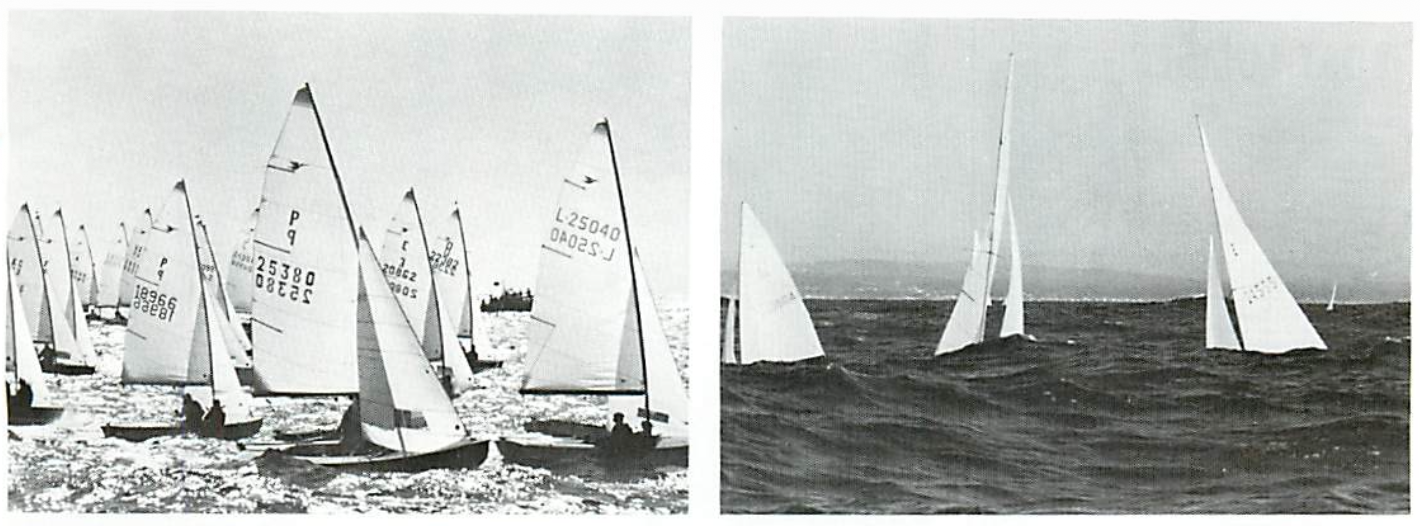
All areas of the Snipe world were well represented at this championship. With the first three positions going to three continents, Snipe sailors again proved that there is heavy competition everywhere.
The top ten boats ranged from old to new and were built in South America, the U.S., and Europe. While equipment, sails, and rigging also varied as to maker and national origin, a remarkably one-design boat is still the result. The sailing characteristics of all the boats remained remarkably equal, with no area having a “break-through” for any added advantage.
Thirty-eight boats from nineteen countries registered for the championship which was sailed in the Atlantic Ocean off Leixoes Harbor. Weather conditions included all sorts of winds and sea conditions, from light to heavy, to test the skills of the best Snipe sailors in the world.
First race: With only one race scheduled for the afternoon, after the morning skippers meeting, and final measuring, the boats were slow to leave Leixoes inner harbor for the first race. Winds were very light, but the committee boat took up its station, and the race started on time in the north winds which ranged from three to five miles per hour. Some boats were late for the start. At the first mark Bjurstrom led, followed by Commodore Doug DeSouza. Gancedo, Labandeira of Argentina, and Lenhart were next. The order was the same until the race was called just short of the end of the triangle, because of the 1 1/4 hour time limit. A second start was not possible for the day, and racing was postponed again the next morning, because of light wind, with a race finally getting underway at about 1:10 p.m. in winds of three to five. DeSouza led at the first mark, followed by Gancedo, Haenelt, Santos, and Sakita of Japan. The Commodore had increased his lead at the next mark, but the race was called before the end of the triangle, as time ran out. In the next start, after a general recall, four boats were over the line early, including Grael. At the first mark Craig Martin led, followed by Steve Kelly of the Bahamas, Haenelt, Japan, and the Commodore. The line-up remained the same at the end of the first triangle, where Santos and Jeff Lenhart, back in 10th and 11th place, split with the fleet, going right while everyone else went left. Santos gained dramatically, finishing second behind Craig Martin, who led all the way. Gancedo was third, Haenelt fourth, and De Souza fifth.
Second race: The second race started in winds of 10 mph, on a line favored on the committee boat end. The leaders remained the same throughout the race with European Champion Haenelt leading at every mark. Paulo Santos got another second. Craig Martin was third, and Gancedo fourth. Just as the last boat finished, a heavy fog moved in from the north, and boats had to be towed back to the harbor in the zero visibility.
Third race: After a general recall several boats were over early on the second start in very light wind. Finland’s Bjurstroms held a big lead at the first mark which they kept all the way to the finish. The light wind shifted after the start, causing a course change for the second windward leg. At the finish Bjurstrom still led, followed by Haenelt who had edged up from fourth place. Grael was third, Gancedo fourth, and Craig Martin fifth. Paulo Santos had rounded in 29th place at the triangle, but managed to come back to 12th at the finish. DeSouza crossed the line in eighth place but was disqualified for being over the line early.
Race four: A second start for the day got underway at about 4:15. This was a long race, and Torben Grael led all the way, only to have the time run out on the last beat, when he had a five-minute lead on the fleet. This was the last of the light-air starts. The next morning the wind had come back and there were big seas. The wind was building as the first start resulted in a general recall and was about 15 mph as the boats left the line. Paulo Santos and Craig Martin exchanged the lead during the race with Martin finishing first, Santos second, MacCall third, Lenhart fourth, and Haenelt fifth.
The wind had continued to increase, and the seas were monstrous by the beginning of this race. The life jacket flag went up, and the committee set a shorter line. Torben Grael led all the way in this race, which was one of the longest in the series, as well as the one with the heaviest wind.
Fifth race: The wind had continued to increase, and the seas were monstrous by the beginning of this race. The life jacket flag went up, and the committee set a shorter line. Torben Grael led all the way in this race, which was one of the longest in the series, as well as the one with the heaviest wind. Laurentzen of Denmark was second, Santos third, Felix fourth, and Totto Hartman fifth. Craig Martin, in sixth place at the first mark, capsized on the first reach and rounded the reaching mark in 29th place. He recovered to a 12th place finish, but the capsize cost points which might have meant the championship. Several other boats either capsized or had gear failures, and although there had been an announcement that three races might be sailed on this day, it was too late for a third start.
Sixth race: The wind and waves were both less than the day before. The first start was good, and at the first mark Haenelt led with MacCall second, DeSoto third, Grael fourth, and Santos fifth. By the end of the triangle, positions were scrambled with Grael in the lead, McCall still holding second, and Haenelt third. Santos had dropped back to sixth, and Craig Martin, who had guessed wrong and got caught in a bad shift on the first beat, was in 14th place. At the finish, a short line in heavy seas, there were some close finishes, as boats would slide down off a wave in a different position, and in a different wind than when they went up the wave. Grael finished first with DeSoto of Spain second. MacCall, finishing third, edged out Haenelt without knowing it. Since the first three finishers were having equipment checks, and MacCall failed to realize he had the third, he did not report for the check. His disqualification was later set aside since the judges accepted his explanation of the circumstances. Paulo Santos finished fifth, and Craig Martin recovered to a 10th place finish.
Seventh race: As the seventh race started, Paulo Santos led, but Grael, Martin, and Haenelt were also in a position to win the championship. The winds were 18 to 20 as the race began, with both Grael and Martin near the Committee boat end of the line. At the windward mark Grael led with Martin in second. Neither Santos nor Haenelt was in the top boats rounding the mark. Positions continued much the same, with Grael holding his lead, and Bjurstrom moving into second ahead of Martin, at the second windward mark. They maintained these positions to the finish with Mats Gothlin of Sweden finishing fourth and Johnny MacCall fifth. Santos finished 14th for the race, and Haenelt had his throwout race for the series.
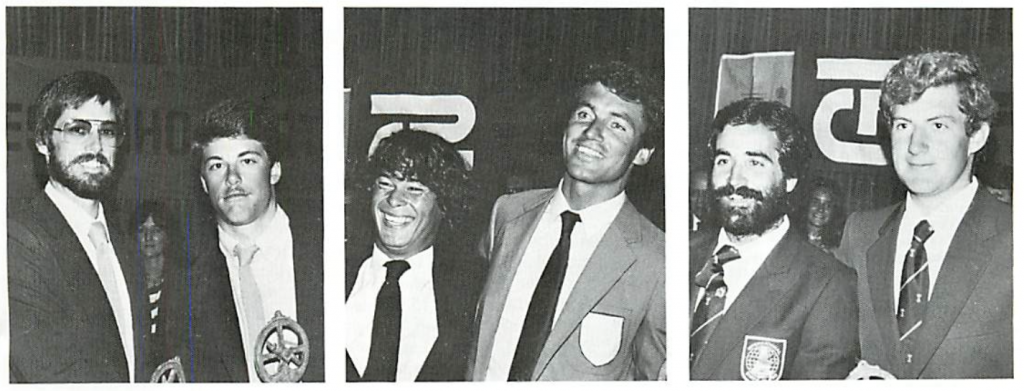
Above, left: Craig andKenyon Martin of the U.S. were a close second. Above, center:Juan Grandeand Johnny MacCall ofArgentina are all smiles as they accept their fifth place trophies. Above, right: European Champions Jorge Haenelt and Laureano Wizner, Spain,finished third. (All Worlds ‘photosbyBuzz Lamb)
Social side:
The social program of the XXXI Snipe World Championship immersed visiting sailors and SCIRA officials in a vibrant celebration of Portuguese hospitality and camaraderie. The week unfolded with a rich blend of local tradition and international unity, beginning at the Sport Club do Porto with a marching band performance and the ceremonial hoisting of flags. The opening festivities reached a high point at the majestic Palácio da Bolsa, where defending champions lit candles on a special SCIRA anniversary cake during dinner.
Throughout the week, the warmth of the host region was on full display through themed dinners hosted by Matosinhos and Santo Tirso. Competitors savored local gastronomy—from classic grilled sardines paired with regional wine to traditional tripe dishes and a post-race Pimm’s Cup party. A mid-week lay day offered a scenic boat trip down the Douro River, port wine lodge tours, and a feast featuring bacalhau. The spirit of the fleet was captured at the Casa Branca during an “old time Snipe sailors party,” where host Ruy Moreira toasted the enduring, multigenerational bond of the Snipe class across decades and continents. The championship concluded at the Praia Golf Hotel, where folk dancers set the stage for the trophy ceremony before guests said their farewells and danced the night away at the discotheque.
Read also:
Wave Dancing Samba Like Torben Grael:
1985 Snipe Worlds – Buenos Aires, Argentina (November 23–December 1, 1985)
In 1985, the sailing world witnessed the first of three world titles captured by the Argentine hero Santiago Lange.
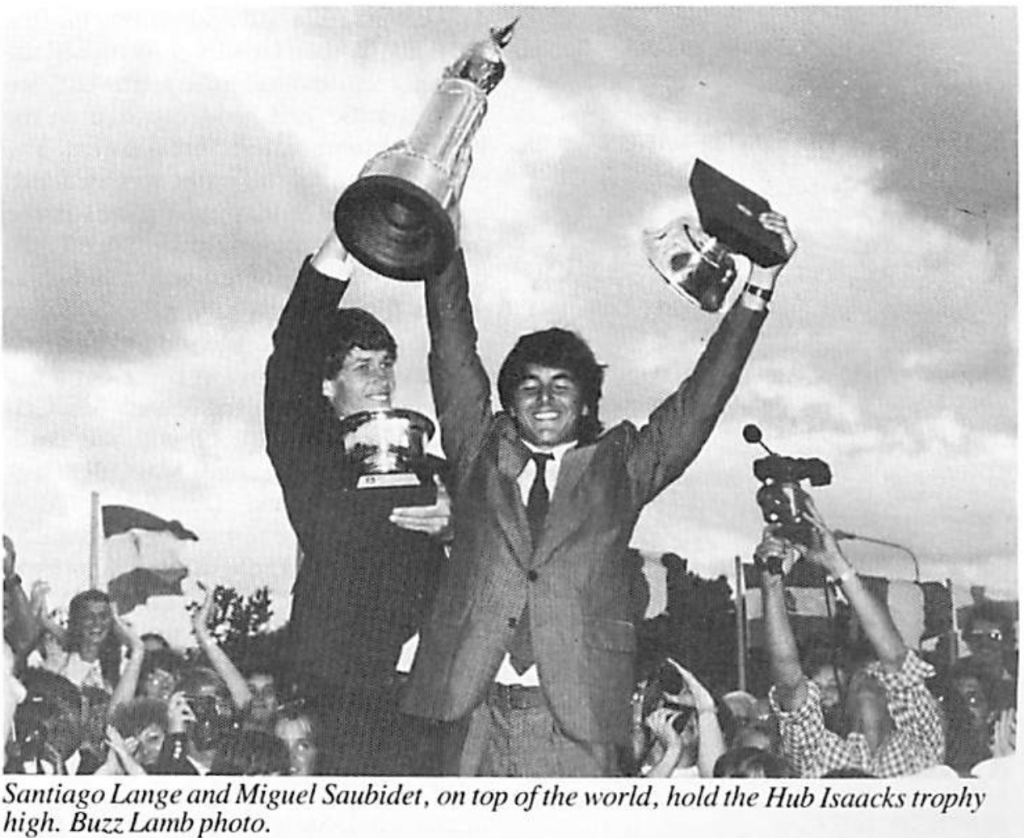
Argentina Triumphs In 1985 Snipe World Championship – Snipe Bulletin February 1986
Santiago Lange and Miguel Saubidet lead one-two Argentine sweep at Buenos Aires.
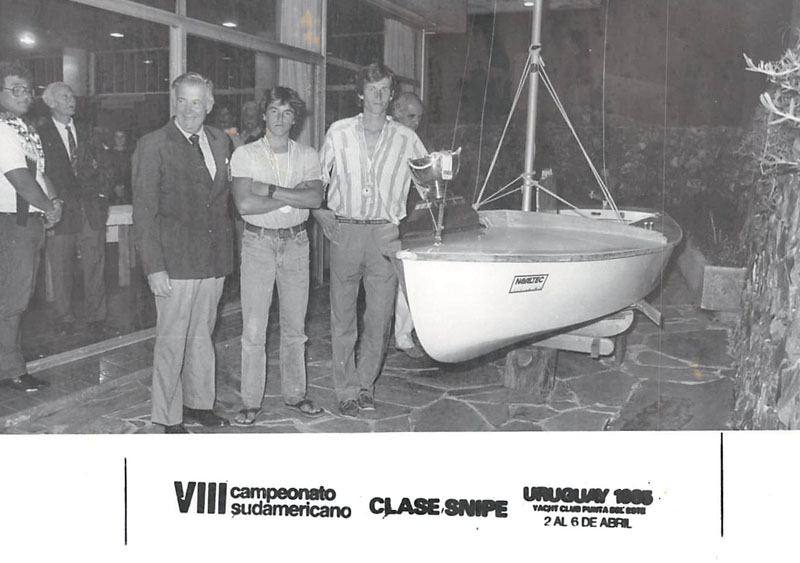
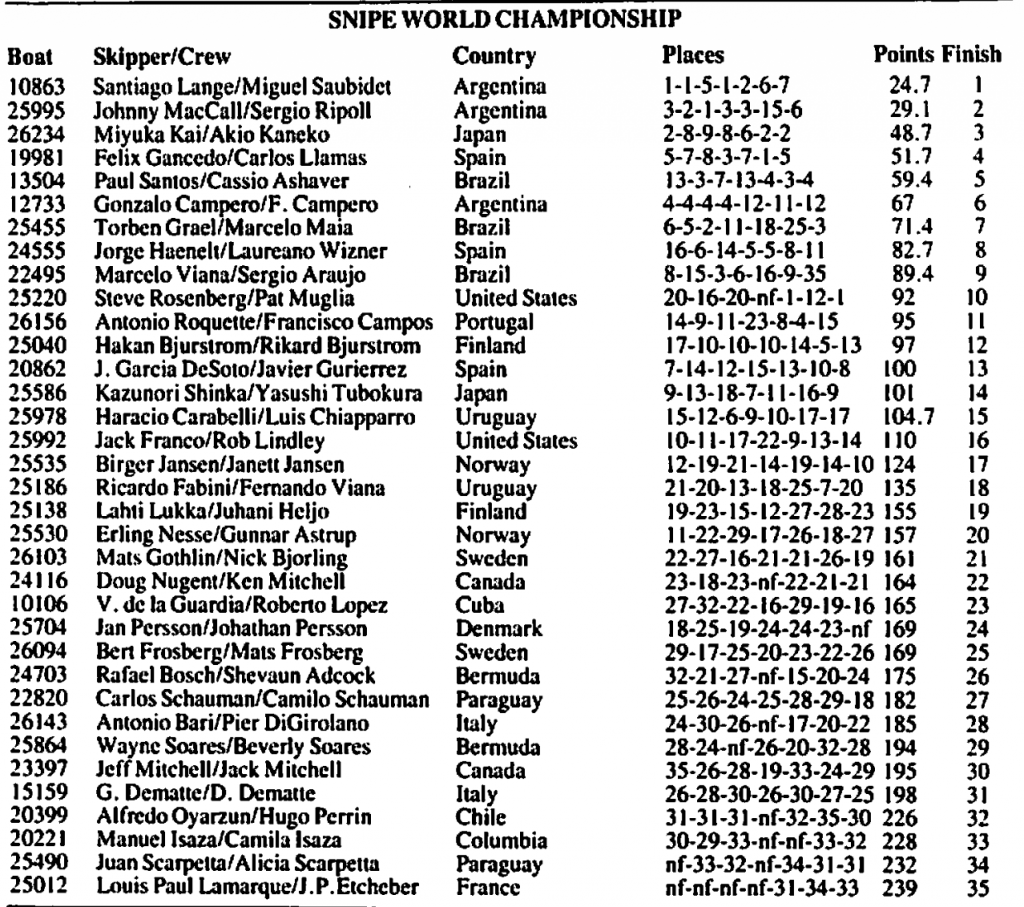
Santiago Lange and Miguel Saubidet, Argentina, are the 1985 Snipe World Champions. Santi and Miguel, representing the host club and fleet, Club Nautico San Isidro, Buenos Aires, Argentina, finished 4.4 points ahead of fellow Argentines, Johnny MacCall and Sergio Ripoll. Miyuki Kai and Akio Kaneko of Japan were third; Felix Gancedo and Carlos Llamas, Spain, were fourth; and Paulo Santos and Cassio Ashaver, Brazil, finished fifth. Gonzalo and Francisco Campero, Argentina, were sixth; defending champion Torben Grael and Marcelo Maia, Brazil, seventh; Jorge Haenelt and Laureano Wizner, Spain, eighth; and Marcelo Viana and Sergio Araujo, Brazil, ninth. Steve Rosenberg and Pat Muglia, U.S., although they won two races, finished tenth overall.
The regatta, raced November 23 through 30, on the broad and shallow River Plate, featured long courses, in mostly medium to heavy winds. The strong current and shallow depth contributed to a short steep chop, which was difficult to master. Teams arriving with coaches and rubber boats for a week of practice before the races, decided they needed at least two weeks to master the tricks of effective steering through the waves.
The competition was the best ever assembled for a Snipe event; Gancedo and Grael have three Snipe world titles between them, and Kai was world champion in 470. Current hemisphere champion MacCall and Haenelt competed, as did USYRU Champion of Champions Steve Rosenberg. The winners, Lange and Saubidet, hold the South American Championship title.
The competition was the best ever assembled for a Snipe event; Gancedo and Grael have three Snipe world titles between them, and Kai was world champion in 470. Current hemisphere champion MacCall and Haenelt competed, as did USYRU Champion of Champions Steve Rosenberg. The winners, Lange and Saubidet, hold the South American Championship title.
The first place went to a 10,000 series wooden boat, second was a new South American Alax, third was a Japanese Chubasco, fourth Felix Gancedo’s classic Skipper Snipe, and fifth another wood boat.
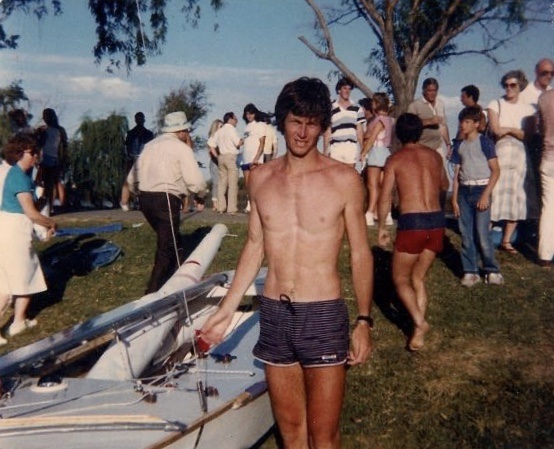
The equipment used was as wide a cross section as the class can provide; the first place went to a 10,000 series wooden boat, second was a new South American Alax, third was a Japanese Chubasco, fourth Felix Gancedo’s classic Skipper Snipe, and fifth another wood boat. All boats were carefully measured by an international measuring team which has developed a new method for testing moment-of-inertia. The only radical departure in equipment was the exceptionally long poles carried on the Argentine boats; an innovation quickly copied after the first day of racing.
Nineteen Snipe nations were present for the regatta, with Cuba and Chile returning after several years of absence from international Snipe competition.
The Scene
Club Nautico San Isidro, one of Argentina’s oldest yacht clubs, located on the Rio de la Plata, in a suburb of Buenos Aires, was host for the XXXII Mundial de Snipes November 23-30, 1985, with the assistance of Club Nautico Olivos. This world championship was a part of the celebration of the club’s 75th anniversary.
The club’s spacious grounds include the main clubhouse, a riverside dining room, a sailors snack bar, a golf course, tennis courts, swimming pools, and a picnic island across the river, to accommodate a membership of about 12,000. The club maintains fleets of training boats for juniors, and the new world champion is a product of its training program.
Sailing is on the broad river, which features the sort of challenging racing that should prevail in a world championship. The tricky river current is complicated by wind and tide; all of which helps to create a short stiff chop in the shallow water.
On The Course…
Race I: A long race course was set in the 15 to 18 mph winds. A heavy current helped push the fleet over just before the gun, resulting in a general recall. The second start was good, and those working the right side of the course arrived at the mark first, with Garcia DeSoto in the lead, followed by two Argentine boats and Gancedo. On the reach the story of the regatta began to unfold, as the Argentine boats showed amazing speed in the planing conditions. On the second beat Kai of Japan, working the left side of the course, picked up a lot of distance to round behind Santiago Lange, and just in front of Johnny MacCall. Garcia DeSoto dropped to fourth, Campero was fifth, and Felix sixth. With the wind dropping toward the end of the long race, Santiago Lange still held a good lead to the finish, followed by Kai, MacCall, Campero, and Gancedo. Defending Champion Torben Grael worked up to sixth, and DeSoto finished seventh. Two boats dropped out with equipment problems; Scarpetta right after the start, and Mitchell at the end of the second beat.
Race II: The second race, scheduled back-to-back with the first, was started after the entire course was shifted to the left, and further out to sea. (All courses had marks at least one mile from shore). Again, there was a good start after a general recall. On this first beat Norway’s Birger Jansen led around the mark followed by Bjurstrom, of Finland, and Paulo Santos. The wind was lower on the reach, and with some boats working high, Santiago Lange went low, and rounded in the lead. As boats bunched up at the mark in the lighter wind, Lange, in clear air, worked out a huge lead, followed around the leeward mark by Johnny MacCall, Santos, and Torben Grael. Positions held mostly in this order to the finish, with Santiago Lange taking his second bullet, followed by Johnny MacCall, Paulo Santos, Gonzalo Campero, and Torben Grael.
Race III: Tuesday’s races were in heavy wind following the passage of a thunderstorm and front on Monday night. The course was several miles from the club, and at least two miles from the shore. The heavy current tended to carry the fleet in the direction of the course, resulting in four general recalls before the fifth start proved good, with only Italy over early. In the heavy wind and waves, capsizes were common, along with several breakdowns. Johnny MacCall worked out an early lead, and had three minutes on the fleet at the second windward mark. He was followed by Viana of Brazil, Torben Grael, Paulo Santos, and Felix Gancedo. By the finish the wind had moderated and shifted more to the south. The shifts were pronounced, and difficult to predict, even though the courses were set far from shore. At the finish it was MacCall, still maintaining more than two minutes on Torben Grael in second. Viana was third, Gonzalo Campero fourth, and Lange fifth.
Race IV: By the start of this race the tide and wind were both less strong, but three general recalls were still called before the fourth start was good. Steve Rosenberg, with a perfect start on port at the pin end, was over early, and did not restart, giving him his drop race for the series. The wind increased again during the first beat, and Torben Grael’s crew missed the hiking strap, and had to be retrieved from the water. Several boats capsized on the beat, and some suffered breakdowns. The shallow depth of the water was an added hazard, since the mast would stick in the mud if the boat tried to turtle. Vice Commodore Wayne Soares had two breakdowns for the day’s racing. Again Santiago Lange showed amazing speed on the reaches, working out a big lead. Felix Gancedo and Johnny MacCall traded places in the race with the finish order as follows: Lange, MacCall, Gancedo, Campero, and Haenelt.
Race V: Only one race was scheduled for Wednesday. The wind was very light and shifty at the scheduled start time, and the start was postponed for the wind to settle. After one general recall, a huge wind shift of 45 degrees or more forced a change of the whole course. After the course was reset, the start was good, but the course was long for the lighter wind. Steve Rosenberg had a huge lead at the first windward mark, followed by Paulo Santos, Johnny MacCall, Campero, and Gancedo. The order remained more or less the same, and with MacCall closing the distance, Rosenberg engaged him in a tacking duel up the second beat. A continued shift in the wind resulted in a shift of the finish mark 30 degrees to the north for the final beat. The order at the finish was: Steve Rosenberg, Santiago Lange, Johnny MacCall, Paulo Santos, and Jorge Haenelt of Spain.
Race VI: After a lay-day for play and picnicking, the racing resumed for the final day with the lightest wind of the series, about 8 to 10. Since a pampero (a particularly violent form of thunderstorm) was predicted for that night, the committee was anxious to complete races on schedule. With light wind, and the tide running against the line, the first start was good, except for a few individual recalls. MacCall and Lange were far ahead of the field at this point, and racing each other. They played the left side of the course, and rounded the first mark with Lange in 10th and MacCall in 13th. Bjurstrom of Finland was first to the mark, with veteran Jan Persson of Denmark second, Viana third, and Roquette of Portugal fourth. At the triangle the order remained about the same, with Portugal moving into second; Lange and MacCall were ninth and 11th. A shifting wind shifted fortunes as well, and on the second beat Kai rounded first, Bjurstrom second, and Gancedo third. Twice world champion Felix Gancedo showing how well he handles the boat and the wind, moved into first place on the last beat. Kai finished second, followed by Santos and Roquette. Bjurstrom fell to fifth, with Lange in sixth. MacCall had his worst race, finishing in 15th place.
The crowd went wild.
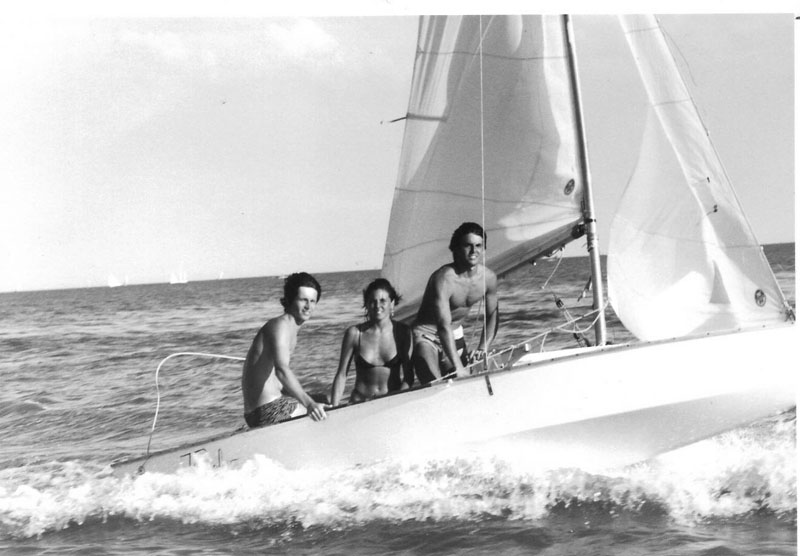
Race VII: Going into the last race MacCall could still catch Lange, but he had to finish third or better, and have at least one boat between himself and Lange. The wind had picked up a little between races, and for the first time there was a perfect start, with nobody over the line early. The current was still running strong, however, as demonstrated when the first two boats hit the windward mark in rounding. Rosenberg took the lead at that point, followed by Santos, Campero, and MacCall in fourth. The wind picked up and shifted during the first reach. At this point Lange was in 16th place. On the second reach MacCall moved into third place, with Lange still well back in the pack. A wildly excited spectator fleet following the two hometown favorites had to be firmly ushered off the course during this race, and spectator buoys had to be established beyond the finish line. On the second beat MacCall misjudged the wind shifts. Rosenberg maintained his first place, followed by Kai and Santos, but MacCall rounded in seventh, with Lange still in 12th place. At the finish it was Rosenberg first, Kai second, Grael third, Santos fourth, Gancedo fifth. MacCall finished sixth, just ahead of Lange. The crowd went wild.
The Social Side
A full moon, loud music, and a small club bursting with sailors, guests, girls, and gate crashers, made “La Universal” Fiesta at Club Nautico Olivos a fitting finale for a fun filled week of Sniping and socializing.
Earlier, at Club Nautico San Isidro, a gaily striped tent was set up on the lawn as Snipe party headquarters for the week, starting with a get acquainted dance on Saturday. Sunday’s opening ceremony and flag raising was followed by a cocktail party at the tent, and Monday night, when the rest of the club was closed, Snipers were treated to a special dinner at Club Nautico’s riverside dining room.
A highlight of the week was Thursday’s lay-day boat tour of the river delta, featuring an asado at the Isla Club Nautico San Isidro. Sausages and barbeque! Those Norte Americanos present enjoyed it thoroughly, thinking of home, turkey, (and snow?) on that Thanksgiving Day. The asado was followed by a football game; soccer, not American football; in which South America took on the whole world! They won there, too, and there was only one casualty among the 75 or so young men on the field. He was “only” a crew, and his skipper found a local replacement for the final day of racing.
Read also:
1987 Snipe Worlds – La Rochelle, France (August 31–September 4, 1987)
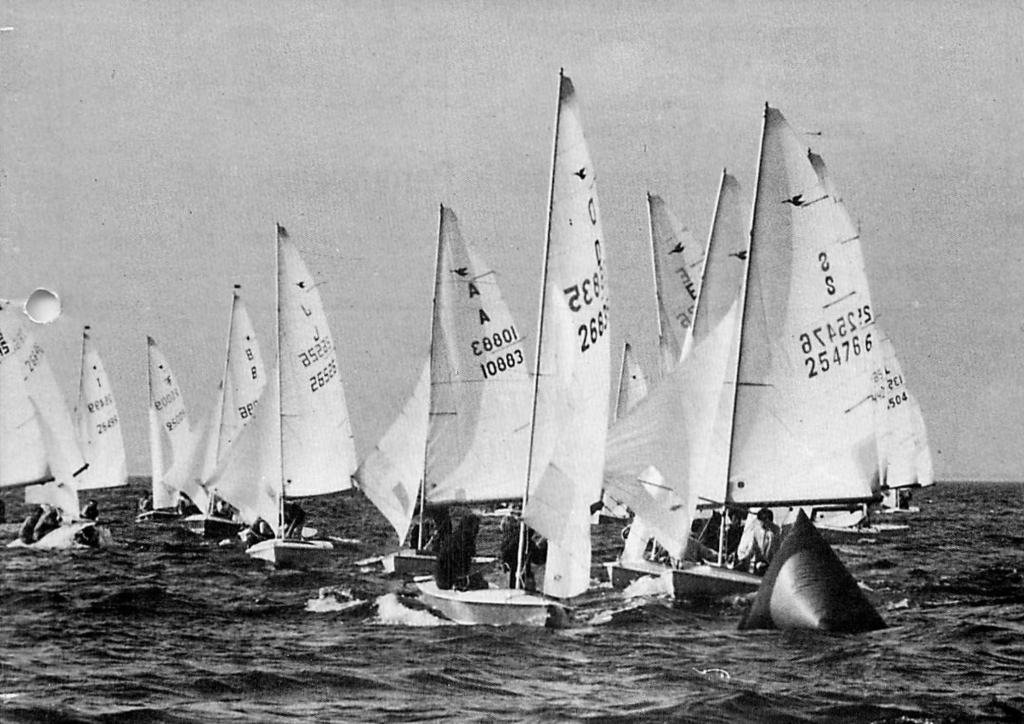
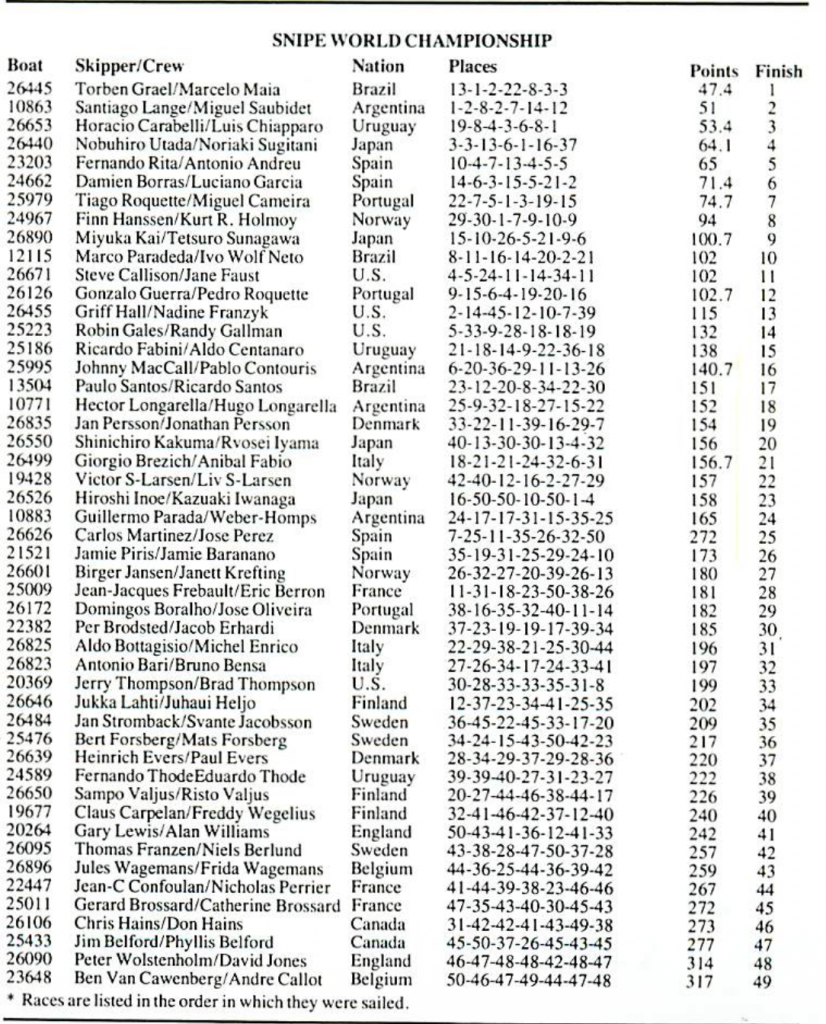
The 33rd Snipe World Championship in La Rochelle, France, brought together a record-breaking fleet of 49 teams from 16 nations under new class rules aimed at expanding international participation. Hosted by the Société des Régates Rochelaises, the regatta took place on an Atlantic bay protected from heavy ocean swells by surrounding islands. However, competitors had to navigate tricky strong tides, heavy currents, steep chop, and predominantly light, fickle winds, which even forced a complete postponement of racing on one of the scheduled days.
The ultimate storyline of the regatta, however, was a dramatic final-day turnaround for the championship title. Heading into the last day of racing, Brazilian sailor Torben Grael, alongside crew Marcelo Maia, sat in fifth place and trailed defending champion Santiago Lange of Argentina by more than 20 points. Grael steadily closed the gap in the penultimate race and executed a remarkable comeback on the final beat of the seventh race, securing a third-place finish while Lange slipped to twelfth.
This decisive shift allowed Torben Grael to claim first place overall with 47.4 points, regaining the Hub Isaacks Trophy he had previously won in 1983. Santiago Lange and Miguel Saubidet of Argentina finished as runners-up just 3.6 points behind with 51 points. Junior World Champions Horacio Carabelli and Luis Chiapparo of Uruguay won the final race to take third place overall, followed by Japan’s Nobuhiro Utada and Noriaki Sugitani in fourth, and Spain’s Fernando Rita and Antonio Andreu rounding out the top five.
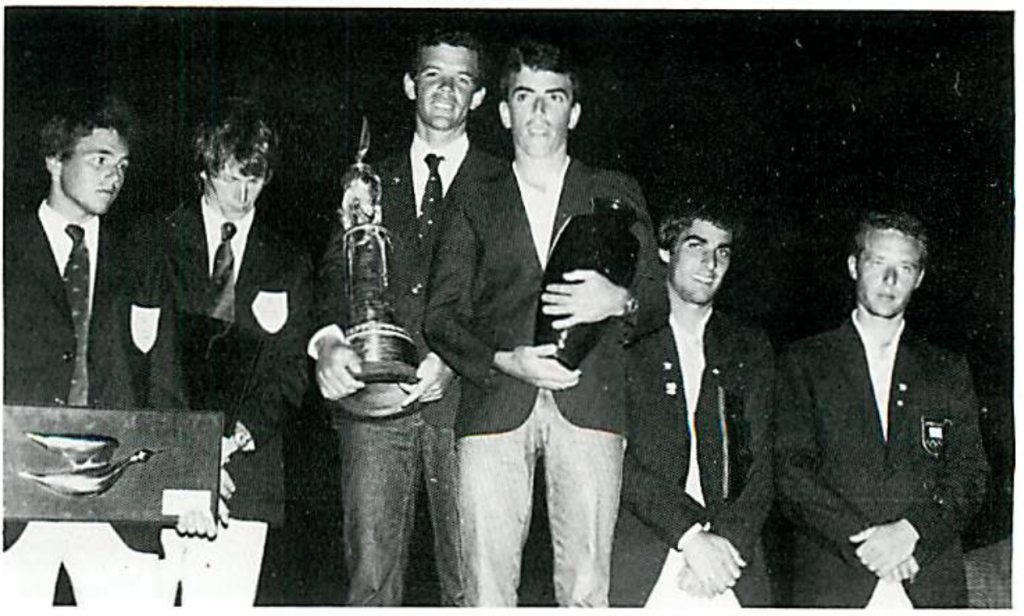
Above: Torben Grael and Marcelo Maia, center, pose with the Hub Isaacks World Championship Trophy which Torben also won as
1983 World Champion. Defenders Santiago Lange and Miguel Saubidet, left, finished second, and world junior champion Horacio Carabelli and crew Luis Chiapparo, right, were third. Buzz Lamb photo
1989 Snipe Worlds – Karatsu, Japan, August 22-28, 1989
KARATSU WORLDS – Snipe Bulletin November 1989
Japan’s magnificent hospitality is a fitting background for a fine performance by Ricardo Fabini and Harold Meerhoff of Uruguay…
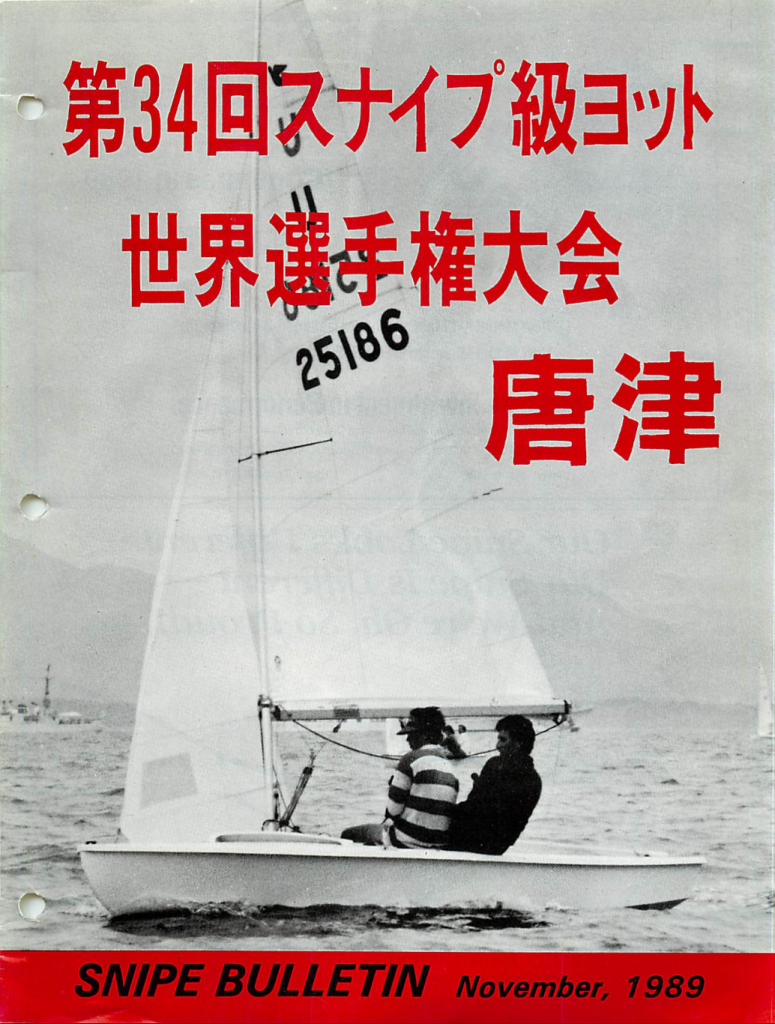
Above: Skipper Ricardo Fabini and crew Harold Meerhoff are the new World Champions! Tom Payne photo
It’s 5:30 a.m., my second day in Karatsu, Japan, and I’m wide awake. The spartan conditions in my free room at the Seamans Maritime School dorm don’t include air conditioning, and already it’s hot.
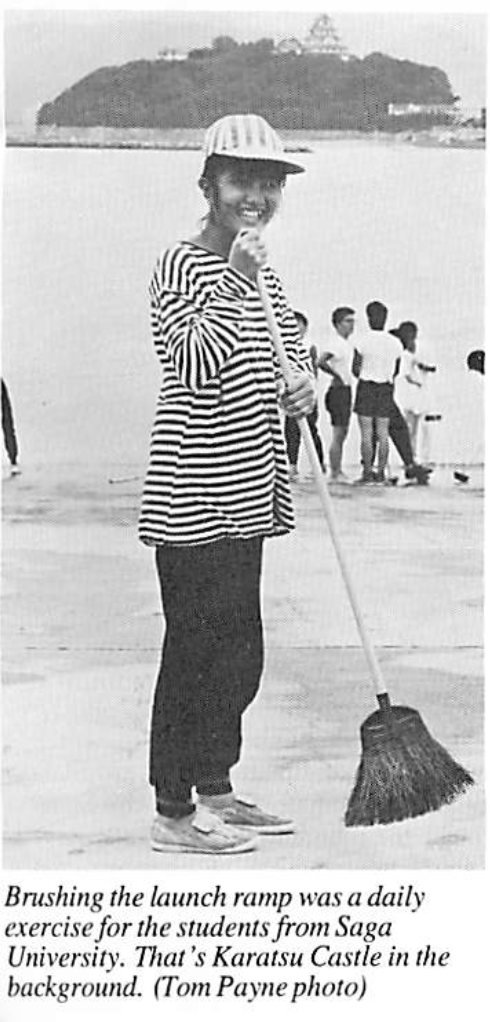
I throw on some clothes, grab the camera, and head for my bicycle. In a moment I am at the end of the breakwater enclosing a small harbor on the shore of Karatsu Bay. In the predawn light the fishermen prepare their small boats for a day’s work. In the hills above, the crows start their morning ruckus. Soon the clouds to the east alight with the coming of the day. Takashima Island, rising in the middle of the Bay, blocks my view of the sun breaking the horizon. Across the Bay to the south, Karatsu Castle, built high on a hill, glows as it receives the first golden rays of what will be the first of many magic days.
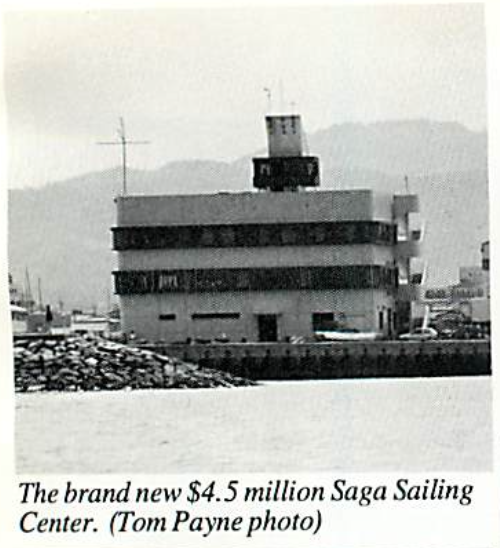
Halfway between my vantage point and the castle, the sparkling new $4.5 million Saga Sailing Center is quiet. Soon it will be buzzing with activities as 44 teams from 18 nations prepare to contest the 34th Snipe Class World Championships.
Back on the bicycle, I am soon ‘lost’ in the streets of this city of 80,000. I head toward the center of town where, the night before, we danced the traditional “Bon Odori” folk dance with over 200 women dancers, all in traditional dress. It was the first of many lessons as the citizens of Karatsu taught us their way of life and traditions of the city that is still somewhat rural and much less westernized than Tokyo. Hosting the Snipe Worlds was their chance to attract attention in hopes of becoming a major player in Japanese and International sailing and no effort or expense was spared. And of course, there is the reknown Japanese hospitality and friendliness. Everyone I meet as I pedal through the backstreets greets me with a smile and “Ohio Gozai-mas.” I soon head for the sailing center. SCIRA Commodore Per-Ole Holm, of Finland, and I have a 10 a.m. appointment to meet the mayor of the city.
I didn’t notice it, but Per-Ole later told me that he was somewhat surprised that the police were stopping traffic and waving our car through the intersections as we neared city hall.
My first indication of what was in store came when I realized that the formal receiving line, headed by Mayor Yutake Nozoe and backed up by 150 or so city hall workers, a couple of TV cameras, and at least 10 press photographers, was for us! Fortunately we had practiced and our bows were low and perfect. We were ushered into the formal reception chambers where we exchanged greetings and pointed out our hometowns on the mayor’s atlas. Back in the car, we shared our amazement at the reception we had received. Little did we know that this was just the beginning.
Day Three, time for another practice race, but it will be abandoned at 1:30 p.m. to give the sailors time to prepare for the opening ceremonies. It’s standing room only in Citizen’s Hall, the large theatre adjoining city hall. The floral arrangement at the base of the podium would eat up the budget of most small regattas. A military band plays as the flags of the competing nations are marched in by students from Saga University. Speeches are made and then Torben Grael and Marcello Maia of Brazil return the Commodore Hub E. Isaacks Trophy in a special ceremony. The teams form each country stand as they are introduced. There are television cameras everywhere.
Outside, in the city square, we form into groups for a parade through town. Aerial bombs are fired, calling the citizens to the sidewalks. The bands strike up and we’re off down the main street, then through the fish markets, into a mall area street with trendy shops, and back into the streets. The parade strings out as team members stop to hand out the hundreds of helium balloons provided by the organizers. I notice that everyone is starting to realize just how special this event will be.
Back at city square we are loaded into busses for the trip back to the five-star Seaside Hotel and the mayor’s opening reception. The tables in the grand ballroom are loaded with food and drink. In the center of the room is a huge ice sculpture of a sailboat (of course it’s a Snipe!). And everywhere, more flowers.
After Mayor Nozoe’s short welcoming speech the show begins as the M.C. gives a short history of the Snipe Class and tells of the excitement that hosting the Snipe Worlds has brought to Karatsu. Then the lights go down and with a tympani roll the curtains covering the entire eastern wall of the room are raised to the bay where three Snipes sail in the fading light. Later I learn that the song that is playing was composed especially for this moment.
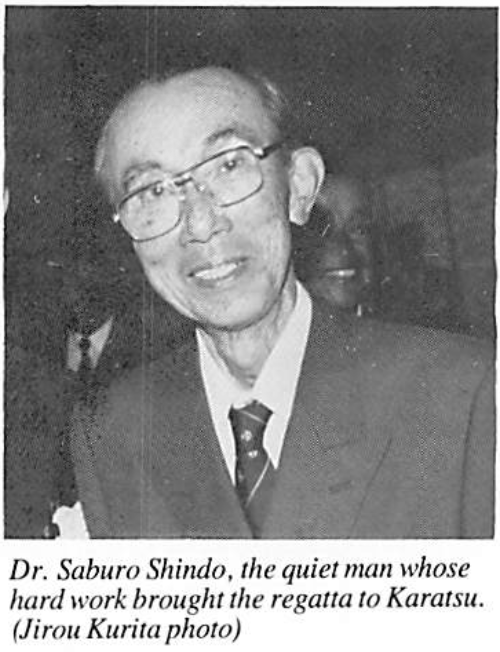
Soon it’s time to break out the sake, literally, as the mayor invites Commodore Holm, the president of the Japan Snipe Class, Katsumi Hirata, and the quiet man behind all of the arrangements to host the regatta, Dr. Saburo Shindo, to join him on stage where they are given large mallets. Together they break open the top of a large barrel. Another great Japanese tradition, as are the square cedar boxes that the saki is served in.
Then we are treated to more traditional Japanese dance and music as the ancient “Song of Karatsu” is played by young men on their drums and flutes. Their driving tempo and the effects of the sake are hypnotic. Soon we return to reality. The first race is tomorrow so tonight the party ends at a decent hour.
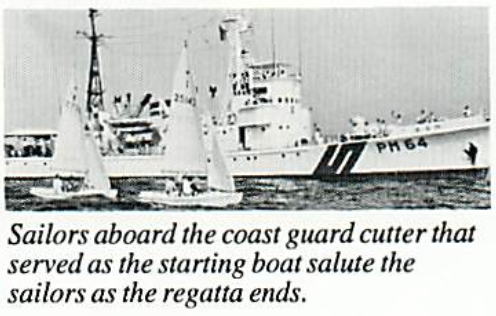
The starting area is crowded with fishing boats, provided for the press and spectators. Three helicopters buzz the line as the fleet prepares to start. A medium-sized Japanese Coast Guard ship serves as the committee boat while a large helicopter-equipped cutter is loaded with 500 to 600 locals out to watch the action. I soon add a new phrase to my companions’ limited English vocabulary: “Big production.”
The winds on the Sea of Genkai are moderate as we head out to the course. I’ve weaseled a ride with reporter Jun Nagai and photographer Jun Arata from Kazi (“Rudder” in Japanese) magazine. They warned me that their inflatable Kazi Maru will be a wet ride, but the seas are calm today.
The starting area is crowded with fishing boats, provided for the press and spectators. Three helicopters buzz the line as the fleet prepares to start. A medium-sized Japanese Coast Guard ship serves as the committee boat while a large helicopter-equipped cutter is loaded with 500 to 600 locals out to watch the action. I soon add a new phrase to my companions’ limited English vocabulary: “Big production.”
Arata’s motor winder runs non-stop as the start gun goes, the helicopters buzz low in front of the fleet. Arata signals Nagai that he is done, throws his camera in the cooler and we blast off, around the jibe mark and up to the windward mark.
Looking downwind we struggle to pick out the leaders. Soon we see that Ricardo Fabini, 22, and his crew Harold Meerhoff, 18, of Montevideo, Uruguay, are in the lead. Mikuni Kai if Japan is second, and Ivan Pimental of Brazil is third. John Keane, a former All-American from Harvard, with Anne-Marie Weldon crewing, is the leading U.S. boat, in fourth. Peter Commette, with Connie Suddath crewing, is near the front but Californians Craig Leweck, with Brett Davis crewing, and Jeff Lenhart and crew David Pritchard are deep in the fleet.
Fabini and Meerhoff pull away on the reaches. Keane and Weldon are third at the leeward mark, but they have trouble with their pole takedown. They elected to save shipping costs and are sailing one of 35 brand new charter boats, equipped with a manual whisker pole, unlike John’s boat at home which has a pole launcher. Commette squeezes inside, into third. The leaders hold their positions on the beat and run, but at the finish it’s Fabini by a huge margin over Kai, and Pimental is back up to third. Keane and Weldon cross in fourth. Leweck has made a great comeback and finishes sixth, but Commette is nowhere to be seen. Finally he crosses in 11th. Later, after the fifth place finisher is DSQd, Leweck and Commette move up one spot to fifth and 10th. Lenhart and Pritchard are 12th. A good start for the U.S. boats. Grael has a hard time in the light (by his standards) winds and takes a 14th.
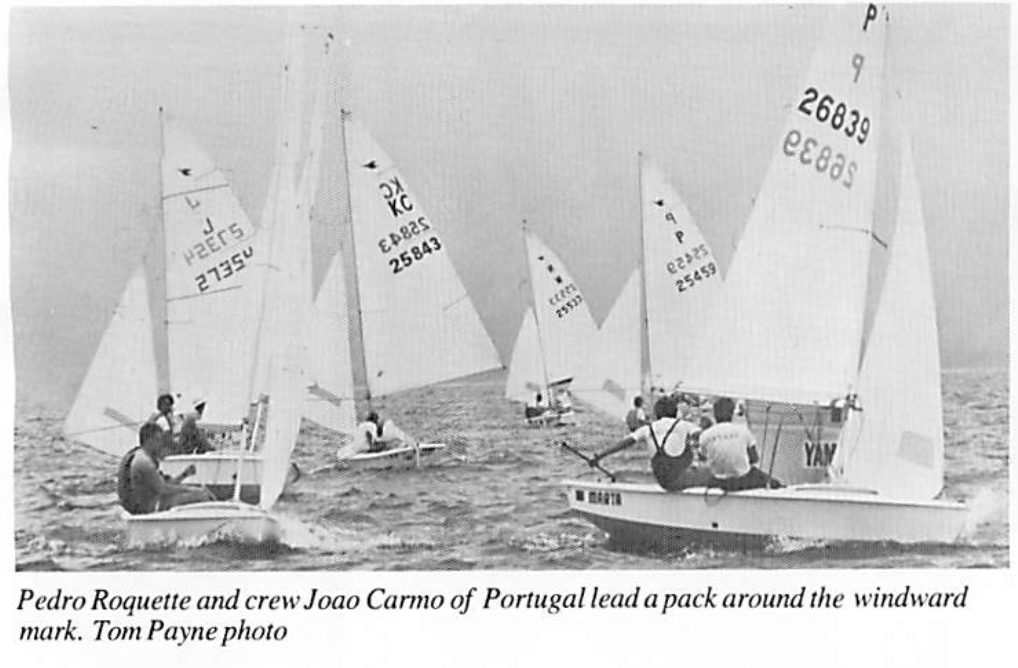
Back in the parking lot Keane and Leweck are beaming. Lenhart and Pritchard are complaining about boatspeed, and Commette’s mood is almost nasty. Thinking that maybe a little psyche will help him, I check my escape route and then say: “Hey Peter, it’s only the Worlds!”
Tonight is the Board Meeting with a lengthy agenda that keeps us busy until midnight when Commodore Holm mercifully adjourns. We will reconvene on the Thursday layday. We arrive back at the Sailing Center just as the Citizens for Success Beach Party comes to an end. Judging from the empty trays of food and the condition of the sailors it was a grand fete.
The racing starts early the next morning and it’s a different sea as we head out to the course. The light chop of the day before is replaced by some nice-sized rollers. The wind is up to 12 knots and will continue to build. The helicopters are gone and only the serious press remains. We’re kept well away from the start, forced to use binoculars to pick out sail numbers, a difficult job as the Kazi Maru bounces along in the waves.
Someone has done an incredible job of breaking away from the line and has a huge lead. It’s Commette and Suddath! Clear and ahead of the fleet and pulling away. “No one will catch them,” I tell the boys from Kazi. We head for the weather mark, a wild and wet ride for us, and I think of the crews hiking like crazy in the building breeze and getting a good drenching with every wave. We wait at the mark, the binoculars uselessly wet and nothing to dry them with.
Grael and Maia have a nice lead with Utada, Parada, and Pimental close behind. Where is Commette? Arata and I whip out our cameras and shoot a few frames. Suddenly a shaft of pure sunlight breaks the gray overcast and focuses on the rounding boats. I hear Arata’s excited “hai, hai” just as I say “yes, yes.” It is a magic moment for photos, the boats bouncing madly in the seas and the most incredible lighting I have ever seen. Totally engrossed with the camera I lose track of the rounding positions.
We’ll never make it to the jibe mark so we head downwind. Grael has widened his lead. Utada, Pimental, and Parada are still fighting for second. Commette is well back in the pack as are the other U.S. boats. As the last boats round I realize that Keane and Weldon are missing. I look back up the reaching leg and see them capsized. They retire, too far behind to attempt a recovery in these conditions, and prepare for the next race.
At the finish it’s Grael with a huge lead. Utada is second, Parada third and Pimental fourth. Fabini is fifth followed closely by Cao Leme of Brazil and Sugiyama. Leweck and Davis are the first U.S. boat in 12th. Commette crosses in 15th.
The waves seem like mountains and the wind is up to 20 knots as race three starts. Grael continues his domination and has a healthy lead at the windward mark. Parada, Utada, Kai, Fabini, and the Bjurstrom brothers are fighting for runner-up. Leweck is sailing well, but Commette, Keane, and Lenhart are deep. It is madness at the jibe mark as these conditions challenge the world’s best Snipers.
Grael and Maia make it look easy. They’re gone, clearly the superior crew in this heavy going. Suddenly there is confusion and noise as several boats in the pack lose control. Even though we are 50 meters from the mark, we can hear the collision. Neil Martin and crew Alan Williams of England retire with a huge hole in their bow.
At this point the conditions are too rough for us to attempt to make it to anywhere but the leeward mark. We are soaked to the bone and our cameras have been splashed more than once. We wait as the fleet works its way upwind and then back down on a rocket-ride run. Grael and Maia continue to dominate. Everyone else fights to make the rounding. Pimental comes in on starboard and when he jibes to round he falls out of the boat. He retires. Someone capsizes at the mark creating yet another obstacle for the fleet. Commette and Suddath don’t jibe. They’re heading in. Later we learn they they had been involved in a collision before the start of the first race. So much water found its way into the resulting hole in their bow that the boat is in danger of sinking. They will be awarded YMPs for the two races.
Somehow we make it up to the line for the finish where Grael has a huge margin. Parada is second, Utada third, Kai fourth, and Fabini fifth. Leweck leads the U.S. team with a 13th. It is quickly apparent that the South Americans and the Japanese (with home-court advantage) are the superior sailors in these conditions.
Race Four and it’s another beautiful day. The breeze has moderated somewhat, and is officially recorded at 12 knots at the start. Pimental makes it look easy and leads the entire race. Hakan and Rikard Bjurstrom sailing their plywood homebuilt Turbo Joker, take second, followed by Grael in third, Sugiyama in fourth, and Fabini takes his third consecutive fifth. Commette and Suddath have an excellent race and finish sixth.
Later we board busses for a trip to Hamatatama Town and yet another party hosted by the mayor. More excellent food and as usual, plenty of spirits.
Thursday is the layday and everyone takes off in different directions to see more of Japan. Dave Pritchard of the U.S. asks Dr. Seichi Isotani where he can rent a motor scooter. In a typical gesture of hospitality, Isotani-san insists that Dave take his scooter. Back at the Sailing Center we learn that a typhoon is headed our way, but will probably pass to the east of us later that night.
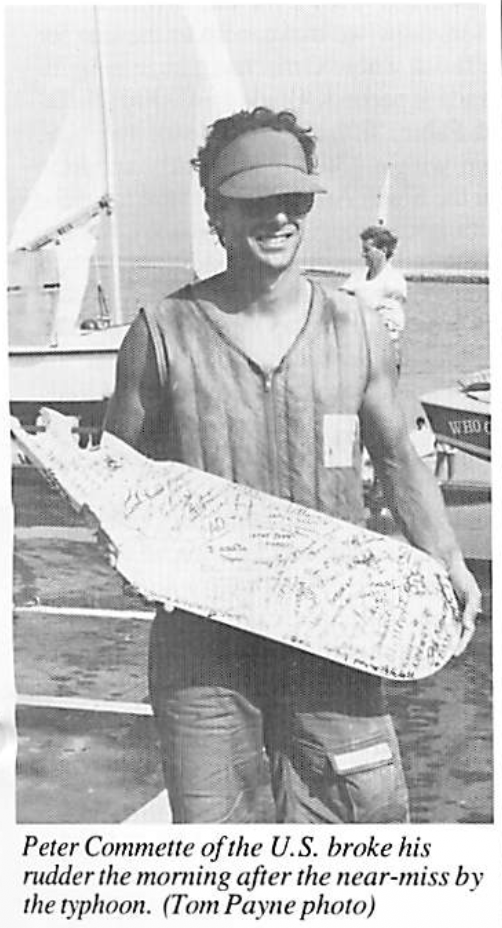
Commette breaks his rudder. The wind is a steady 23 knots, gusting to 30. The race is abandoned. Back in the parking lot Connie Suddath has everyone sign the broken rudder, a great souvenir of the day.
Friday morning the wind and seas are wild. Judging from the conditions on shore we can easily see that there will be no racing, but the authorities assure us that the winds out on the course are below the SCIRA limits so the fleet heads out.
Lenhart and Pritchard bust their starboard shroud. One of the Spanish boats capsizes and somehow rip their main away from the boltrope. Commette breaks his rudder. The wind is a steady 23 knots, gusting to 30. The race is abandoned.
Back in the parking lot Connie Suddath has everyone sign the broken rudder, a great souvenir of the day. That night there is another splendid party hosted by the Citizens for Success at Kai-Jin-Kahn, a restaurant nestled among the famous Karatsu Pines. Dr. Shindo tells me that he used to play here as a child.
Conditions are light on Saturday. It will be a day of victory for someone, and a day of heartbreak for many. The winds are six knots for the start of Race Five and lighten as the race proceeds. There are moments when the race is a drifter. Pimental, who was in strong contention for the title, limps home in 29th. The Bjurstrom brothers have a disasterous 23rd. Maguel of Spain leads from start to finish, by far his best result. Grael drops to 14th, Santos, Chaves, and Leme come through for Brazil and finish 2-3-4. Leweck matches his first race fifth, and Fabini and Meerhoff drop to eighth. Utada is 13th.
Aboard the spectator boat, Brazilian National Secretary Eduardo Bomeisel quickly figures the standings going into the finale. It looks like the fight for the title will be between Grael and Fabini.
The wind has shifted 90 degrees to the right and has freshened a bit. A tight group fights for the lead at the first mark. Santos, Chaves, Commette, and Parada were fighting for the lead, followed closely by Fabini, Utada, and Ericksen of Denmark, but all eyes were on Grael as he struggled in the light going.
The breeze freshened, the crews were hiking, and Grael began to move up through the fleet. Bomeisel was counting boats and calculating. Commette and Suddath had a nice little lead at the second windward mark with Chaves close behind in second, positions that they would hold to the leeward mark. Chaves got by Commette on the final leg to take the win, but now it was down to cases for Fabini and Grael.
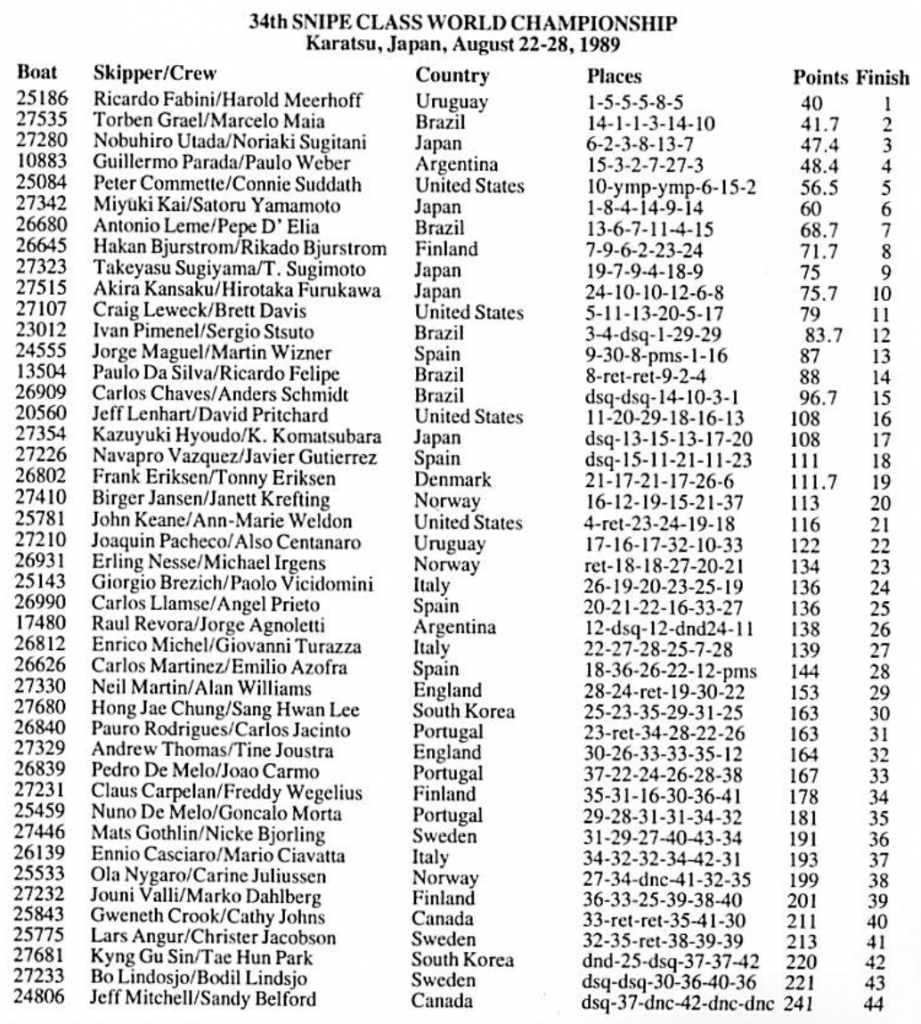
Fabini crossed in fifth. Could Grael pick up enough boats on the final beat? No. He managed a great recovery and finished 10th, but it wasn’t enough. Fabini and Meerhoff were the new champions by 1.7 points.
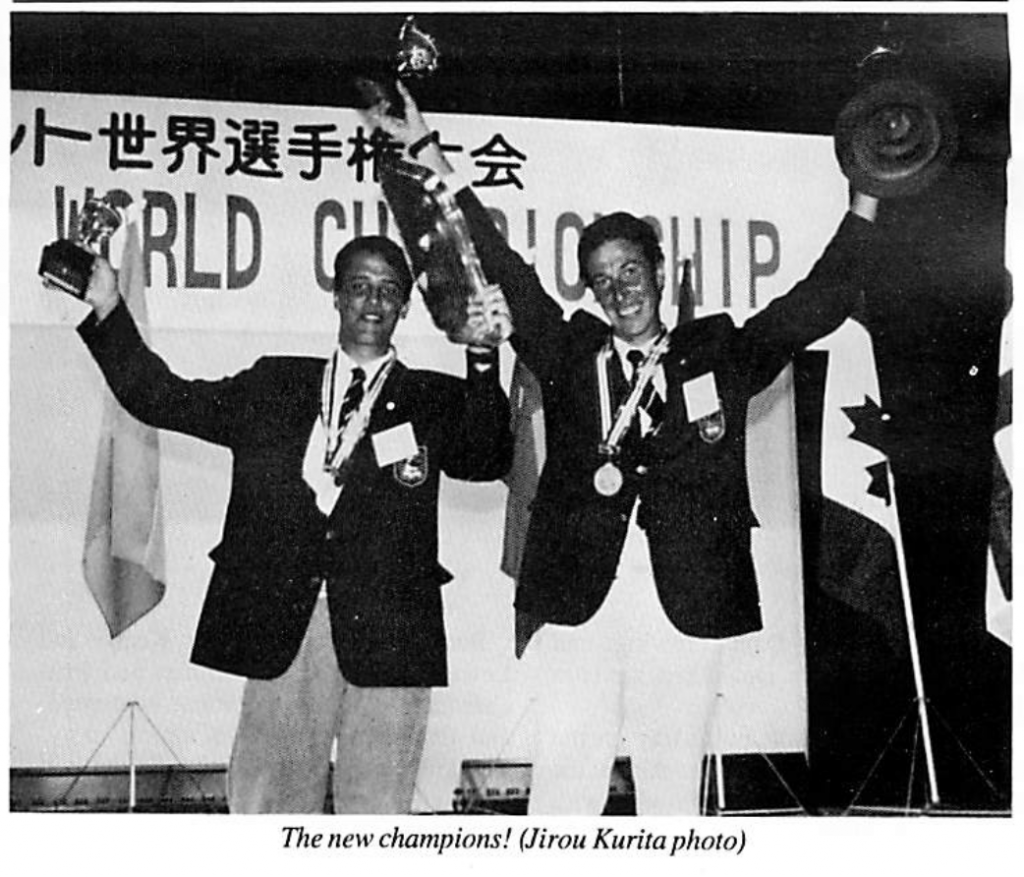
Fabini crossed in fifth. Could Grael pick up enough boats on the final beat? No. He managed a great recovery and finished 10th, but it wasn’t enough. Fabini and Meerhoff were the new champions by 1.7 points. Utada and Sugitani were third, only 7.4 points behind Fabini, and Parada of Argentina was fourth. Commette’s second helped his average and boosted the value of his two YMPs and he was fifth overall. Pimental had another disastrous 29th and dropped out of the top five, as did the Bjurstrom brothers with a 24th.
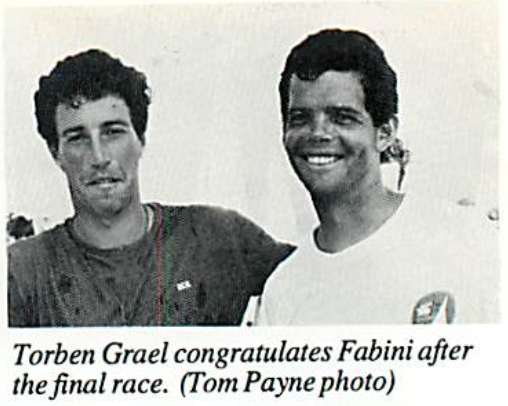
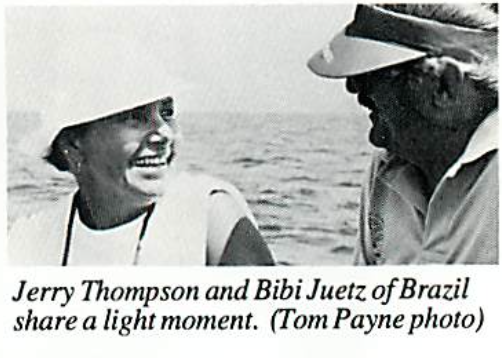
t was a grand scene at the closing ceremonies, hosted by the Governor of the Saga Prefecture at the Karatsu Royal Hotel. Fabini and Meerhoff were ecstatic, Grael and Maia restrained, Utada and Sugitani were heartbroken although pound for pound they had demonstrated the continuing seriousness of SCIRA Japan’s drive for the top. Parada was resigned to fourth but he was not a happy man. Commette and Suddath were clearly elated. They had sailed well despite their bad luck with the collision on the second day. Peter pointed out that he could have won the regatta, carefully noting where he had made mistakes and lost points.
The attention soon shifted to the future as the Norwegian team took the stage. National Secretary Birger Jansen invited everyone to Norway for the 1991 Worlds and presented Mayor Nozoe with a beautiful Viking ship.
It was a wonderful week. A magic week. The Worlds are always special, but SCIRA Japan, the Mayor and Citizens of Karatsu, the students from Saga University, and all of Japan had outdone themselves. Everything that happened during the week was televised, much of it nationally, all of it locally. Everything was done to perfection, and we all had a valuable lesson on the position of importance that the Snipe holds in Japan.
To everyone in Japan we say thank you for the experience of a lifetime. It was special. Very, very special.
NOTES FROM THE 1989 KARATSU WORLDS by -David Pritchard
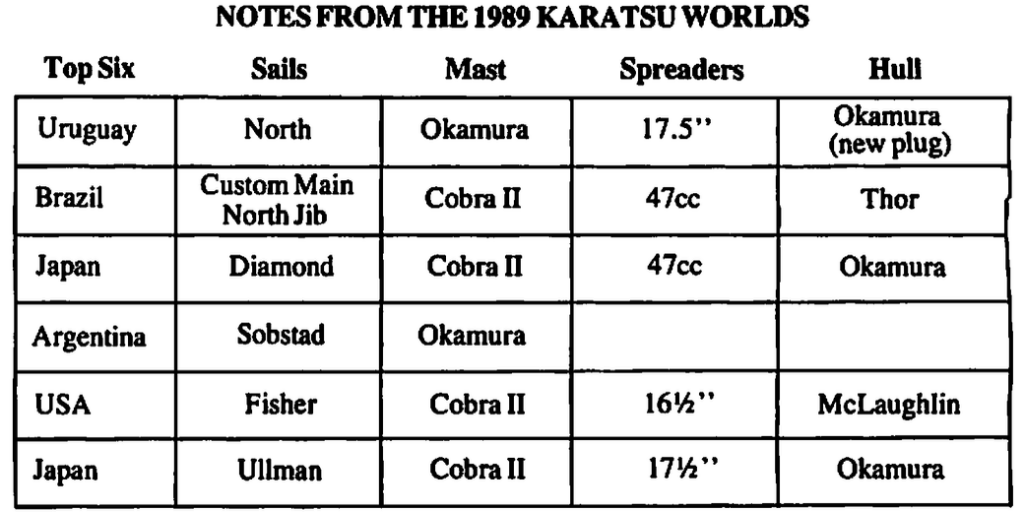
Sails: General cloth weight towards the lighter side of the rule. Torben Grael used a full radial main and won both races in the breeze. Nice looking sail but expensive to make. Most prevalent cloth was Polyant.
Spreaders: Wide variety of combinations. Most of the top boats were sailing longer than the norm (16½”). Tip to tip anywhere from 26″ to 30.” Most spreaders chocked at static upwind position in 8 knots. Most common technique was to heavily pre-bend the mast, moving center of effort forward to improve helm.
Rake: Upwind, 21’4″; downwind, 20’10½” average.
Blades: Most centerboards were uniformly sharp on both leading and trailing edges. Centerboard trunks were very tight. Rope was used as a shim down the front of the trunk. This helped protect the leading edge of the blade and kept board aft. Another feature was a V in the back of the trunk to accommodate trailing edge.
Some centerboards featured multi-adjustment holes.
Rudders: For the most part were maximum thickness and minimum chord length. The Okamura rudder seemed to have tapered thickness, that is to say greater thickness at the head.
Pole: South American teams were very successful at pole reaching in the breeze. Part of their technique involved leading the jib sheet to a “guy” hook located on or by the shroud and then aft to a cleat. This made trimming simple and improved sheet angle to clew.
Read also:
1991 Snipe Worlds – Tønsberg, Norway, August 2-10, 1991
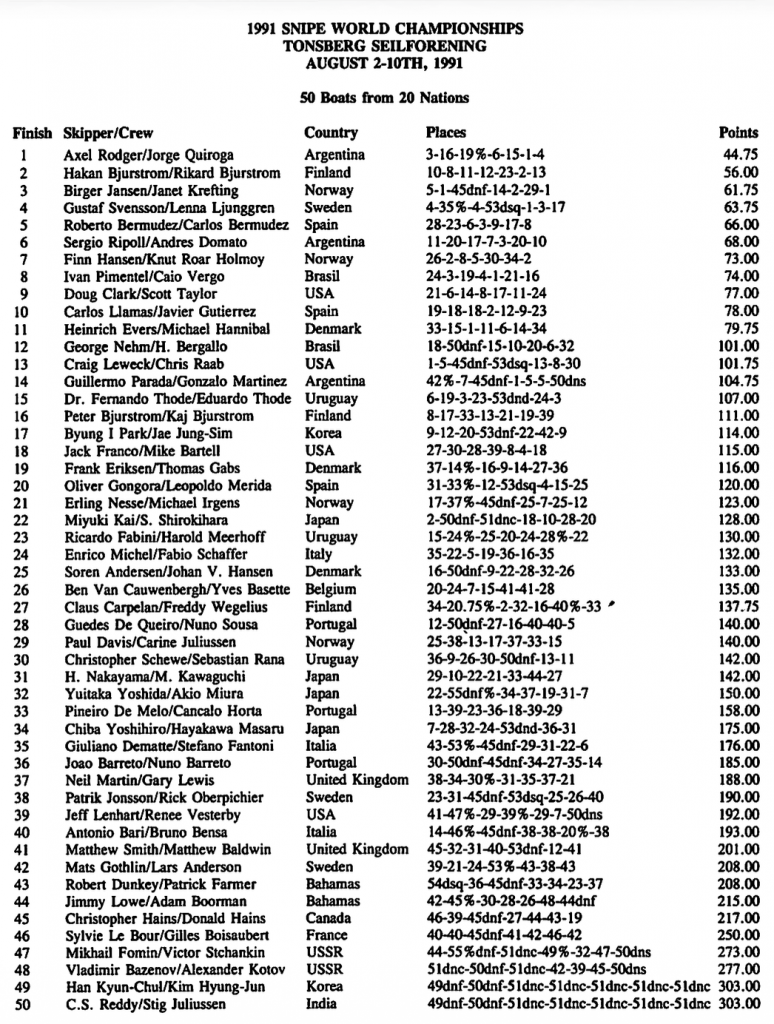
Axel Rodger and Jorge Quiroga spent four years preparing for the 1991 Snipe World Championships. Rodger, who is 24, started sailing Optimists at the age of nine. He represented Argentina on their team to the Optimist Worlds in 1981, and also has extensive experience in Cadets. His crew, Jorge Quiroga is 27. Their boat was a borrowed Skipper with a Sidewinder mast. They used sails from the Argentine North loft. While they normally sail at 134 kilos they had put on a few extra kilos and weighed in at 138 for the Championship.
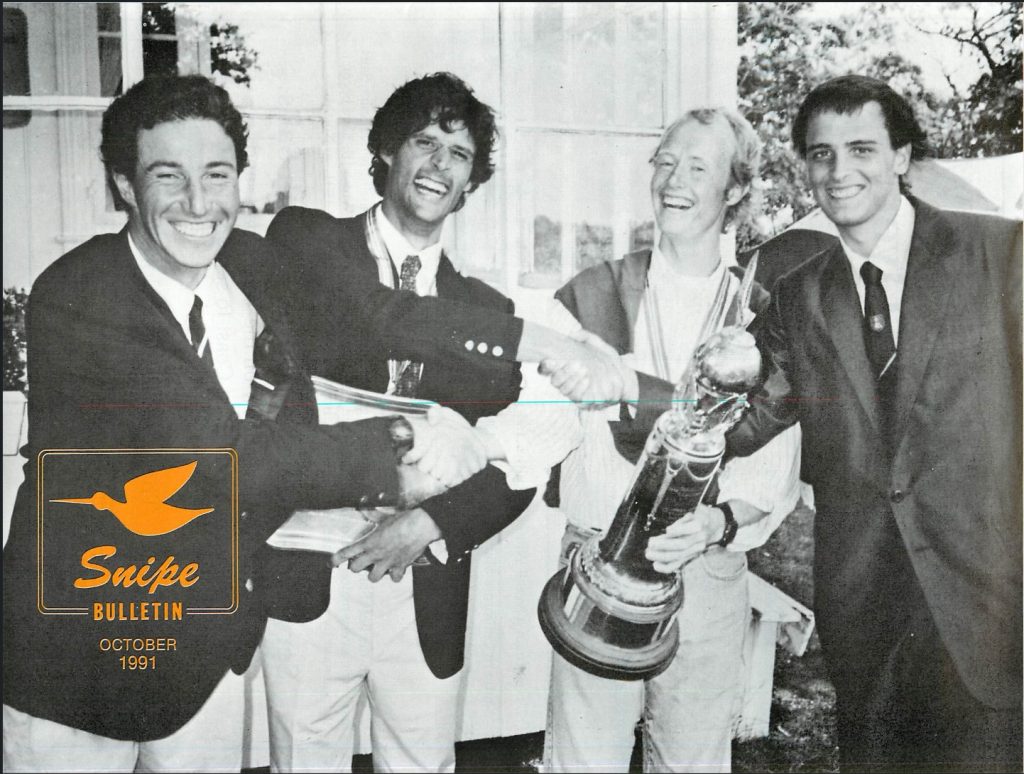
VIVA ARGENTINA! – Snipe Bulletin October 1991
Axel Rodger and Jorge Quiroga spent four years preparing for the 1991 Snipe World Championships. The pair, from Buenos Aires, sailed Regatta Chairman Steinar Woein’s Skipper Snipe to a 11.25-point margin of victory over Finland’s brother team of Hakan and Rikard Bjurstrom, who sailed their self-designed plywood Snipe Turbo Joker. Norway’s National Secretary, Birger Jansen, with Janet Krefting crewing, won the final race moving them into third overall in the 50-boat, 20-nation fleet.
The event pointed out some significant factors in International Snipe competition:
- Parity among the nations is a reality. Noting the results, there were seven different winners of the seven races: Leweck (US), Carpelan (Finland), Evers (Denmark), Parada (Argentina), Svensson (Sweden), Rodger (Argentina), and Jansen (Norway).
- Parity among different Snipe designs is a reality, despite manufacturer’s claims to the contrary. The new designs from Persson, Jibe-Tech, and Lillia were competitive but no more than competitive, as in the final tally it was the “traditional” Skipper that took the victory and the most places in the top ten. Of course one could argue that this was the result of superior numbers of Skippers racing, but the results speak for themselves. Leweck (US) sailed the Persson to victory in race one, Clark (US) in the Jibe-Tech was never able to finish above sixth, and the best that Japan’s Kai could manage in his new Lillia was second in the first race. This is not to say that these new designs lack merit. They are all well-thought-out variations on the Snipe theme, and each is worthy of a closer look by those interested in new Snipes, but no one should expect any radical breakthroughs in speed.
- In mast design and construction, the lead has apparently swung to Erling Olsen’s Sidewinder, as nine of the top ten boats were so equipped. Again, it may be argued that this is the result of superior numbers, but as with the hulls, the results speak for themselves. The one notable exception was Clark with a Cobra II, and Leweck’s race one victory with the Proctor.
- Regarding sails, it was another victory for North’s Argentina loft as they continue to lead the way. The Bjurstrom’s used Rikard’s own NEB sails, while Jansen was sailing with Fishers.
After two General Recalls, Race One was started in 5-knot breezes, but a big shift to the left caused a cancellation as the fleet was about a third of the way up the first beat. After the proper adjustments, the fleet was away again with the clear advantage to those boats who chose the right side of the course. There seemed to be more current on the left, opposing the progress of those who had chosen that side. As Japan’s Kai rounded the jibe mark in first, those who had sailed up the left side were just rounding the windward mark. At the finish it was Leweck, Kai, Rodger, Svensson, and Jansen making up the top five.
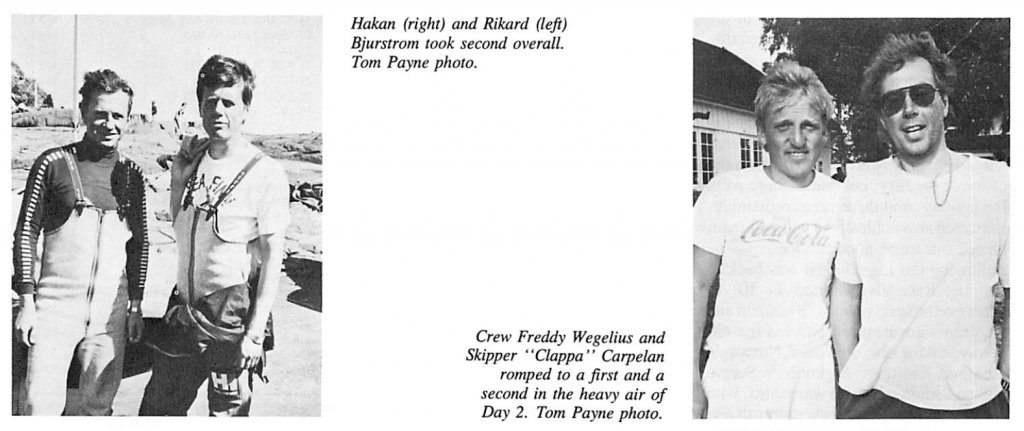
Conditions were radically different on the second day of competition, as the wind built to gear-buster speeds. Finland’s Claus Carpelan and crew Freddy Wegelius were up for the tough going and they took the victory with ease over Norway’s Finn Hansen and Knut Roar Holmoy. Brazil’s Pimentel and Vergo were third. Leweck took an early overall lead with a fifth, but his luck was about to change.
This was the one day when two races were scheduled, and this turned out to be bad news for Leweck, Jansen, and Kai, among others, as breakdowns took their toll. In the day’s second race Leweck broke his rudder. Kai had broken his rudder in the day’s first race and was told by the Race Committee to standby, that another rudder would be brought from the club. This did not happen and Kai was forced to sit out the second race, resulting in his request for “redress,” which the International Jury denied.
The winds were up to 20+ knots for the second race, and again it was Carpelan and Wegelius at the front, closely challenged by Denmark’s Evers and Hannibal. As in the day’s first race, the Race Committee had called for the Double Triangle course (eliminating the run), and on the second time down the first reach, Evers passed Carpelan and held on for the win. Uruguay’s Thode brothers were third and Sweden’s Svensson posted another fourth, followed by Italy’s Enrico Michel and Fabio Schaffer in fifth.
At this point in the competition there had been a total of seven (at least, I lost count!) General Recalls, and the “Zulu Flag” 20% penalty was taking its toll. For those who are not familiar with this new feature of the SCIRA Sailing Instructions it works like this: After one General Recall, the “Zulu” one-minute rule goes into effect. If you’re over with less than one minute to go you must dip back below the line and make a proper restart. You are then assessed a 20% penalty on your finishing position. This applies even if the start that you infringe on is recalled, that is, the 20% carries over to the next start. By the end of the second day of racing, fifteen boats had been so penalized, including Carpelan, erasing his win.
General Recalls were again the order of the day as Tuesday’s race (Race #4) saw two before the fleet got underway on the third try. Winds were moderate, in the 10 to 12 knot range with seas generally much quieter than those of the previous day. It was finally Spain’s day, as Carlos Llamas and crew, Javier Gutierrez lead the first triangle, followed by the Bermudez brothers, Robert and Carlos. Argentina’s Parada and Martinez were third and the Bjurstroms were fourth as the second beat started. Parada managed to get through and take the gun with Llamas in second, Bermudez in third, and Brazil’s Pimentel crossing fourth. The Bjurstroms faded to 12th, a finish that would cost them dearly in the final tally.
As the fleet returned to shore the real controversy of the event was about to unfold: Leweck, Svensson, Spain’s Gongora, and Sweden’s Jonsson were disqualified by the Jury for violations of Rule 54 (Kinetics). Fortunately the Sailing Instructions had been amended before the event started, and a Rule 54 DSQ could be dropped. Leweck and Raab, whose 1, 5 record in the first two races was now burdened by a DNF due to the broken rudder, did not need the further blow of a DSQ, but they remained philosophical as they requested redress for the breakdown. It was denied.
Sweden’s Gustav Svensson was in the parking lot with his mast down, preparing to go home, when Sniper veteran/legend Mats Gothlin persuaded him to appeal to Commodore Means Davis, the SCIRA Representative for the event. Davis explained to the clearly heart-broken Svensson that he was powerless to overturn the decision of the Jury, but that as there were still a lay-day, and three races remaining, the situation was not lost. As you will read, it turned out to be good advice.
Following the Lay Day, it was back to sailing as Race five started in 10- to 12-knot northeasterly winds. Svensson and Ljunggren were inspired and led the entire way, taking the win over Norway’s Jansen and Krefting. Argentina’s Sergio Ripoll and Andres Donato were third, with Spain’s Gongora and Merida in fourth and Argentina’s Parada and Martinez in fifth.
At this point, with a drop race figured in, the series was up for grabs among several teams: Jansen had 32 points, the Bjurstroms had 41, Rodger had 40, Hanssen had 41, Pimentel had 37, Evers had 32.75, and Svensson had 43.75. Clark and Taylor were hanging in with 45 points.
In race six, started in 12 knots of wind, the former Champion, Jeff Lenhart, with Renee Vesterby crewing, finally found the front, rounded the windward mark in first, but was soon overtaken by the Bjurstroms who had the flat-black Turbo Joker in overdrive, and they held a 20-second lead at the first jibe mark. Back in the fleet, Svensson was around the windward mark in fourth. Rodger and Quiroga were seemingly out of it, rounding in 11th.
Axel and Jorge turned on the speed, passed seven boats on two reaches, and finished the first triangle in third. Also making a strong showing after a slow series start was Jack Franco, with crew Mike Bartell. The layday gave them time to search out and repair a leak in the centerboard trunk, the result of a capsize in the Nordic Championships. “Once we got the leak stopped it was a whole new series,” said Jack. The resulting fourth in this race was, unfortunately, too little, too late.
At the second windward mark it was Lenhart who had regained the lead over the Bjurstroms, but it was Rodger, now in third, who would move up to provide the most exciting finish of the series.
As the leaders approached the finish, it was apparent that Rodger and the Bjurstroms would be close. Bjurstrom, approaching on starboard seemed to have the edge, but Rodger and Quiroga slammed them with a beautifully executed lee-bow tack, forcing the Finns to tack away. Rodger covered and again it was a port-starboard confrontation, with another perfect lee-bow job by Rodger. At the line it was sooooooooo close!!! Only one man knew who had won and the first idea that the spectators had was provided by Hakan pounding on his deck in frustration. The Argentines had taken the victory by a matter of “a few centimeters.” Sweden’s Svensson and Ljunggren had moved up into third and Franco and Bartell took a narrow fourth from Parada and Martinez. Lenhart and Vesterby dropped to seventh. Jansen did not help his cause, as he was 29th. Pimentel also took a blow, falling to 21st.
Saturday, August 10th, was a perfect day to decide the championship, with clear skies and winds in the 15 knot range. Finally someone did something right, because the fleet was away clean on the first try! Italy’s Guilliano Dematte and Stefano Fantoni were on the correct side of a big right-hand shift and held a narrow lead over Uruguay’s Thode brothers. Jansen was making some serious noise, rounding the windward mark in third. Rodger and Quiroga were back in ninth, with the Bjurstroms in 14th.
Now the winds were building, with gusts to 18 knots on the first reach. By the time the fleet started back upwind the winds were gusting to 20 knots and Jansen had taken the lead, with the Thodes in second and Norway’s Finn Hansen in third, as Dematte and Fantoni fell to fourth. Rodger held his own, protecting his lead over the Bjurstroms.
At the finish it was Jansen and Krefting, providing a good show for Norwegian Television who had come to tape the finale. They were followed by Hansen in second and the Thodes in third. Then it was the turn for the new World Champions, Rodger and Quiroga, as they sealed their victory with a fourth. Portugal’s Guedes and Sousa were fifth. The Bjurstrom’s sealed second overall with a 13th.
As stated earlier, Rodger and Quiroga had spent the last four years preparing for this event. Rodger, who is 24, started sailing Optimists at the age of nine. He represented Argentina on their team to the Optimist Worlds in 1981, and also has extensive experience in Cadets. His crew, Jorge Quiroga is 27. Their boat was a borrowed Skipper with a Sidewinder mast. They used sails from the Argentine North loft. While they normally sail at 134 kilos they had put on a few extra kilos and weighed in at 138 for the Championship (approx. 307 pounds).
The Bjurstroms were somewhat subdued at the awards ceremony, but this is normal for this quiet pair. They had been in a strong position in the 1989 Championships in Karatsu, Japan, until a disastrous final day left them deep in the fleet. This time it was only a matter of a few points, and after all, second was the best that a Finnish team had ever managed at the Worlds, and the best Scandinavian finish since the Brodsted brothers of Denmark took second in the 1973 Worlds in Malaga. This result, along with the fantastic 1,2 second day record posted by Carpelan and Wegelius, made the SCIRA Finland table at the awards dinner a loud and happy place!
As you would imagine, Jansen and Krefting’s third overall was very popular with the home crowd. They had sailed well, despite the breakdown in the third race, and things could have been different if they had been able to do better in the sixth race when they recorded the 29th. Janet may be “long and lean” but she can hike like crazy and apparently is a great crew. She was the only female crew in the top twenty boats.
Svensson’s fourth overall was a great result, considering that without the intervention of Mats Gothlin and Means Davis, he was headed home following his Rule 54 DSQ! His 17th in the final race didn’t help him any, but again, another Scandinavian boat in the top five (three out of five!) is great news for proponents of world-wide parity.
Spain’s 1991 National Champions, the Bermudez boys, sailed a consistently quiet series, a third in race four being their best, to take fifth overall, and Argentina’s Sergio “Heartbreaker” Ripoll and crew, Andres Domato, were sixth, a mere two points behind.
For Norway’s Finn Hansen and Knut Roar Holmoy, it was a case of “might have been,” as they were very much in contention until a they hit a cold streak in races five and six. This is one team that’s sure to be at the top in future Worlds!
Brasil’s infamous “Chupador,” Ivan Pimentel, with crew, Caio Vergo, lead that nation’s efforts with an eighth overall. Again, this was a case of consistency as they had only two races in the top five and their third best race was an eleventh. One expects that this team will be tough when the 1993 Worlds in Brazil come around.
Being the top U.S. boat was little consolation for Doug Clark and Scott Taylor. They were clearly disappointed with their 24th in the final race, a result that left them in ninth overall. Leweck and Raab were also victims of bad luck, as their 13th overall seems to signify. The broken rudder and the Rule 54 DSQ were disasters that they didn’t need and a final race 30th sealed their fate.
Another clear victim of hard luck was the Argentine team of Parada and Martinez. A 20% penalty in race one, and a DNF in race three were obstacles that they could have overcome with a good result in the final race, but they fell victims to an underwater rock on the way out to the course. The resulting grounding drove their centerboard back through the trunk and the boat almost sank by the time they made it back to the dock.
What about the defending champions, Fabini and Meerhoff? It’s been a great reign for this pair, as they’ve also recorded wins at the 1990 Western Hemispheres, and Meerhoff was crewing in the 1991 Junior Worlds when a broken boat cost Uruguay the victory there. Add a South American title and a third in the 1991 South Americans and you have an enviable record. Their streak came to an abrupt end in Norway. Despite a massive grant from the Uruguayan government that enabled them to train in Norway for over a month, they were never in the Worlds, as their 23rd overall indicates. They were sailing Fabini’s new Snipe which has a hull characteristic of a McLaughlin, but with a wide, low, very flat deck borrowed from the Bjurstrom’s Turbo Joker design. While the boat may not have been the problem, it certainly was no answer.
The final “major disappointment” award must go to Japan. Although they now lead the world in numbers of sailors in Snipes, their best, Miyuki Kai and crew Skirakihara were unable to recover from their disastrous second day (broken rudder, DNS) and were never again near the front, save for a tenth in race five. One can only hope that this will cause a renewed effort in Japan, as the glory and honor of being the first Japanese World Champion still awaits.
On the social side, the Tonsberg Seilforening did a great job with a limited budget. There was no question that this was the cheapest place in town to buy a beer, as the local bars charged in the vicinity of $5.00 US for one brew! The organization, headed by Dr. Steinar Woien, was excellent, and he was ably assisted by a staff of secretaries, kitchen help, and club members who tried their best to solve any problems that came up.
The club itself was founded in 1888 and has hosted many major championships over the years. The facilities were perfect, with plenty of room for the 49 participating boats. The club was located on a rocky point of land and many sailors who strolled along the point found that the local scenery was truly breathtaking!
And so another Worlds is in the record books. Many thanks to all of the hard work by SCIRA Norway National Secretary Birger Jansen, the members of SCIRA Norway, the officers and members of Tonsberg Seilforening, and everyone who contributed to this successful championship.
XXXI – Porto, Portugal, September 5-11, 1983
- Torben Grael and Lars Grael, Brazil
- Craig Martin and Kenyon Martin, USA
- Jorge Haenelt and Laureano Wizner, Spain
- Paulo Santos and Jose Santos, Brazil
- Johnny MacCall and Juan Grande, Argentina
Sailed on the Atlantic Ocean, 18 nations, 37 starters
XXXII – Buenos Aires, Argentina, November 23-December 1, 1985
- Santiago Lange and Miguel Saubidet, Argentina
- Johnny MacCall and Sergio Ripoll, Argentina
- Miyuki Kai and Akio Kaneko, Japan
- Felix Gancedo and Carlos Llamas, Spain
- Paulo Santos and Cassio Ashaver, Brazil
Sailed on the Rio de la Plata, 19 nations, 35 starters
XXXIII – La Rochelle, France, August 31-September 4, 1987
- Torben Grael and Marcelo Maia, Brazil
- Santiago Lange and Miguel Saubidet, Argentina
- Horacio Carabelli and Luis Chiapparo, Uruguay
- Nobuhiro Utada and Noriaki Sugitani, Japan
- Fernando Rita and Antonio Andreu, Spain
Sailed on the Atlantic Ocean, 16 nations, 49 starters
XXXIV – Karatsu, Japan, August 22-28, 1989
- Ricardo Fabini and Harold Meerhoff, Uruguay
- Torben Grael and Marcelo Maia, Brazil
- Nobuhiro Utada and Noriaki Sugitani, Japan
- Guillermo Parada and Paulo Weber, Argentina
- Peter Commette and Connie Suddath, USA
Sailed on Sea of Genkai, 15 nations, 44 starters
XXXV – Tønsberg, Norway, August 2-10, 1991
- Axel Roger and Jorge Quiroga, Argentina
- Hakan and Rikard Bjurstrom, Finland
- Birger Jansen and Janet Krefting, Norway
- Gustaf Svennson and Lenna Ljunggren, Sweden
- Roberto and Carlos Bermudez, Spain
Sailed on Oslo Fjord, 20 nations, 50 starters
About the 2026 Snipe Worlds:
Mahon, Menorca, Spain, September 19-26, 2026
Leave a reply
Your email address will not be published. Your comment will be revised by the site if needed.

0 comments