
Snipe Worlds: Plotting the Course — Episode 4
From the Origins to Mahon
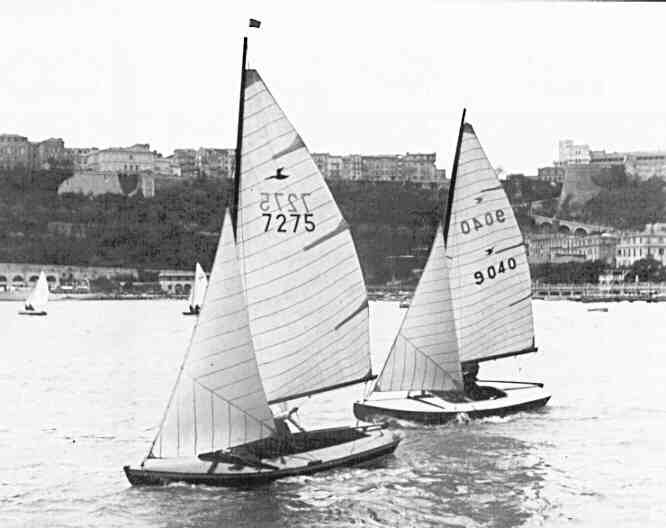
As we continue our journey through the history of the Snipe World Championships, this fourth installment examines the pivotal decade of the 1950s. This era saw remarkable international expansion, fierce technological debates over tolerances, the rise of legendary sailors, and legendary logistical adventures.
1953: Monaco — September 5–12, 1953
For the 1953 World Championship in Monaco, we have numerous fascinating sources to consult. The regatta is chronicled by Ted Wells in his famous “Wells’ Wanderings” columns in the October and November 1953 Snipe Bulletins.
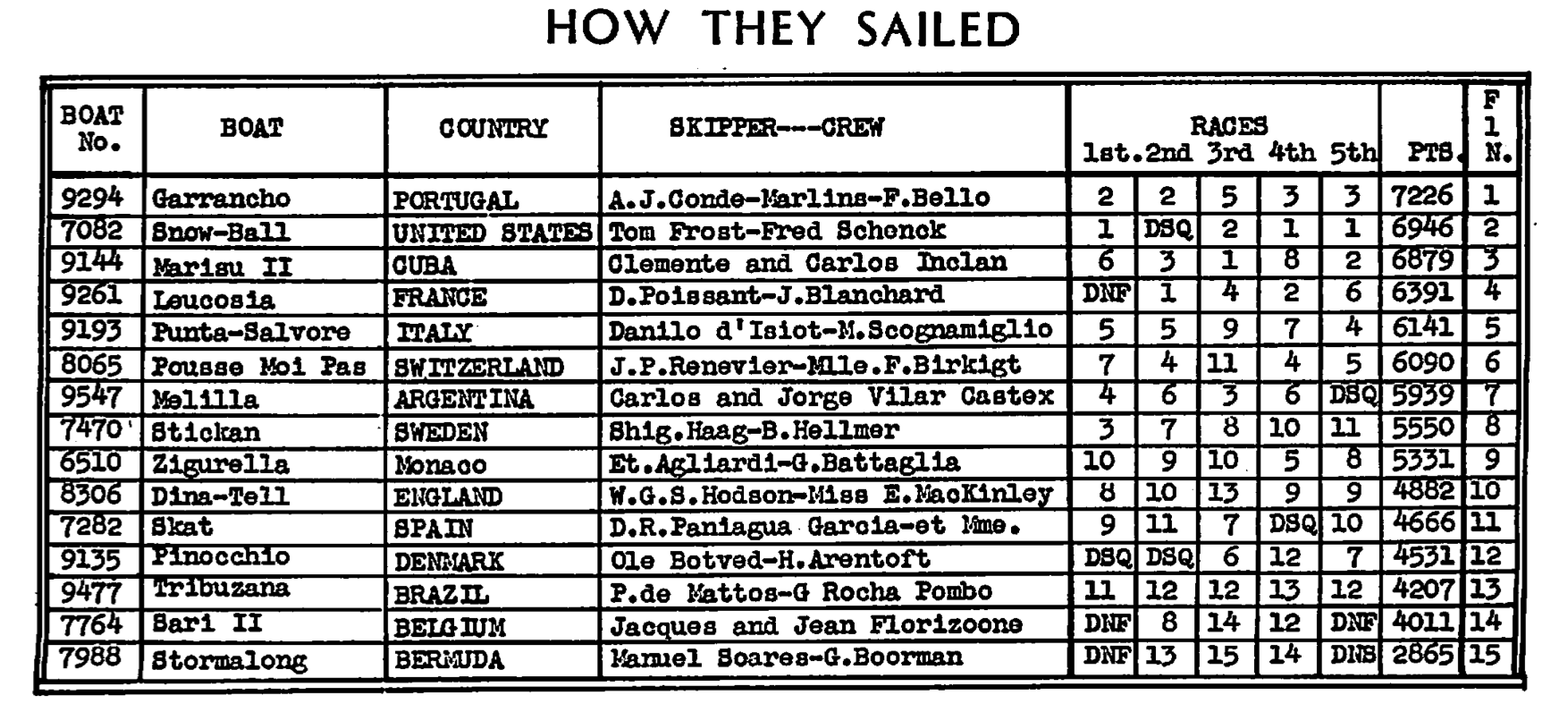
The winning skipper that year was 17-year-old António José Conde Martins with crew Fernando Lima Bello from Portugal, securing the title with a consistent 2-2-5-3-3 series. Second place went to the United States team of 17-year-old Tom Frost and crew Fred Schenck (finishing 1-DSQ-2-1-1), sailing the 1948 Varalyay Snipe #7082 Snowball, which had also won the US Nationals that same year.
Wells’ Wanderings (October 1953 Snipe Bulletin) – By Ted Wells:
It was interesting to see the improvement in the quality of the Snipes in this regatta. The newer European boats are light in weight, have better finishes on them now, and are well equipped for racing.
The World Championship at Monaco was the biggest yet, with fifteen nations represented, thirteen of which brought their own boats. Brazil and Bermuda were the only ones to sail borrowed boats.
Consistently good sailing and no bad mistakes won the regatta for Portugal. The winds varied from almost nothing to about fifteen miles per hour, and the sea from flat to fairly mountainous. The starting and finish lines were probably a bit exasperating to the skippers as they wandered about the Mediterranean (the line was wandering because the committee boat was a very unmanouverable 115 foot ketch which couldn’t be anchored, and the Snipes were wandering around attempting to keep up with it).
In the first race, Belgium and Bermuda had troubles fairly early in the race and dropped out. Denmark was disqualified for tying up to replace a split rudder after the start, and France lost a stay when they were in the lead at the end of the first lap. The wind was about 15 miles per hour at the most in this race, but the sea was very rough and the Snipes as well as their skippers and crews were pretty well worn before the start as a result of a 45 minute delay in the starting time while an unsuccessful attempt was made again to anchor the committee boat.
In the second race, there was a fairly light wind with a heavy sea running, left over from the morning breeze. The United States got to the leeward end of the starting line a little too soon and, after luffing in an attempt to slow down, ended up on the buoy. The third race was sailed with a nice breeze in a fairly heavy chop, which held over for the fourth race. However, the breeze didn’t and the three hour time limit ran out with France well in the lead. The fourth race was re-sailed on the following morning with another light breeze, but on a calm sea.
Again the wind died down in the afternoon, and the United States barely got under the time limit, eleven minutes ahead of the second boat to win the fifth and final race. The last boat did not finish until about an hour after it was pitch dark.
It was interesting to see the improvement in the quality of the Snipes in this regatta. The newer European boats are light in weight, have better finishes on them now, and are well equipped for racing. Many of them still use pivot boards, and there was one with a permanent back-stay, which is a feature I have not seen here since 1939. But they are building quite a lot of new boats which look very good, although there is still a tendency to make them suitable for local conditions rather than all conditions.
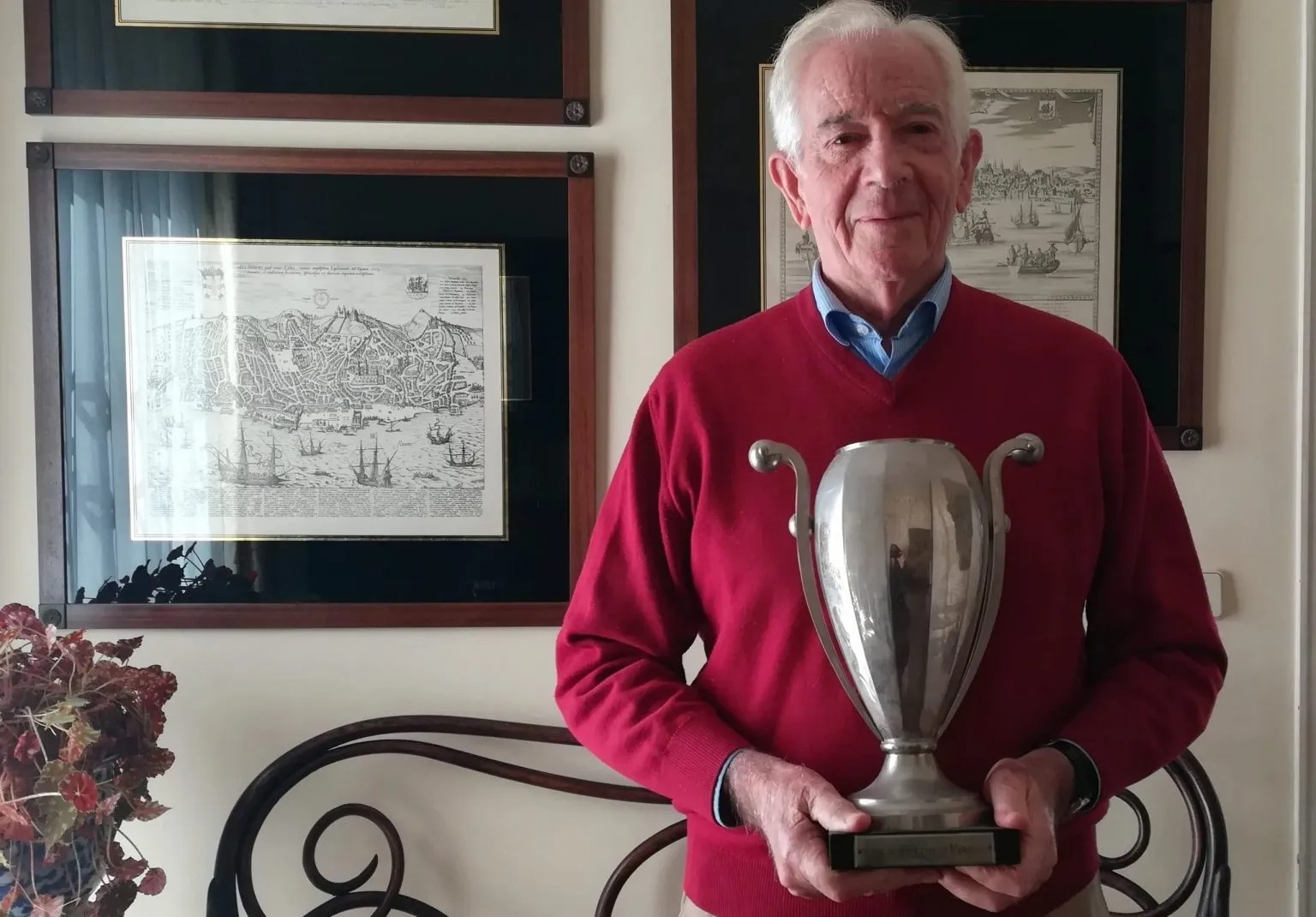
Above: Antonio Jose Conde Martins with one of the trophies won in Monaco (courtesy of Mediotejo.net)
An equally captivating account of the winners appears in the Portuguese publication Revista da Armada. In the article “Evoking Monaco 1953: Portugal’s First Sailing World Title,” several remarkable details are highlighted:
- Skipper António José Conde Martins and crew Fernando Lima Bello won the 1953 Snipe World Championship in Monaco aboard Garrancho #9294. This marked Portugal’s first-ever world title in sailing—a record that stood unmatched for 28 years.
- The Path to Qualification: Conde Martins won the 9th Portuguese National Snipe Championship in Leixões in June 1953. To prepare for the World Championship, the Portuguese Sailing Federation selected the experienced Fernando Lima Bello as crew, alongside reserve crewman Antunes Fernandes.
- Logistical Misadventures: Facing severe financial constraints, the team traveled nearly 2,000 km to Monaco over four days in an old Morris Oxford towing the Snipe. Driven primarily by 17-year-old Antunes Fernandes, the car repeatedly overheated in the Pyrenees—forcing them to cool the engine using water carried in their championship trophies! They arrived in Monaco early in the morning on the day measuring began and missed their scheduled practice time.
- Overcoming Adversity at the Championship: Despite sailing with heavier, traditional cotton sails against competitors using modern dacron sails, the Portuguese team showed great consistency. They finished 2nd in the opening race behind the American team (Tom Frost) and maintained steady placements without major mistakes, securing 1st place overall.
- Triumphant Return: On their drive back to Lisbon, their tow hitch broke at Cabo do Mondego, and they were even fined near Vila Franca de Xira for not covering the “TOW” sign on the vehicle. Upon reaching Lisbon, they received a grand public welcome and parade at Rossio and the Palácio da Independência.
- Legacy and Honors: President Craveiro Lopes awarded both sailors the Sports Merit Medal, and the Lisbon Municipality honored them with municipal medals. Both sailors went on to distinguished careers: Fernando Lima Bello became an Olympic sailor, IOC honorary member, and sports executive, while Conde Martins had a distinguished career as a naval commander and submarine specialist.
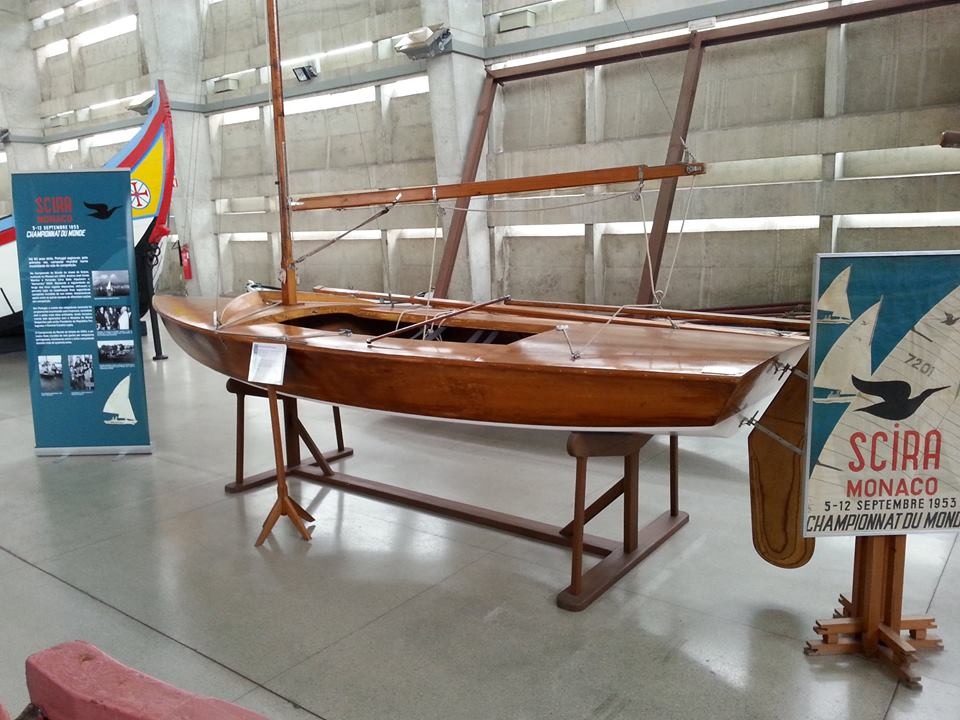
The winning boat, Snipe #9294 Garrancho, is today on display at the Portuguese Marine Museum in Lisbon. Owned by Fernando Bello—World Champion crew, inventor of the “Bello Bailer,” and creator of the circular vang track later used on Star boats.
Wells’ Wanderings (November 1953 Snipe Bulletin) – By Ted Wells:
The subject of measurements and tolerances came in for much discussion in the meeting of all of the European secretaries after the Championship at Monaco. Several countries had had experiences in having large numbers of boats thrown out by either being built outside of the tolerances or going outside of them and some of the opinions on what to do about the situation were pretty violent. The final recommendation of the European secretaries was to reduce the overall length tolerance and add two more stations to be measured on the stem contour.
Since returning to this country I have received two French magazines with articles on the World’s Championship at Monaco. These articles were quite interesting in view of the almost universal European opinion that it is necessary to do tricky things with the Snipe lines and tolerances in order to make a boat which can win races. At Monaco they had an excellent measuring rig and I had hoped that after they measured Tom’s boat, which is a Varalyay just like mine except that it is only five years old instead of six, Tom’s performance in the races would convince them that there was more to winning races than fiddling with tolerances.
This hope turned out to be pretty much in vain, however, as even though the boat showed on the measurement rack that it was built to almost the exact middle of all tolerances nobody would believe it. One of the French magazines published an article on the World’s Championship and stated that the boat was specially built for the World’s Championship (quite a bit of foresight was involved in this case as the boat, judging from its number, must have been built about five years ago) and was extremely carefully built because it came within the tolerances everywhere by a margin of one millimeter. The other French magazine carried an article covering both the World’s Championship and the International Invitation Regatta at San Remo. This article said in effect that while after Monaco it could be said that the American boat of Tom Frost was the best, after San Remo in which Americans finished first and second out of forty-five boats—one of the boats being a borrowed one—the conclusion had to be that the Americans won by being better skippers and possibly having better sails.
The subject of measurements and tolerances came in for much discussion in the meeting of all of the European secretaries after the Championship at Monaco. Several countries had had experiences in having large numbers of boats thrown out by either being built outside of the tolerances or going outside of them and some of the opinions on what to do about the situation were pretty violent. The final recommendation of the European secretaries was to reduce the overall length tolerance and add two more stations to be measured on the stem contour.
It sounds silly but I think probably the first statement on the measurement data sheet and in the rule book should be to the effect that the Snipe is a one-design class boat and all hulls are supposed to look alike and be alike. Two regattas have been won during the past summer by Snipes which were later found to be outside of the tolerances with very embarrassing results all around. In one case the boat did not even look too much like a Snipe as there was about a six-inch radius between the stem and the deck with a piece of aluminum tacked on so that the shape of the stem in a side view from a distance looked like it belonged on a Snipe. This boat also had the centerboard trunk cut down considerably below the deck line. The prize for having boats out of measurement goes to the Italian Championship for this year, however, as only four out of twenty-eight boats which showed up were allowed to race. No wonder some of the Europeans were pretty excited about clamping down on measurements.
Another recommendation which they made was that a new weight limit be adopted covering the hull, centerboard, mast, boom, rudder, tiller, and rigging but nothing else that wasn’t firmly buttoned on to the boat and could be accidentally left on shore. The reason for this was that several boats have shown up with thirty or thirty-five pound anchors which at the least is carrying ballast and at the worst can be forgotten and left on shore on a light day. The same tendency has been noticed in United States recently and this recommendation will undoubtedly be adopted.
Another recommendation which the European secretaries made was that sliding seats, hiking boards, trapeze rigs, etc., should be specifically ruled out. These have been considered illegal for some time but nothing has ever been written in the rules on the subject.
From these historic chronicles, an almost obsessive interest emerged surrounding the American boat Snowball #7082. For further reading on this era, check out these articles:
You can also watch vintage footage from an international regatta held in Monaco in 1952, one year prior to the World Championship:
1955: Santander, Spain — August 27–September 1, 1955
1955 saw Italy’s only Snipe World Championship victory to date, achieved by Mario Capio and Lorenzo Podestà. Mario Capio, from Genoa, later went on to win a Flying Dutchman World Championship and represented Italy at the 1956, 1960, and 1964 Olympic Games.
From the Snipe Bulletin – November 1955
Italy Wins World Title, Cuba Second, Portugal Third. Sixteen Nations Compete
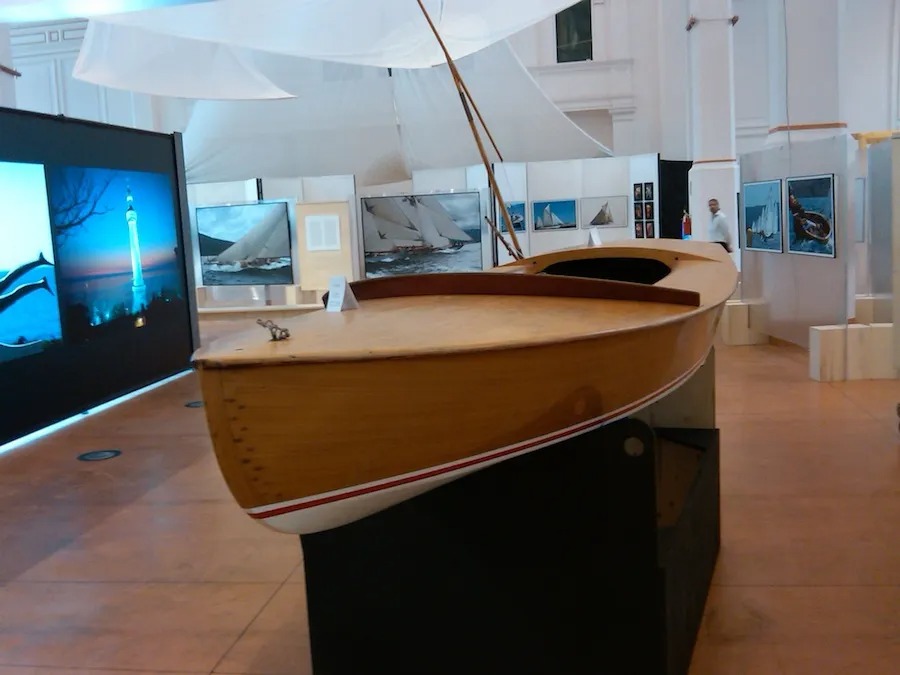
Above: The winning boat in 1955 was the famous Portorose, built by Danilo D’Isiot
With 16 nations participating under the co-sponsorship of the Federation Espanola de Clubs Nauticos and the host fleet of the Real Club Maritime de Santander, the 17th World Championship Races of the Snipe Class were sailed in Santander, Spain, August 27th-September 1st, 1955.
And for the first time, an Italian team consisting of Mario Capio, skipper, and Enzo Podesta, crew, won the title of Champions of the World after a series of splendid races. Using their own boat, the Milan-built “Portorose”, with which they had recently won the Second Mediterranean Championship, the Italians won with the outstanding characteristic of consistency.
In the words of spectator Barse Miller, Governor of District #1, “Bullfighters splendid in silver and gold passing through the hotel portal to waiting limousines; tourists in chaperoned groups off to see the prehistoric caves at Altimira; and well-showered, tired-eyed yachtsmen back from the races burdened with bags of wet sails–such is the scene of the Campionato del Mundo de Snipes.”
The European teams, plus Cuba and Argentina, shipped their own boats to the regatta. Brazil, Bermuda, Uruguay, and the United States sailed Spanish boats of varying quality, allotted on a catch-as-catch-can basis. In general, they seemed to be the equal of the average American snipe.
All the races were sailed in Santander harbor and the Bay is a perfect place for small boat sailing. The area is large enough to get a perfect triangular or windward-leeward course whatever the wind is. There is some tide but, as the races were sailed around high tide, the currents made very little trouble, though tricky. Almost ideal sailing weather prevailed throughout, with varying wind velocities. The race on the first day was light and fluky, but thereafter, the wind shifted from the north and became very strong. The second and third races were in winds of 25 mph with gusts up to 35 mph. These winds, coupled with the interesting tidal currents, made these races a real test for skippers and equipment.
“Commodore Williams and SCIRA officers extend official greetings, best wishes for fair winds, and good luck to all national champions.” With the above cablegram expressing the interest of snipers all over the world, the series got under way on the morning of August 26th with a general tune-up race. In gentle, varying winds, the U.S. team of Harry Allen, skipper, and Terry Whittemore, crew, walked through the fleet after rounding the first windward mark to win the huge and beautiful Cup of Santander, awarded to the winner. And the first real race of the series, in winds of 4 to 8 mph, proved almost a duplicate of the trial race. Allen, sailing the Spanish “Canute IV”, took off after the first short windward leg to build up a lead of possibly 500 yards at the end of the first round, only to sit near the turning mark while the entire fleet moved up. The Swiss boat, sailed by Mlle. Francoise Birkgit and Jose Mantilla for Cuba almost barreled past on a following wind, but the U.S. crew managed to finish first by about two minutes, followed by Switzerland, Cuba, Brazil, Portugal, Uruguay, Italy, Bermuda, Belgium, Spain, England, Denmark, Sweden, Monaco, and France in that order. In general, the boats from the northern countries did less well in light air than those from the south and Latin-American countries.
The race of the second day was another matter. With a northwester of Force 4 and gusts up to 25 mph, the Portugese yacht crossed the line first only because the Danes were forced into a luffing match by the Italians on the last few hundred yards down wind. On this day, misfortune struck both the Brazilian yacht (a broken tiller) and the U.S. crew, whose mast sheared off just a few seconds after the start. Incidentally, Sitca spruce is not available in Spain and they have to make their masts out of pine, which just won’t stand up in a heavy blow. Italy, Denmark, Uruguay, and Argentina all crossed the line flying protest flags and the protest committee finally sat down to dinner at eleven thirty p.m. But Portugal was disqualified on protest to leave Denmark in the lead with Italy and Cuba in the next places.
For the third event, the wind was a perfect 15 mph from the northwest on a triangular course. The U.S. team was back in business with a good spruce mast borrowed from Paul Elvstrom of Denmark and they took an early lead after a perfect start. They were never headed. However, it was not a runaway victory as Italy pressed him all the way and was very close at the finish. Their beautiful teamwork was outstanding as they finished second after a tight contest with Cuba, Denmark, and Portugal. At the end of the third race, the standing of the first four boats was: Italy 4198 pts.; Cuba 4184; Denmark 3885; and U.S. 3825.
The fourth race, on a windward-leeward course in fresh winds, gave some of the keenest racing of the series and was a corker for the spectators. After a long beat to the turning mark, Harry Allen brought his boat up to take the lead down wind by a few hundred yards, followed by Italy, Portugal, Cuba, and England. The second round up-wind was a thriller, with Portugal, U.S., Italy, and then Cuba reaching the up hill turn in that order. At the finish it was Portugal’s win with U.S. crossing eight seconds later followed by Italy. England was fourth, and as Cuba almost capsized doing a last-minute jibe, the Swiss boat crossed ahead of him in fifth position.
The fifth and final race was sailed Sept. 1, with the going good and dusty in winds of 15-18 mph. Italy was now in a very secure position for winning the cup. Anywhere near the front would do, but Mario Capio would not be satisfied with that. The course was triangular and Italy got off to a well-timed start at the leeward end of the line. The U.S. boat was recalled, so it trailed almost the entire fleet to the first mark. The first three boats around were Italy, Cuba, and Portugal and the Italians began to assume a commanding lead.
On this leg, Harry Allen passed about three boats, but the real thrill began on the next leg when he got his snipe to plane and moved rapidly from ninth position to second around the lee mark, only to be out-tacked going to windward by Portugal, Cuba, and Switzerland. But again, on the second lap down hill, the U.S. picked up boats to regain his second place, but still well behind the Italians. But then, to the amazement of all, the U.S. boat rapidly fell off to leeward and lost eight positions. This time a dagger board had jammed, which cost him a possible second in both the race and the series. It was heartbreaking to watch them limp across the finish line well in the ruck after their earlier performance. In the meantime, Italy had sailed a beautiful race and came home with a handsome lead over Portugal and Switzerland.
And so the series is now history and the winner’s trophies awarded to Mario Capio of Italy, with Lorenzo Podesta as crew. Second was the Cuban team of Jorge Mantilla, skipper, and Jesus Barazal, skipper; and third the Portugal entry, Helder Soares Oliviera, skipper, and Dulio Severo, crew. All of the teams participating praised the perfect organization of the regatta by the Royal Yacht Club of Santander, which also furnished boats to the various crews who came without them. The Federation of Spanish Yacht Clubs has received letters from practically all contestants expressing their appreciation for the hospitality which they received during their stay in Spain. In the words of Terry Whittemore: “The Spanish hospitality was superb, the food and quarters excellent, and the girls?—just ask Harry Allen (or any other batchelor who attended!).”
(The above account is largely taken from the excellent article written by Barse Miller and published in YACHTING.)
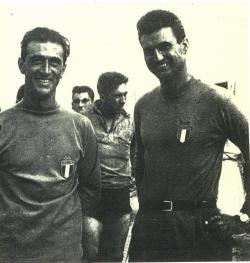
Above: Lorenzo Podestà (left), Mario Capio (right) and Paul Elvstrom (behind).
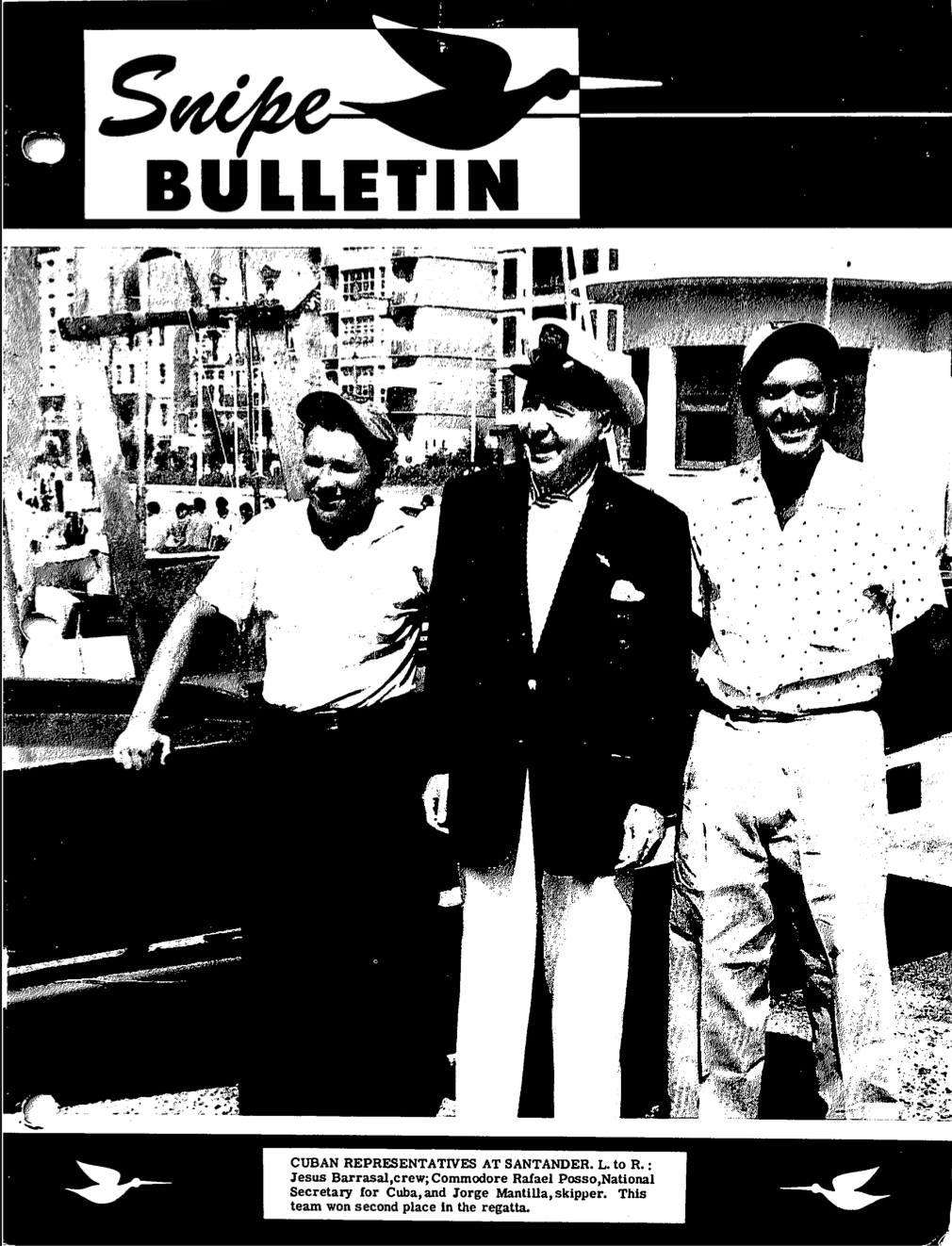
A notable highlight from this championship was the outstanding 5th place overall finish by Mademoiselle Françoise Birkigt from Switzerland, who finished just a few points behind sailing legend Paul Elvstrøm!
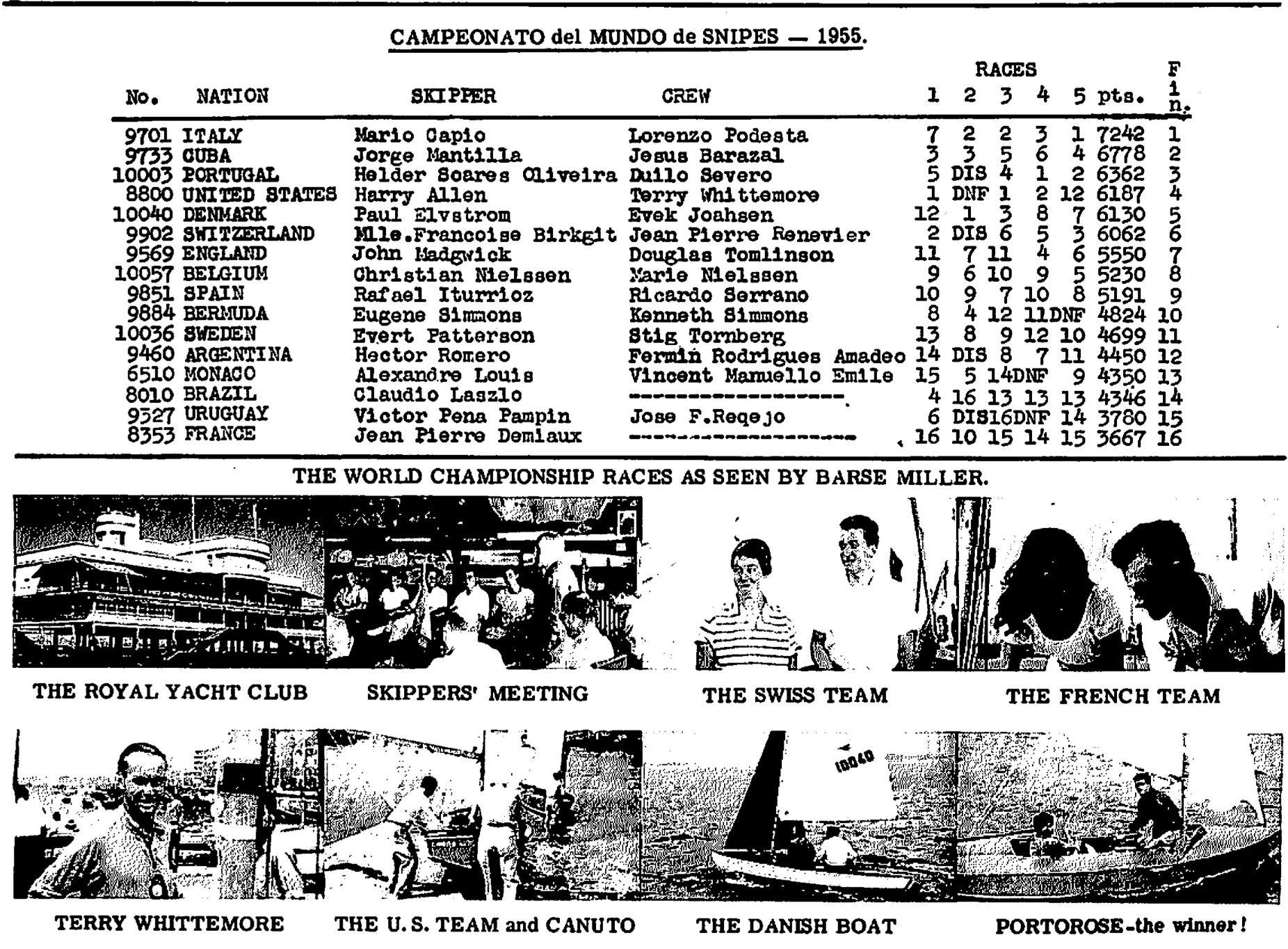
1957: Cascais, Portugal — September 2–9, 1957
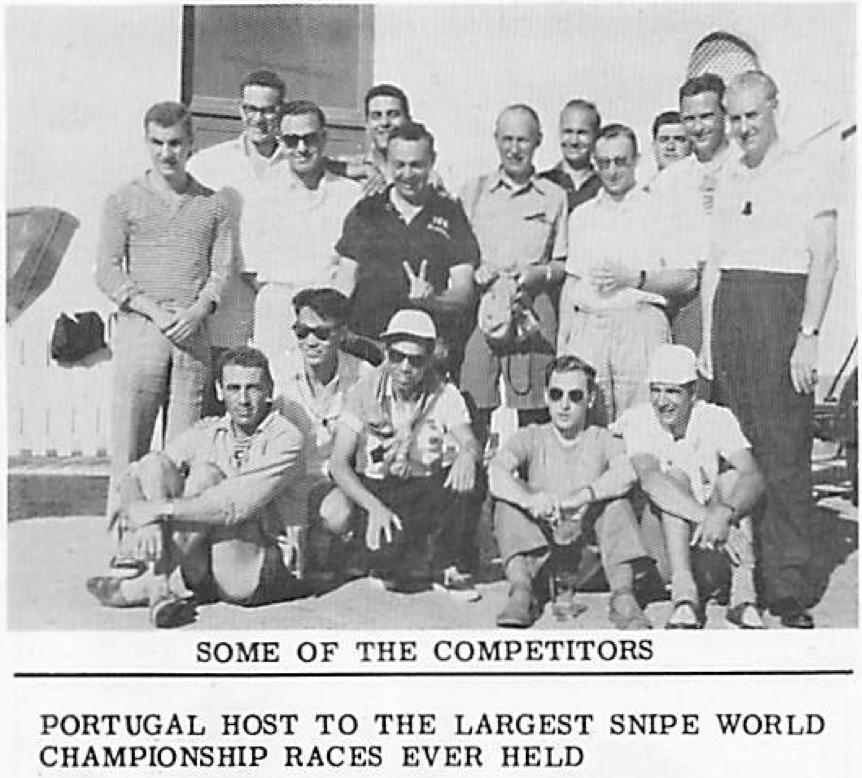
The report by US crew member Terry Whittemore was published in the November 1957 Snipe Bulletin:
Spain wins the Isaacks Trophy for the first time
When the top ranking sailors of 21 sovereign nations assemble at one yacht club to determine who will be the World Champion of the World’s most numerous one-design Class, you can be certain that the event must be worthy of special interest and recognition.
Precisely this is what occurred at the Clube Naval de Cascais the early part of last September. From Japan to Turkey, Canada to Argentina, and from the Scandinavian countries to South Africa, with a host of nations in between, the top Snipe team of each country, selected through a rigid series of eliminations, arrived at the delightful port of Cascais, Portugal, with an eye toward winning the most coveted honor of Snipedom. Many brought their own Snipes, generously transported gratis by their hosts on Portugese steamers. The remainder were given their choice of Snipes from the cream of the Portugese fleets. The series to determine the Champion consisted of six races of at least seven miles each. Out of deference to those using borrowed boats, each contestant was allowed to drop his worst race of the series to compensate for possible equipment breakdown.
Three windward-leeward and three triangular races were sailed alternately, the first race being over a windward-leeward course. One race a day for six days (Sept. 2-7) was the schedule and, fortunately, weather conditions caused no postponements or cancellations.
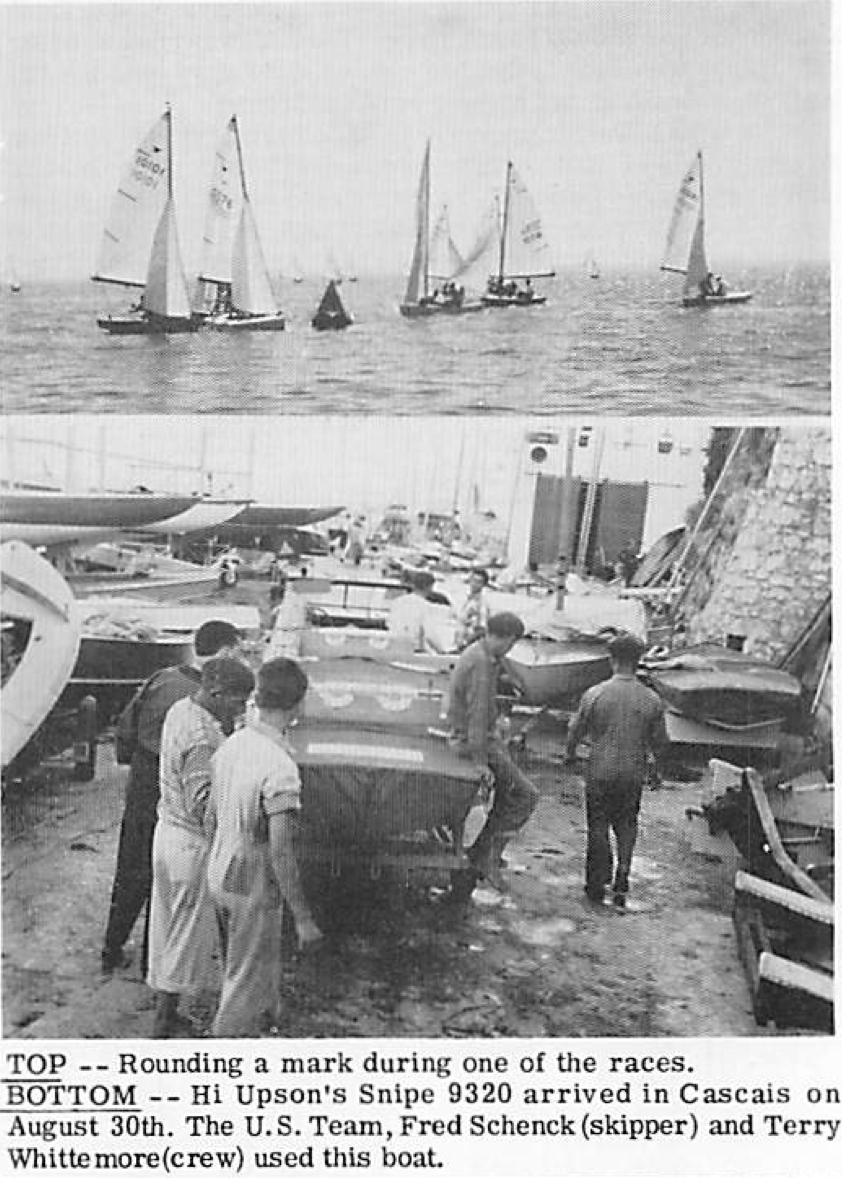
Three windward-leeward and three triangular races were sailed alternately, the first race being over a windward-leeward course. One race a day for six days (Sept. 2-7) was the schedule and, fortunately, weather conditions caused no postponements or cancellations.
Three of the races were held in shifty winds up to 8 mph. Another saw the wind a steady 12 mph, while the other two required maximum hiking and agility as the gusts exceeded 20 mph. As a result, this regatta provided a true test of the contestants ability under a variety of conditions.
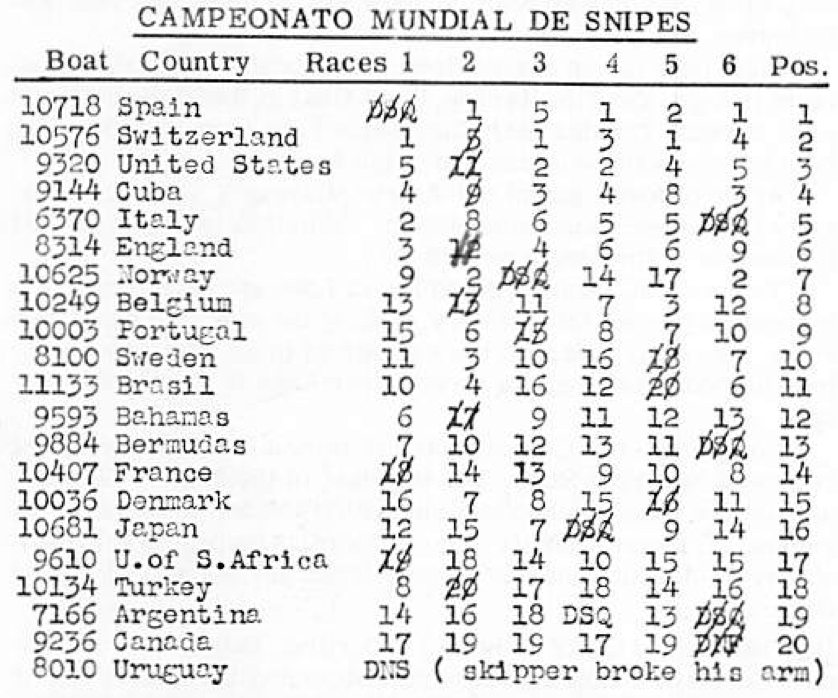
Juan Manuel Alonso Allende, the Spanish representative, and Fragniere Raymond of Switzerland, each sailed a sweet, sweet series! Both had three firsts thereby shutting out everyone else from even a fleeting moment of glory. Allende acquired a second and a fifth in the other two races which, under the Snipe Class scoring system, nosed out the Swiss, who had a third and a fourth in the other two races, by only four points. The Spaniard was superior by far in a blow; no one could come close to touching him under heavy conditions, yet he was right in there when the breeze was light. The Swiss, on the other hand, had a magnificent feel in the light winds, and in two of the races, worked out fantastic leads.
Steady sailing on the part of the U.S. skipper, Fred Schenck of Newport Beach, California, earned him a neat third in the final standings, by way of two 2nds, a 4th, and two 5ths. Moreover, he accomplished this feat using a strange boat and a crew with whom he had never sailed. This is, indeed, a great tribute to his sailing skill.
Dr. Clemente Inclan, the Cuban skipper, famous both in Ocean Racers as well as Snipes, placed fourth, while Italy’s National Champion, Pierino Reggio, nailed down the number five spot.
Our hosts in Portugal left no stone unturned to insure that everyone experienced a memorable as well as delightful visit to their lovely country. The scope of their planning can be better appreciated when it is revealed that there were over a hundred yachtsmen there—the Stars and Dragons were racing for their European Championships at the same time—and the multitude of invitations were extended to all the sailors, their National Secretaries, and families. In this brief article, it is impossible to enumerate all the wonderful trips and events that were planned. I must mention, though, the picturesque Belham tower, acres of colorful gardens, the renowned Casino de Estorile, and an all day side trip into the bull fighting country. There all were wined and dined to the strains of gay music accompanied by authentic and exotic folk dances, and the final frosting was added when everybody was invited to try their luck in the little bull ring. Bravery evaporated, and the F-106 would emulate a turtle compared with the speed with which the ring was evacuated when the bull came charging out. Suddenly, a flying trapeze in a hurricane seemed like duck soup. At the many lavish festivities planned for us by our hosts—each original, each different, and each magnificent—everyone had a glorious time, needless to say.
We were fortunate to have the services of Arch Higman of California as official SCIRA representative. He did a beautiful job! There was little cause for controversy, largely due to the smooth way he handled things. This was the friendliest regatta imaginable, noteworthy as it was the first World Championship for several nations, and this friendly feeling is one of the strongest points of the Snipe class.
This World Championship will go down in history as the one where the decision was made to submit the Snipe Class sailboat to IYRU for their International Class rating. This action was encouraged because of the great international interest in the Snipe, as witnessed by the large number of entries and the great success of this truly international event.
1959: Porto Alegre, Brazil — October 16–25, 1959
The 1959 World Championship truly made history for our Class. It was won by the Danish phenomenon Paul Elvstrøm (today widely considered the GOAT, or at least one of the top two or three sailors in history), who would go on the very next year in Naples (Rome 1960 Olympics) to win his fourth consecutive Olympic Gold Medal (one in Firefly and three in Finn). Elvstrøm had previously attempted to win the Snipe Worlds in 1955.
This championship is also famous for the legendary 12000-series wooden Snipes built by Alberto Lineburger. Provided to all competitors, these boats remained exceptionally competitive for decades even after the advent of fiberglass (some of these hulls are still sailing and racing today).
Beyond the official reports, fascinating behind-the-scenes stories emerged—including personal accounts shared by Gonzalo “Old Man” Diaz, who finished runner-up for Cuba. The regatta was preceded by controversies regarding the Danish team’s sails, as well as the tragic withdrawal of the dominant local Brazilian skipper. Gabriel Gonzalez had won 2nd place in Race 1 for Brazil, but sustained an injury on the beach and was replaced by Waldemar Bier. Per SCIRA rules, Race 1 could not be counted for Bier, forcing Brazil to use it as their drop race.
The Report (December 1959 Snipe Bulletin):
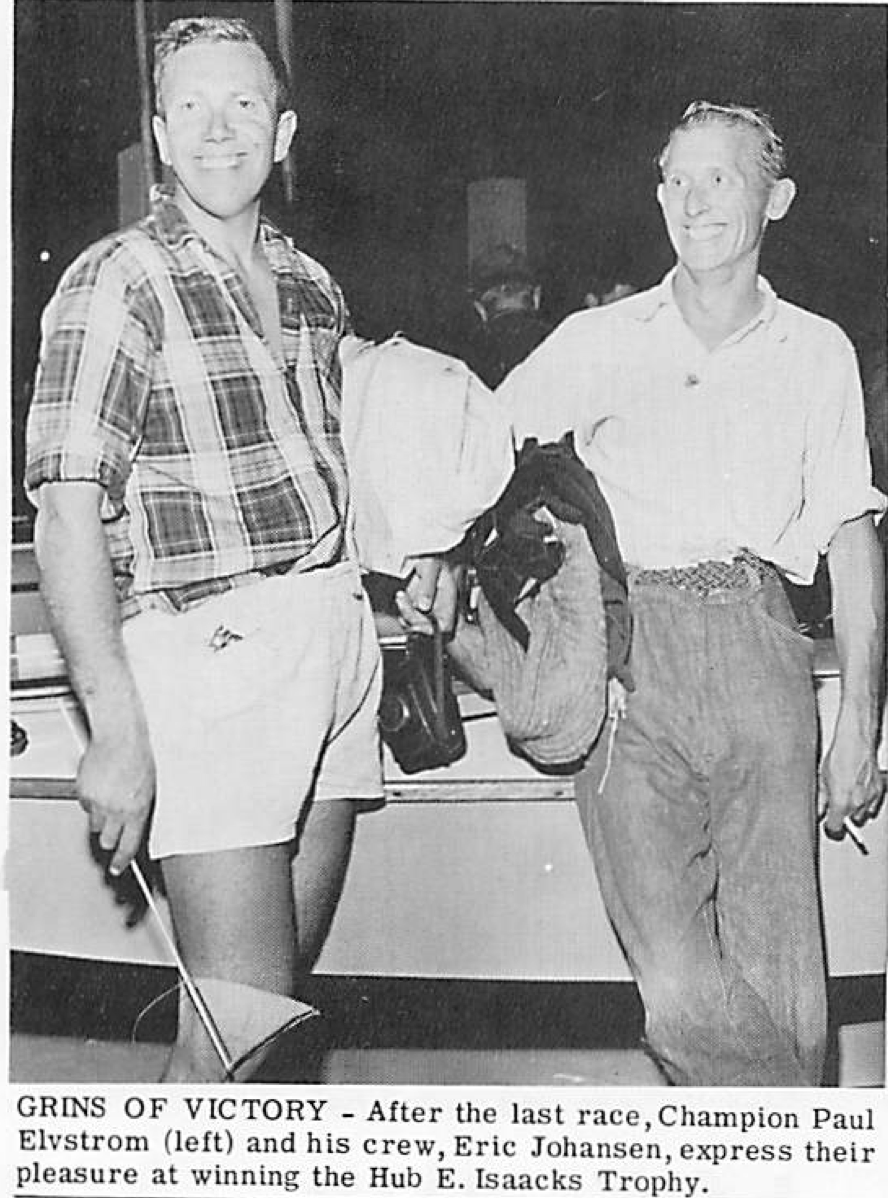
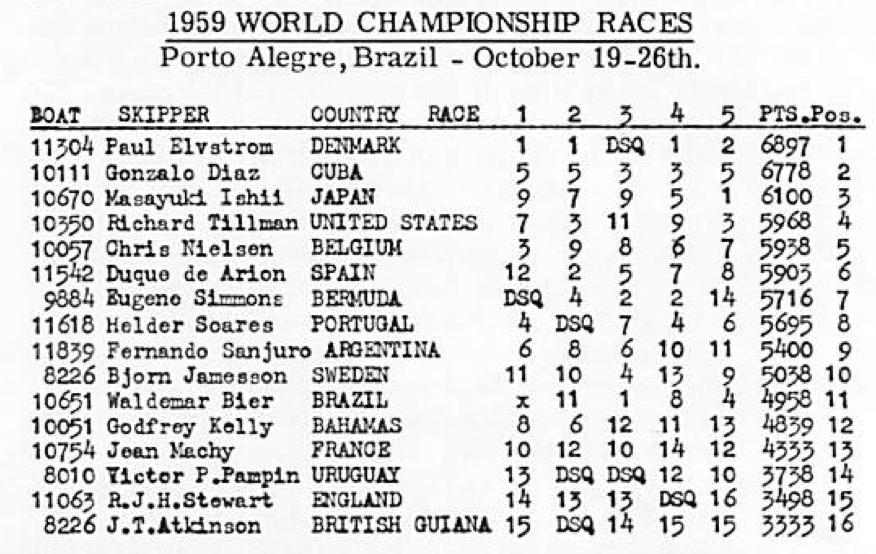
A new country joined the select list of Snipe Class World Champions when Paul Elvstrom and Eric Johansen from Denmark won the 25-year old event and the Hub E. Isaacks Trophy this year. They combined a 1-1-DSQ-1-2 to win the title with 6897 points and a margin of 121 points over the Diaz brothers from Cuba.
After identical boats were assigned by lots Friday evening, the next morning was spent in making allowable individual adjustments getting ready for the two tune-up races that afternoon and Sunday morning.
The regatta, officially sponsored by the Brazilian Sailing and Motor Boating Association, was organized by the Yacht Club dos Jangadeiros and the Rio Grande do Sul Snipe Fleet 426 at Porto Alegre and raced on the Guaiba River October 19-26th. 16 countries from Europe, the Western Hemisphere, and Japan participated, and competition, as usual in the Snipe Class, was of the highest championship quality.
The courses were laid out on the Guaiba River in front of the Yacht Club, located a few miles below the city of Porto Alegre. At this point, the river is a little over 2 miles wide. Running south, it empties into 200 mile long Lake dos Patos before reaching the ocean; consequently, the water is always fresh with no tide and at that time of year, was light brown in color and taste. The current is not strong, but steady, and in this area, it is diverted by a point of land diagonally across the river from the east to west shore. It is always a factor to be considered.
After identical boats were assigned by lots Friday evening, the next morning was spent in making allowable individual adjustments getting ready for the two tune-up races that afternoon and Sunday morning. These were sailed in strong winds and choppy waters and gave the teams fine opportunity to try their equipment and learn the courses. When Denmark won the first race and finished 2nd in the other, it was an omen of things to come.
The classic William Crosby Open International Race was scheduled as the last race before the big series. Sailed Sunday afternoon under ideal conditions of a heavy wind, choppy waves, and clear skies, it was a gala affair witnessed by hundreds of spectators. 59 boats entered the event and all discovered that they were outclassed from the very start by the famous Schmidt twins, Alex and Eric, from Rio de Janeiro. They led Denmark, Spain, Bermuda, and France across the starting line and that was it — they defied anyone to catch them as they led at every mark around the two laps of the triangular course in a wind varying from 20-30 mph.
At the 1st mark, the positions had not changed; at the 2nd mark, it was Denmark, Spain, Portugal, and U.S. in hot pursuit. At the end of the 1st lap, Denmark still held 2nd, but Belgium had moved in front of Spain with Kurt Keller of Brazil close behind. The 2nd lap of this wild affair (wind gusts now over 30) saw many changes in the rear as the twins increased their lead. The 4th mark, they were followed by Belgium and Denmark; the 5th by Portugal and U.S.; and the final score was 1-Schmidts; 2-Portugal; 3-U.S.; 4-Belgium; 5-Kurt Keller, Brazil; 6-Gabriel Gonzalez, Brazil; 7-Terry Whittemore, U.S.; 8-Waldemar Bier, Brazil; 9-Cuba; 10-Gaston Almayer, Brazil.
Only 37 of the original starters finished. There were many capsizes and broken masts — the most notable being one eliminating Elvstrom, while the Duque de Arion of Spain withdrew after hitting a mark. It was a thrilling race and pepped everyone up in anticipation of furious action due in the coming week.
Monday morning dawned bright and fair, but Sunday’s big wind had disappeared. At 3 P. M., a triangular course was chosen, medium wind from the south. A beautiful start was made, led by U. S., Bermuda, Denmark, and Brazil. Here an unfortunate incident occurred when, in a mixup of recall numbers, the U. S. boat answered a wrong number and made a new start, sailing off by herself on a port tack through the fleet and with the current. This later turned out to be a good course. Simmons of Bermuda led at the 1st mark, followed by Denmark with the rest of the boats closely grouped behind them and this was the pattern for the rest of the race. Gonzalez of Brazil was 6th.
On the 2nd lap, the two leaders increased their gap, but Brazil, playing the east shore, had moved up to 3rd with Portugal in a solid 4th and Cuba 5th. Bermuda continued to sail a perfect race without any close competitors except Elvstrom, who dogged their transom at every tack, meantime putting up a fierce battle with Brazil for 2nd place. But Bermuda’s victory was short-lived! A protest involving right-of-way and a possible collision was lodged against Bermuda by Elvstrom; it was upheld by the Protest Committee and Bermuda got a DSQ. Thus Denmark was 1; Brazil-2; Belgium-3; Portugal-4; and Cuba-5. U.S. got a very creditable 7th in spite of their troubles at the start. But the DSQ did not worry Bermuda much at the time, as the regatta was 6 races with the privilege of dropping 1 for the best 5.
And here a great tragedy occurred for Brazil after the race was over. Champion Gabriel Gonzalez, walking up the beach on his way home, stepped on a piece of glass, cutting a tendon in his right foot. Rushed to the hospital, his foot was placed in a cast and he in bed, thus eliminating him from further competition.
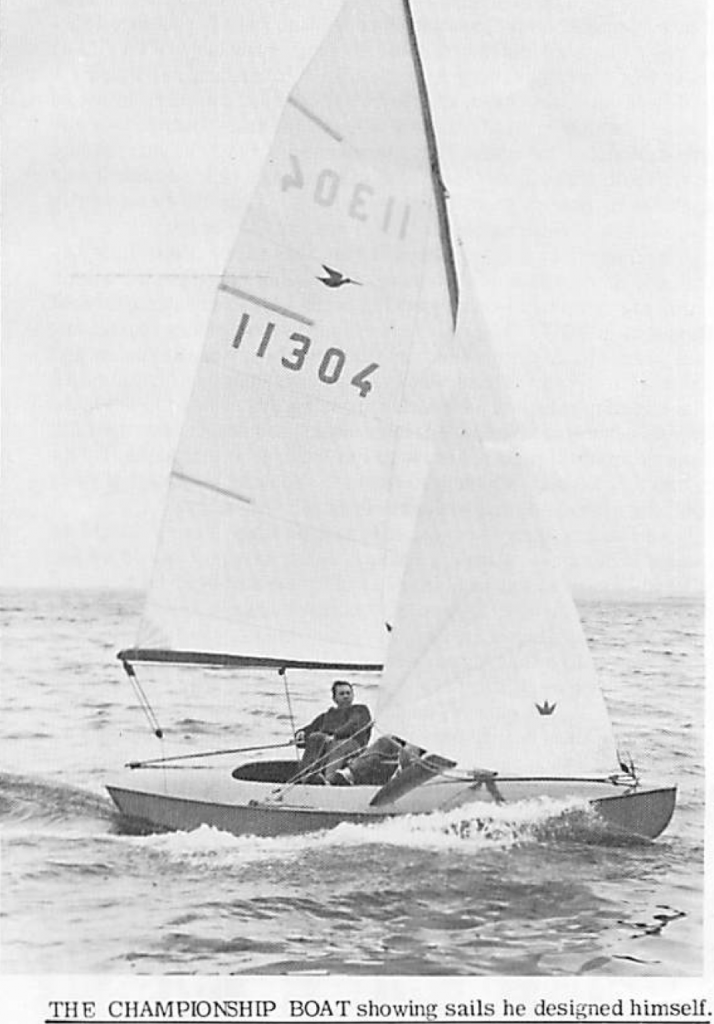
And here a great tragedy occurred for Brazil after the race was over. Champion Gabriel Gonzalez, walking up the beach on his way home, stepped on a piece of glass, cutting a tendon in his right foot. Rushed to the hospital, his foot was placed in a cast and he in bed, thus eliminating him from further competition. After lengthy deliberation, it was decided that he could be replaced by the runnerup in the National Championship series, so Waldemar Bier, using the same crew, Nelson Piccolo, took over the helm. A condition was that the first race sailed by Gonzalez could not be counted as one sailed by Bier and would, therefore, have to be the race dropped by Brazil. Bier would sail 5 races and they would count for Brazil. Consternation gave way with the realization that Bier was an able substitute.
Tuesday saw stormy weather with heavy winds and the race was cancelled for the day. 2 races were scheduled for Wednesday. The 1st one in the morning was a windward-leeward with light breezes of 3-5 mph from the south. The start saw Japan, U.S., and Cuba on the leeward end with Denmark in the middle of the fleet but to windward. At the windward mark, it was Spain, Argentina, France, Denmark, and U.S., the first 3 boats gaining by splitting tacks and going down the west side of the course. On the 2nd lap, the wind freshened to 5-7 mph and the ever-pressing Elvstrom moved up on Spain to give him a close fight the remainder of the course. Spain led at both marks at the end of the run and reach, but on the short beat home, Elvstrom demonstrated his mastery by taking everyone to nudge in ahead of Spain for 1st place. In this stretch, U.S. likewise moved up from 5th to 3rd place, followed by Bermuda and Cuba.
The 3rd race that afternoon was laid over a triangular course with a 4-9 mph wind. With Elvstrom leading, a good start was made by everyone with the exception of U.S. Trying for a perfect leeward start, Dick was ahead of the gun and had to go back. This resulted in his worst race of the series. With the fleet mainly sailing down the middle of the course, Brazil took a long starboard tack into the east shore away from the current, and what looked like a mistake, turned out to be the race, for he reached the windward mark so far ahead of the others that he sailed on to victory all by himself in relaxation. Bermuda, Denmark, Cuba, Sweden, and Japan fought for runner-up positions with Bermuda turning in a beautiful performance. Final results after Denmark got a DSQ on protest by Spain, were: Brazil-1; Bermuda-2; and Cuba-3.
At this point, Denmark led with 3200 points with Bermuda second with 2890. Cuba was not far behind while Belgium and U.S. were definitely in the running.
Thursday was a free day. Friday afternoon brought the usual southerly wind of 6-10 mph and the same triangular course. The start was perfect with Elvstrom leading the entire fleet over the starting line, followed by Bahamas, Spain, U.S., Bermuda, and Cuba. And that was all the lead Paul needed, for he protected it brilliantly during this crucial race. Tacking in to the east shore, he was followed closely by U.S. and Argentina and those 3 were first to the windward mark. They maintained positions on the run and reach, but Denmark and U.S. gradually pulled away from the bunched fleet. With wind dying on the 2nd windward leg, Denmark cleared the windward mark 90 seconds ahead of U.S., while Tillman in turn was 60 seconds ahead of the next boat.
Sailing straight for the leeward mark on the run, they had it made, but here Luck stepped in for the first time in the series with a complete calm 2/3rds of the way down the leg. Elvstrom, Tillman, and Argentina sat there, sails flapping, while the rest of the fleet, led by Bermuda, Brazil, and Cuba, took a circuitous course up the east shore, getting a land breeze from the east as the wind revived. It hit Denmark in time for him to get started ahead of his competitors, but U.S. sat helplessly and watched 7 boats go in between them. This was a discouraging blow to that team. Elvstrom exerted all his championship skill to keep ahead of fast-moving Bermuda who was pushing him all the way. He barely nosed them out at the finish and this was his supreme victory. Bermuda, Cuba, Portugal, and Japan finished in order.
The 5th race Friday afternoon saw the same old weather conditions with a 5-10 mph southerly wind over a triangular course again. This final race (as it turned out) saw the pattern change. The start on the leeward end of the line was beautiful with Bahamas, Japan, Denmark, and Bermuda leading the way. They all started for the famous east shore and held their course, but Bermuda, evidently making a supreme effort to get out of 2nd place, decided to gamble with a port tack. Leaving the fleet, Simmons sailed away by himself with the current into disaster, for when he tacked back again, he had lost 10 boats. Bahamas likewise tacked a little too soon and lost her position with the leaders.
The Japanese boat fairly flew to the windward mark in the light favorable winds, with Elvstrom, Portugal, and U.S. in futile pursuit. They opened up their lead on every leg of the course, sailing the 2nd lap down the east shore exactly as they did the 1st time. It paid off, and Denmark watched their transom go! U.S. worked up steadily and on the last reach took Cuba and Portugal at the mark for 3rd spot. On the short beat home, Elvstrom made his last supreme effort and reduced Japan’s lead of 75 seconds to 40. Likewise, Brazil slipped in ahead of Cuba and Portugal for 4th place.
The 6th race on Sunday afternoon was delayed for an hour and then finally started in zephyr breezes from the north on a windward-leeward course. The wind died rapidly and the race was finally called at the first leeward mark when only 20 minutes of the time limit was left. It was a great disappointment to the hundreds of Sunday afternoon spectators as well as the skippers and crews. At 6:30 P. M., a south-east wind picked up but it was deemed too late to start a race under uncertain conditions and the Race Committee reluctantly called it a day.
Thus only 5 races, all in light to medium winds, were sailed and so all 5 had to be counted. This dashed the hopes and plans of skippers who had counted on dropping a bad one, but that uncertain factor “Old Joe” Wind — who seems to delight in ruining man-made schedules at big regattas, called the turn.
Thus Denmark came out on top and became the undisputed 1959 Snipe Class Champion. Bermuda had worried Elvstrom the most throughout the affair more than the others, but her mistakes were costly. Cuba sailed a fine, consistent 5-5-3-3-5 to a deserved 2nd place; U.S. with better luck and a break or two, could have been much higher; while the big and pleasant surprise was Japan who got 3rd with her strong 5 and 1 finishes in the last two races. Belgium in 5th place was only 30 points behind U.S. and Spain in turn only 35 behind Belgium. Thus standings between these 3 teams was virtually a toss-up.
But the purpose of the regatta was served and it was clearly established that the best team had won just laurels. SCIRA can be immensely proud of its new World Champion! A native of Copenhagen, 32-years old, he has been a professional sailmaker for 7 years. He is a sailor of great distinction with reputation as one of the best small-boat sailors in the world. Since 1947, he has won 10 international regattas and 5 World Championships, this one being the 5th. 3 of these were Olympic Championship titles won in the Finn Class. He sails a boat in competition every day of the year except when the ice is too thick for the hull to crush a path through it. He and Eric are very proud of their new honor and we are proud of them!
It was, when all is said and done, a most successful regatta. It established a new high in standards in all phases and will never be forgotten by all lucky enough to have participated in it. OUR SALUTE TO BRAZIL!
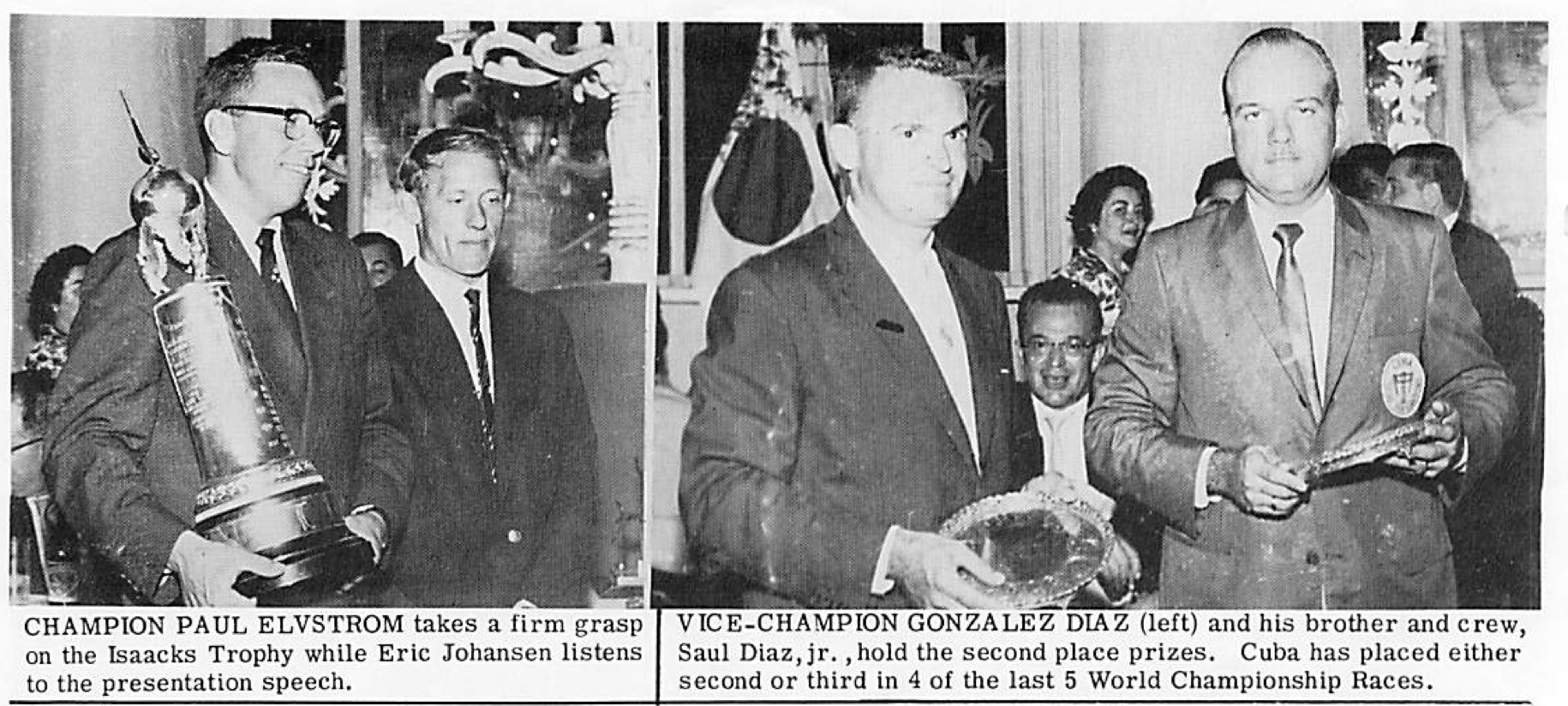
While sailors were permitted to reposition hardware and make minor personal adjustments to their assigned craft, Paul Elvstrom’s sole modification was removing the main sheet cleat altogether, as he preferred to hold the sheet directly in his hand while racing.
Levinson on the 1959 Boats (Snipe Bulletin, December 1959):
In his commentary on the boats built for the 1959 Snipe World Championship, Snipe Commodore Alan Levinson highlighted the extraordinary level of standardization achieved for the regatta. Twenty Snipes were constructed in a batch process where all individual parts were cut out simultaneously rather than built one boat at a time, resulting in nearly identical hulls with dimensional variances of only fractions of an inch and a total weight spread of just five pounds between the heaviest and lightest craft. Each vessel was finished in a distinct color, highly polished, and equipped with self-bailing cockpits alongside top-tier marine hardware.
While sailors were permitted to reposition hardware and make minor personal adjustments to their assigned craft, Paul Elvstrom’s sole modification was removing the main sheet cleat altogether, as he preferred to hold the sheet directly in his hand while racing. Levinson noted that the only true variable among the fleet lay in the masts; although generally stiff and well-made, some of the weaker spars snapped in the heavy winds of the tune-up races, though their impact on the actual championship series remained minimal due to the lighter breezes that prevailed during the main competition.
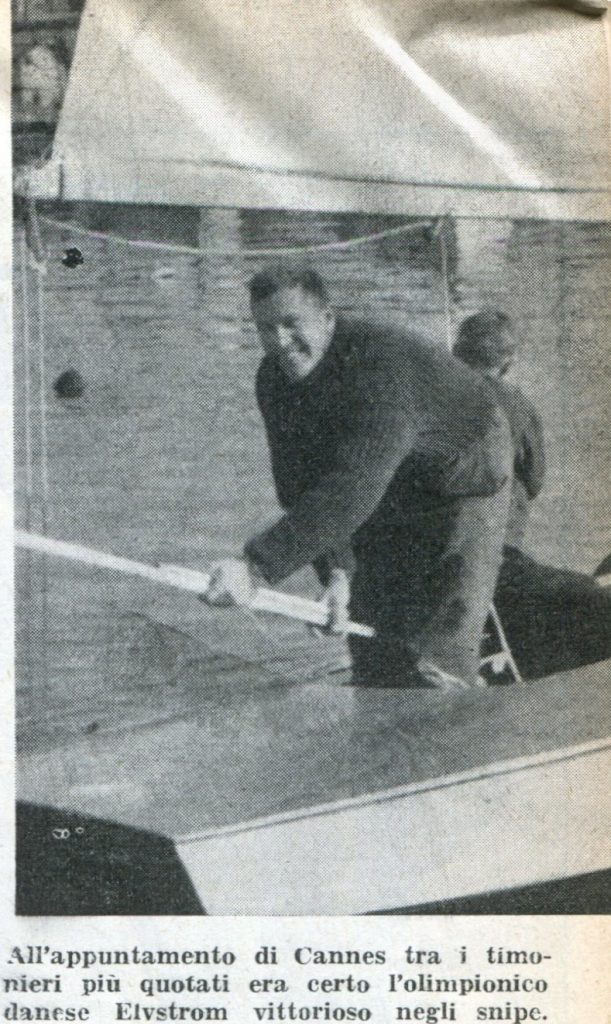
Above: Paul Elvstrom in Cannes, France, for the 1959 Sky-yachting – The Danish champion, as a true first professional of sailing, left nothing to chance: with his sights set on the Snipe World Championship in October in Brazil, he was already out on the water in January on the French Riviera.
The Snipe is the most numerous boat class in the world, providing excellent racing everywhere. Therefore, I had always wished to win this World Championship, which is held every two years. (Paul Elvstrom)
Here is Elvström’s personal account, taken from the book “Elvström speaks on Yacht Racing”:
The Snipe is the most numerous boat class in the world, providing excellent racing everywhere. Therefore, I had always wished to win this World Championship, which is held every two years.
I had competed in these races in 1955 at Santander in Spain, but I had trouble with the boat they had lent me and failed to win. The championship was won by the Italian Mario Capio.
I really wanted to win in this class, so I told my friend Strit Johansen that I would like to go to the 1959 World Championship in Porto Alegre, Brazil, but first I had to be selected. So I took part in the Danish selection trials with a young guy as crew, Ib Anderson, and we won against 30 boats.
The Danish Sports Federation sent us to Brazil, but one of the committee members argued that it wasn’t worth sending a crew so far away, so I was quite nervous because I felt I had to win.
At that time I was not feeling well, and every year it was getting worse. I felt I had to win because everyone expected me to, and I was terrified of losing even a single small race. I was so nervous that during these races I felt unwell, and in one of them, while gybing on port tack, I tried to luff the Duke of Arion who was on starboard tack. Naturally, he protested and I was disqualified.
At the protest hearing, I could say nothing except that I was very sorry. I had never done such a thing before, but I was so nervous that I thought I was on starboard tack when I was actually on port tack.
Later, in the book, I spoke about the boats we used, and how my mast broke during the practice races. Afterwards, they gave us another mast that was more flexible, and the boat went very well. During the World Championship races the wind was moderate, but one race could not be finished, and the last one was cancelled: so only four races remained and all points had to count. We had two wins, a second place, and one disqualification, but we still managed to win [Editor’s Note: actually 3 wins], so you can see that we were performing better than the others.
It was during these races that I made the decision to stop racing because of my nerves. I said I would still go to the Naples Olympics and then: finished!
Read also:
XVI – Monaco, September 5-12, 1953
- Conde Martins, Portugal
- Tom Frost, USA
- Clemente Inclan, Cuba
Sailed on Mediterranean Sea, 15 nations
XVII – Santander, Spain, August 27-September 1, 1955
- Mario Capio, Italy
- Jorge Mantilla, Cuba
- Helder Soares Oliveira, Portugal
Sailed on Santander Bay, 16 nations
XVIII – Cascais, Portugal, September 2-9, 1957
- Juan Manuel Alonso Allende, Spain
- Raymond Fragniere, Switzerland
- Fred Schenck, USA
Sailed on the Atlantic Ocean, 21 nations
XIX – Porto Alegre, Brazil, October 16-25, 1959
- Paul Elvstrom, Denmark
- Gonzalo Diaz, Sr., Cuba
- Masyuki Ishii, Japan
Sailed on the Guaiba River, 16 nations
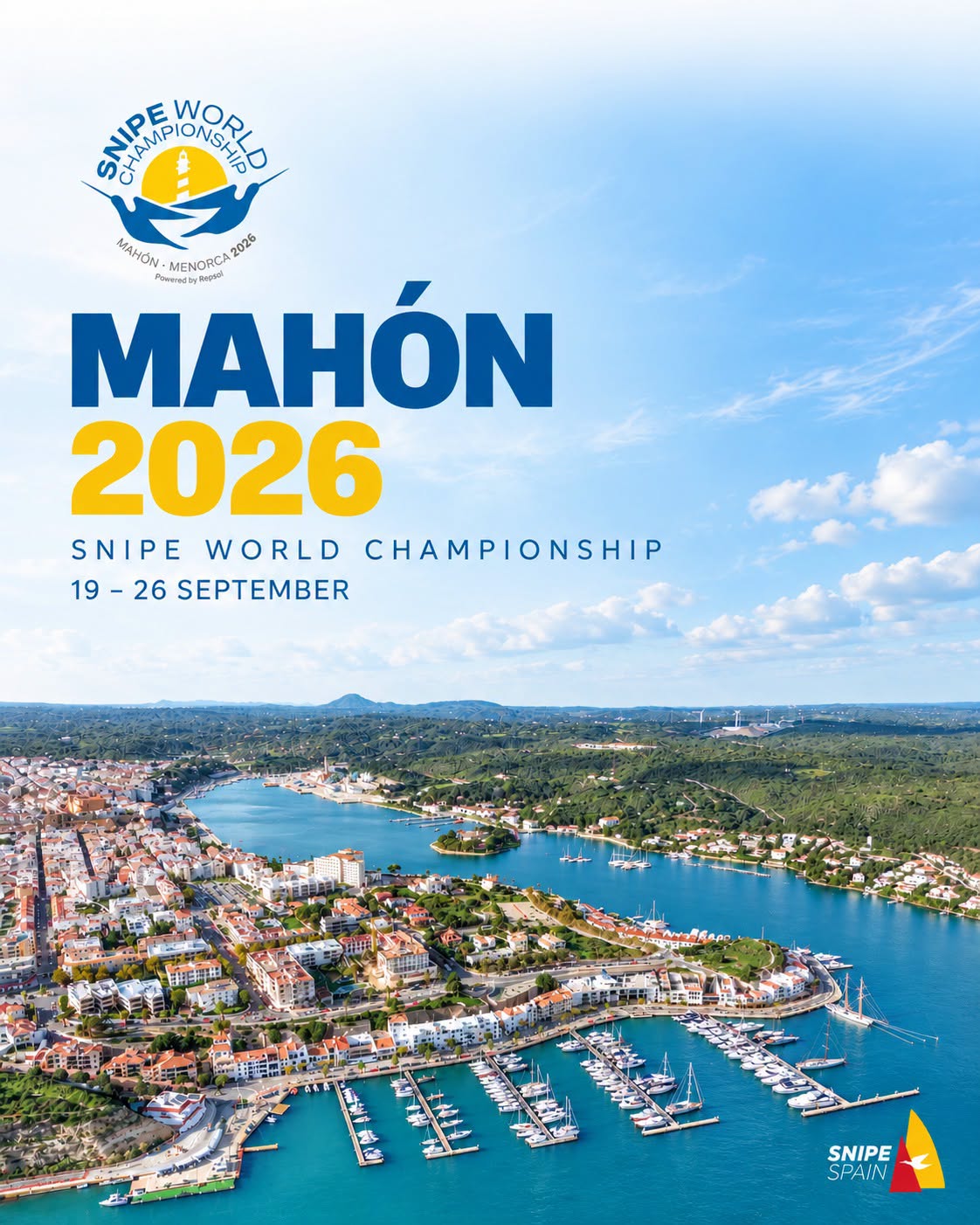
About the 2026 Snipe Worlds:
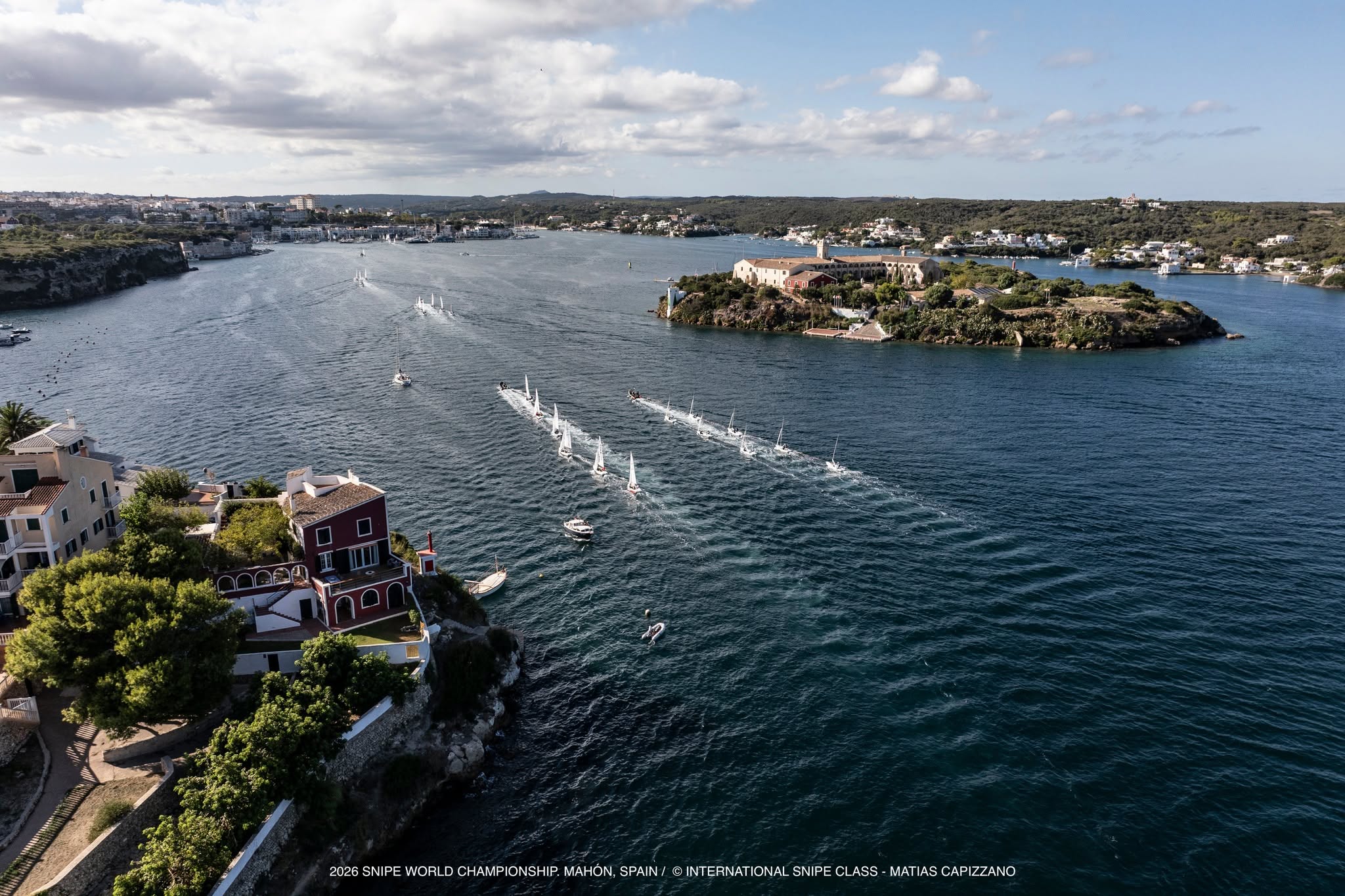
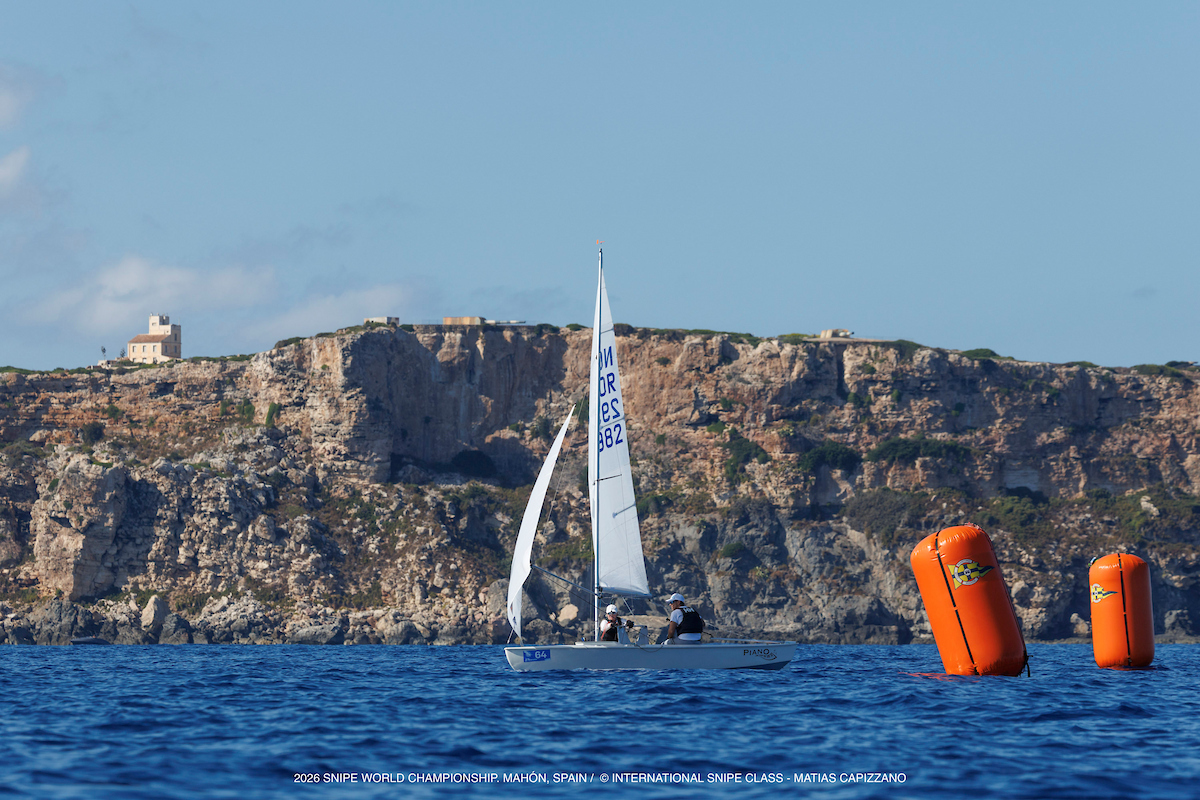
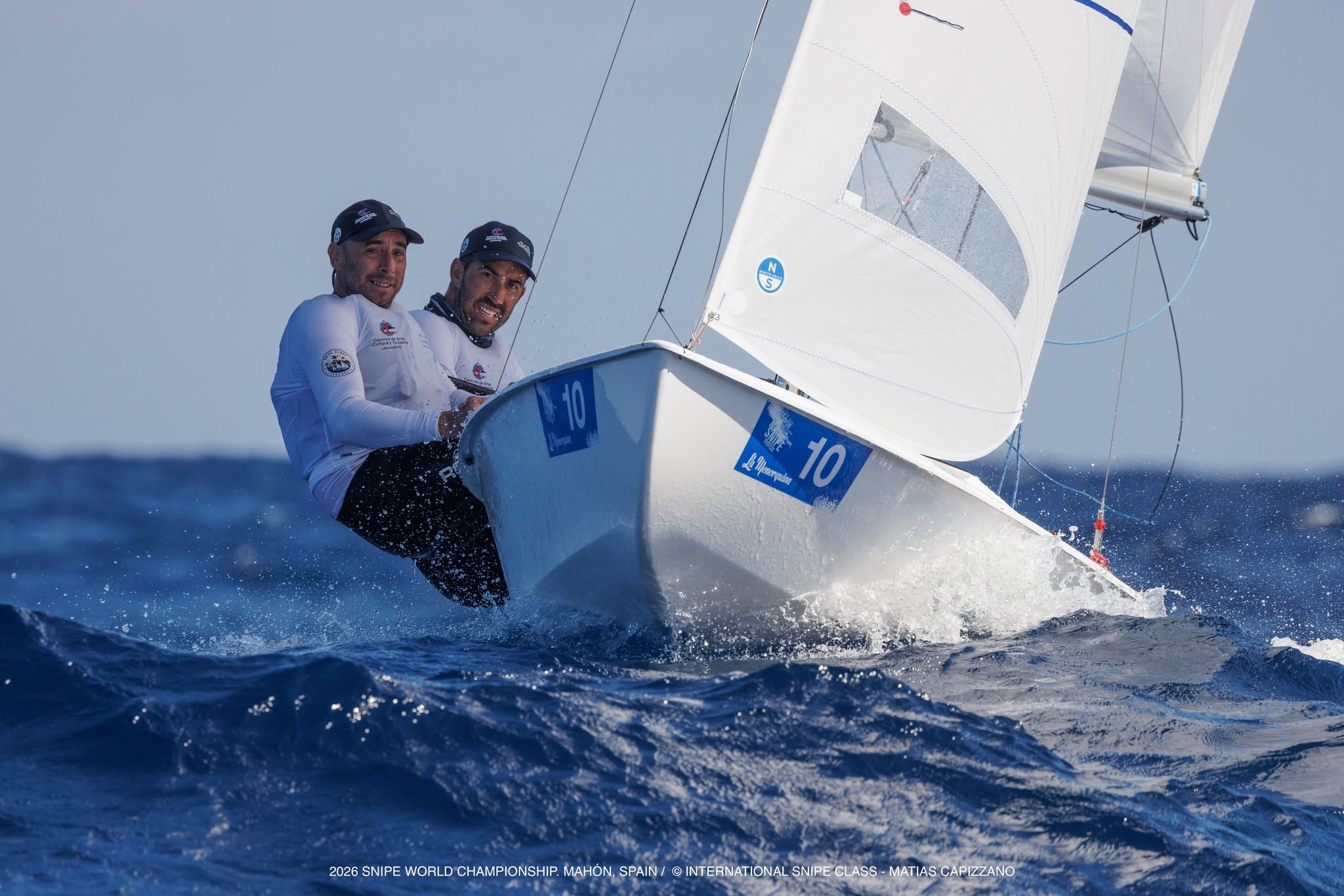
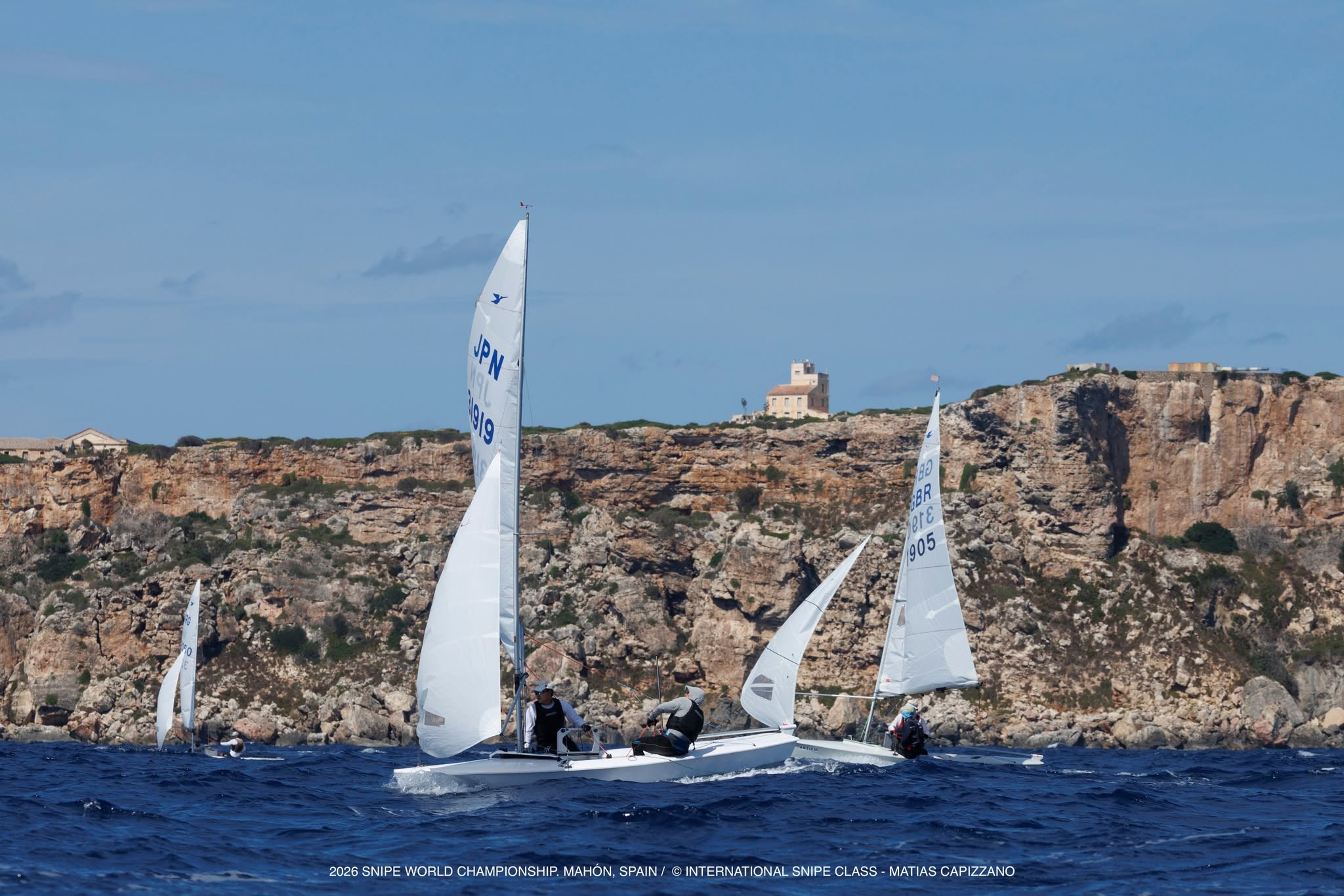
Mahon, Menorca, Spain, September 19-26, 2026
Leave a reply
Your email address will not be published. Your comment will be revised by the site if needed.
0 comments