
Snipe Worlds – Plotting the Course – Episode 8
From the Origins to Mahon
The continuation of our journey through the history of the Snipe World Championships brings us to the turn of the millennium. During this era, South American sailors continued their overwhelming dominance on the international stage, interrupted only by a historic intermezzo victory by the Caribbean nation of Cuba.
1993 Snipe Worlds – XXXVI – Porto Alegre, Brazil, November 1993
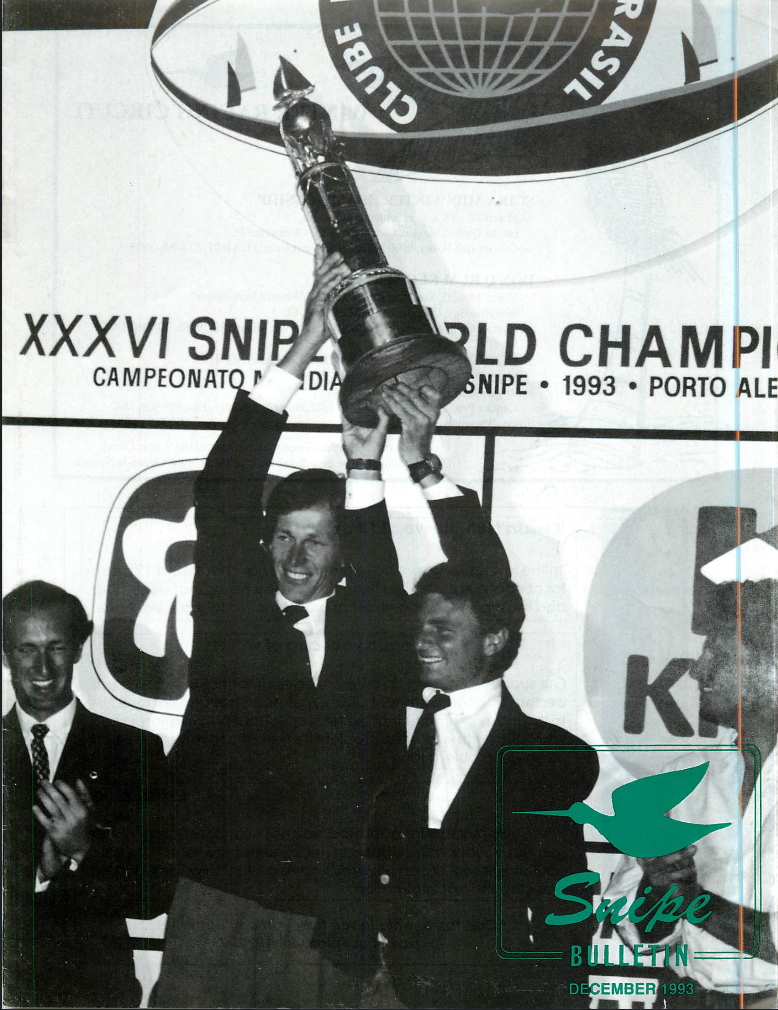
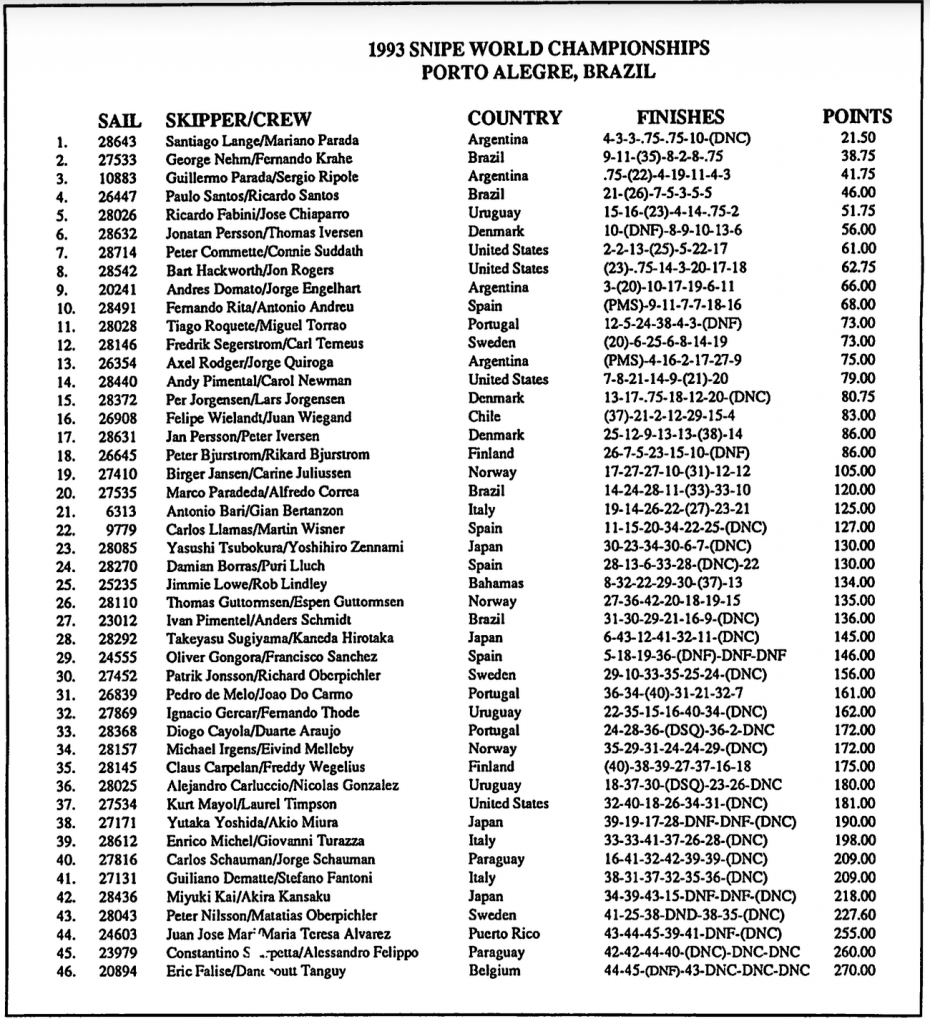
In conditions covering the entire spectrum of wind speed possibilities, Santiago Lange and crew Mariano Parada of Argentina utilized superior boat speed, excellent shift hitting, and a fair amount of gear shifting to win the 36th Snipe World Championships by 17 1/4 points. It was not neccessary for them to sail the last race.
SOUTH AMERICANS DOMINATE WORLD CHAMPIONSHIPS – Snipe Bulletin December 1993
In conditions covering the entire spectrum of wind speed possibilities, Santiago Lange and crew Mariano Parada of Argentina utilized superior boat speed, excellent shift hitting, and a fair amount of gear shifting to win the 36th Snipe World Championships by 17 1/4 points. It was not neccessary for them to sail the last race.
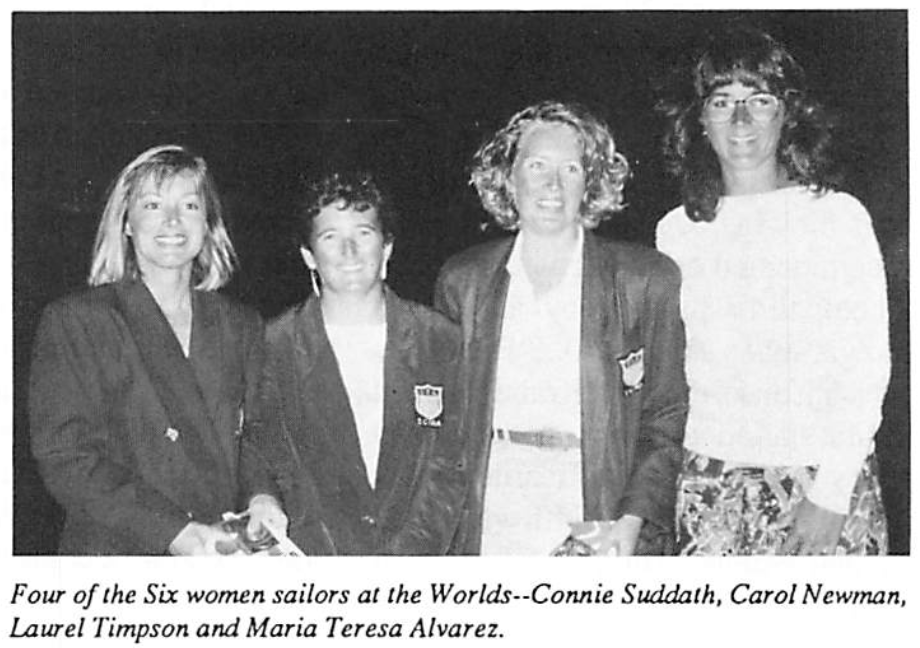
George Nehm and Fernando Krahe, with the support of the entire Brasil cheering team, finished 2nd and Guillermo Parada and Sergio Ripoll of Argentina were 3rd. The rest of the top ten were rounded out by Snipers from Uruguay, Denmark, the United States, and Spain. Jonatan Perrson and Thomas Iverson of Denmark, finishing sixth overall, were top Europeans. Peter Commette and Connie Suddath, seventh overall, finished 1 3/4 points ahead of Bart Hackworth and Jon Rogers, for top U.S. boats. The other U.S. teams of Andy Pimental and Carol Newman finished 14th and Kurt Mayol and Laurel Timpson finished 37th.
The XXXVI Snipe World Championships returned to the site of the 1959 Worlds, which were won by Paul Elvstrom and 2nd place was earned by Gonzalo Diaz of Cuba. The Clube dos Jangadeiros has grown since those days, neccessitating the building of an island off the original club site. Competitors walked out the narrow bridge onto one of the most perfect sites for a major regatta. Measurement dilemmas were solved under a covered patio, complete with lockers, a “sanduiche” and cervecha bar, and sponsors’ booths. Nearby was the administration headquarters where translators of every known language were available. Near the end of the island was the ever popular Brasilian swimming pool and restaurant. Off to the right was the home of the race committee and spectator boats. The Snipes were launched off a ramp in the lee of the island with the help of yacht club staff.
RACING
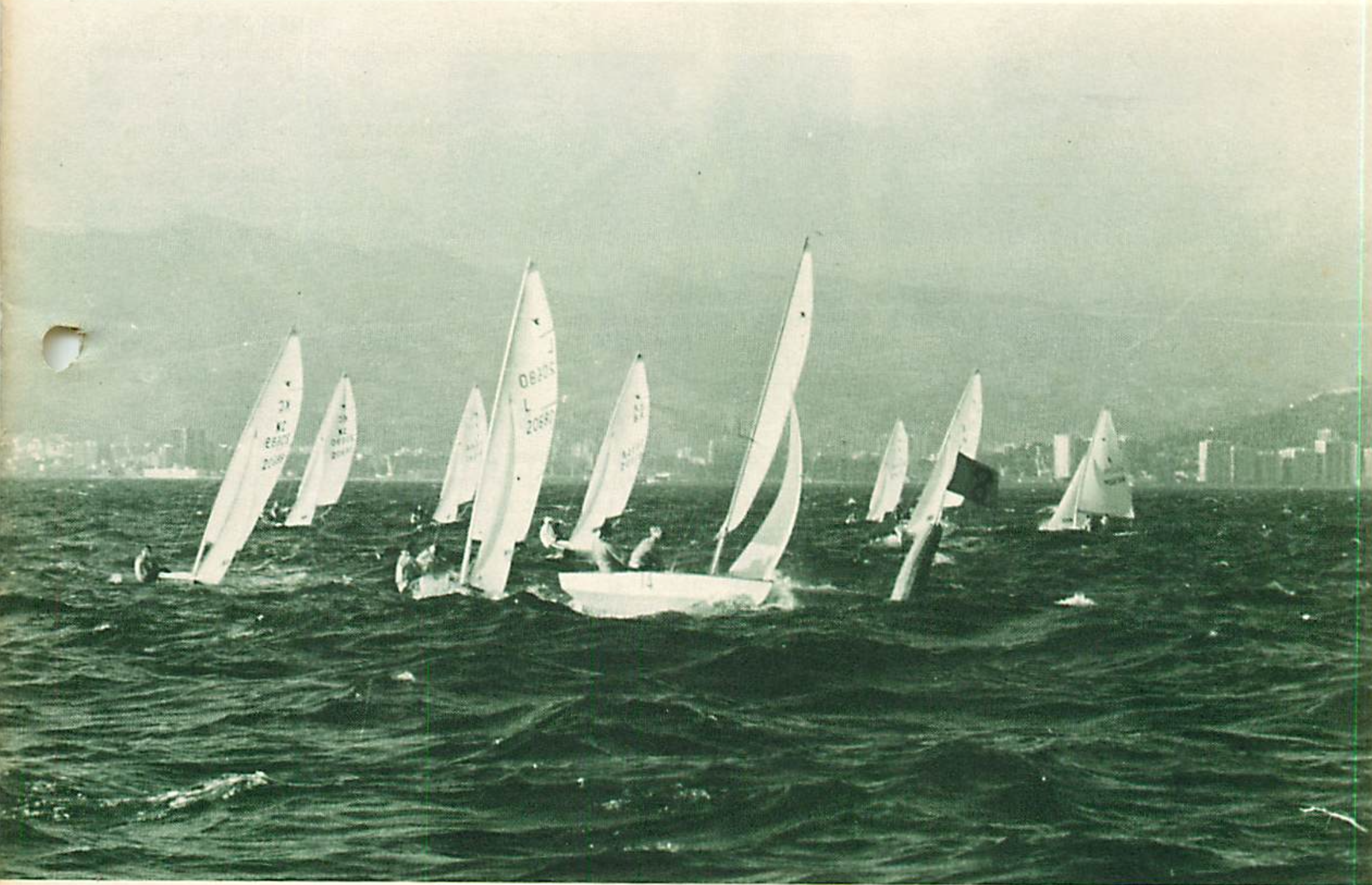
In the practice race, a radical increase in air temperature during the race saw experienced Brasilians heading for the safety of the Clube knowing what was to come. Observant foreigners, and then the entire fleet followed their lead, lashing boats down once at the Clube. Shortly thereafter, the breeze increased to 60 knots. They were not disappointed as the next day unveiled boats blown down the launch ramp.
The first day of scheduled racing turned into a survivial exercise, both mentally and physically. After enduring the wait until the 3 P.M. start, the fleet was sent out and then back to the Clube twice in breeze at the top end of the scale, the day was abandoned. Total damage was 3 masts, 3 rudders, 1 bent daggerboard, and a whole fleet of sails worse for wear and tear. As the fleet scrambled to put the boats back together, little did they know what was in store.
The next day broke clear, sunny, and breathless. The fleet couldn’t buy a puff, even for hundreds of thousands of Cruzeiros. The sunbathing was curtailed as the Race Committee got the first race off at approximately 6:30 P.M. in 5-8 knots. In a race marked by BIG shifts Guillermo Parada and Sergio Ripoll lead wire-to-wire to win the opener. They were followed by Peter Commette and Connie Suddath and third place was taken by Andres Domato and Jorge Englehart of Argentina. 1991 World Champions Axel Rodgers and Jorge Quiroga started off their repeat bid with a disappointing PMS while looking rock solid half way up the first beat.
Day 2 provided a more “normal” day of sailing, normal in that the fleet was able to get in two races. Bart Hackworth and crew Jon Rogers started off the day with a bullet with Peter and Connie scoring another 2nd. Lange and Parada finished third ahead of teammates Rodgers and Quiroga. Parada and Ripoll, 1st day winners, cashed in their throw-out with a22nd. The second race of the day turned some of the fleet inside out with some new names at the top of the fleet. Per and Lars Jorgensen of Denmark won this race ahead of Felipe Wielandt and Juan Wiegand of Chile finishing second. Lange and Parada, starting to show some consistency, finished third. In fourth place, shaking off the afternoon’s first race, were Parada and Ripoll.
As worn out sailors pushed their boats up the launching ramp, they were amazed and some even shocked to see the Clube dos Jangadeiros packed with local party people. As part of the requirements for regatta sponsorship, acute sponsors demanded that the social events be opened up to the local community, thus enhancing marketing and providing sailors the chance to experience Brasilian parties at their best. For hearty sailors able to hang late (especially Norwegian crews who managed a samba lesson on stage) the evenings entertainment provided an affirmation of Brasilian music’s danceabilty.
Once again the Brasilian Team showed uncanny ability to read local conditions as they pulled umbrellas out from the cockpits of their Snipes to help keep cool while waiting for race 4 to start. After a hot afternoon of sunbathing, the race commitee towed the boats back to the Clube for some much needed relief. As the wind showed signs of picking up the harbor gun went off at 4 P.M. and race 4 was started around 5:30 P.M. in 5 to 7 knots. Lange and Parada jumped to an early lead which was magnified by their ability to be in the right spot for the assorted shifts that seemed to be landing spordically around the course. Sailing conservatively up the middle, protecting their 1 minute, 45 seconds lead, they began to scramble as a left hand puff filled in “big time.” As the boats who rounded a little later could see the obvious, they took advantage of the left and planed into the finish line, Lange and Parada managed to hang on for their first bullet of the regatta. Second went to Rodgers/Quiroga with Hackworth/Rogers in third and Ricardo Fabini, the 1989 World Champion and crew Jose Chiaparro finishing fourth.
Race 5 provided a true test of gear shifting for the participants. Under rainy skies, the fleet was off in what the race committees array of three anemometers said was 22 knots. Then, in the shifty, dying breeze, Lange almost secured his Championship with another win. “Part of the problem sailing here is, even when it’s blowing 25, is it is just as shifty as when it is blowing 5. It just doesn’t settle down,” commented one frustrated sailor. A fellow competitor passing by added, “It settles down. When it blows 40…” Brasilians George Nehm and Fernando Krahe finished second and started to look strong due to consistency with Paulo and Ricardo Santos of Spain [Editor’s note: actually Brazil] finishing third. In fourth was Tiago Roquete and Miguel Torrao of Portugual with Peter Commette and Connie Suddath rounding out the top five. It is interesting to note that 4 of the top 5 final boats finished in the top 5 in this race.
Santiago Lange and Mariano Parada’s conservative tenth place finish sealed their World Championship bid. As the spectator fleet blasted horns and waved flags, the two Argentinans stood and hugged each other as their Persson/Lange tracked perfectly to weather. Shortly thereafter, Parada gave Lange a shove sending his skipper into the drink and starting a long night of celebrating for the Argentinian Team.
Race 6 got started in 10-12 knots at 6:40 P.M. A heavy chop on the water, an overcast sky, and some rain contributed to the wind increase throughout the race. After a tight first mark rounding with almost the entire fleet overlapped and some great off-wind dueling, Fabini finished first with Diogo Cayola and Duarte Araujo of Portugual finishing second. Santiago Lange and Mariano Parada’s conservative tenth place finish sealed their World Championship bid. As the spectator fleet blasted horns and waved flags, the two Argentinans stood and hugged each other as their Persson/Lange tracked perfectly to weather. Shortly thereafter, Parada gave Lange a shove sending his skipper into the drink and starting a long night of celebrating for the Argentinian Team.
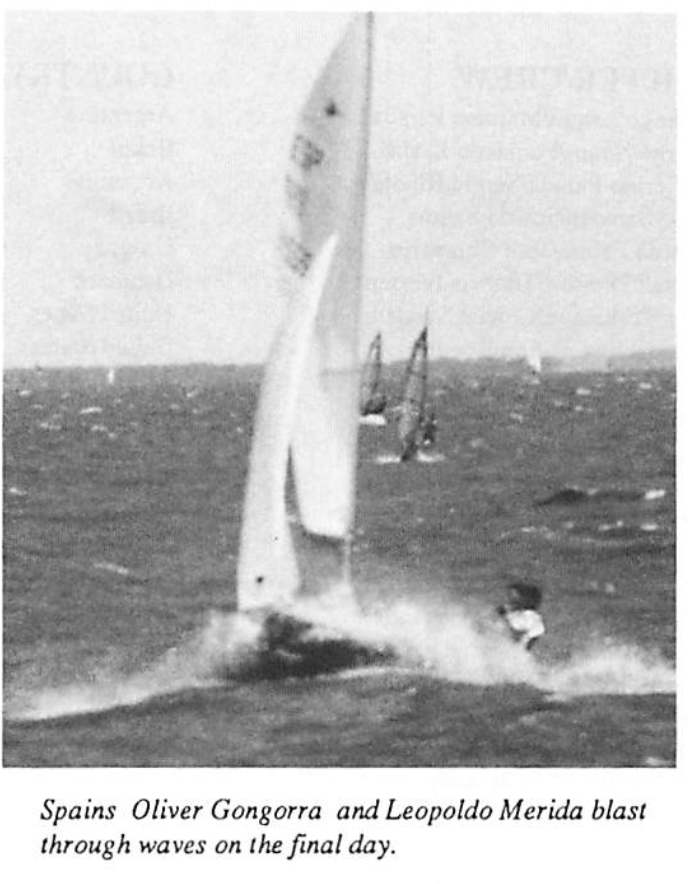
Although race 7 could be considered anti-climatic by some, it was not for lack of wind. As sailors with leased boats carefully lashed down their craft, mentally collecting security deposits, those still in the hunt geared up for another breezy race. With wind conditions strong enough to bring out one protest concerning SCIRA Rule 9.2 for Conducting International Championship Regattas, George Nehm and Fernando Krahe won the last race for the local fleet, securing their second place overall. Fabini was second, Parada third, and Wielandt of Chile fourth with Paulo and Ricardo Santos fifth.
EQUIPMENT
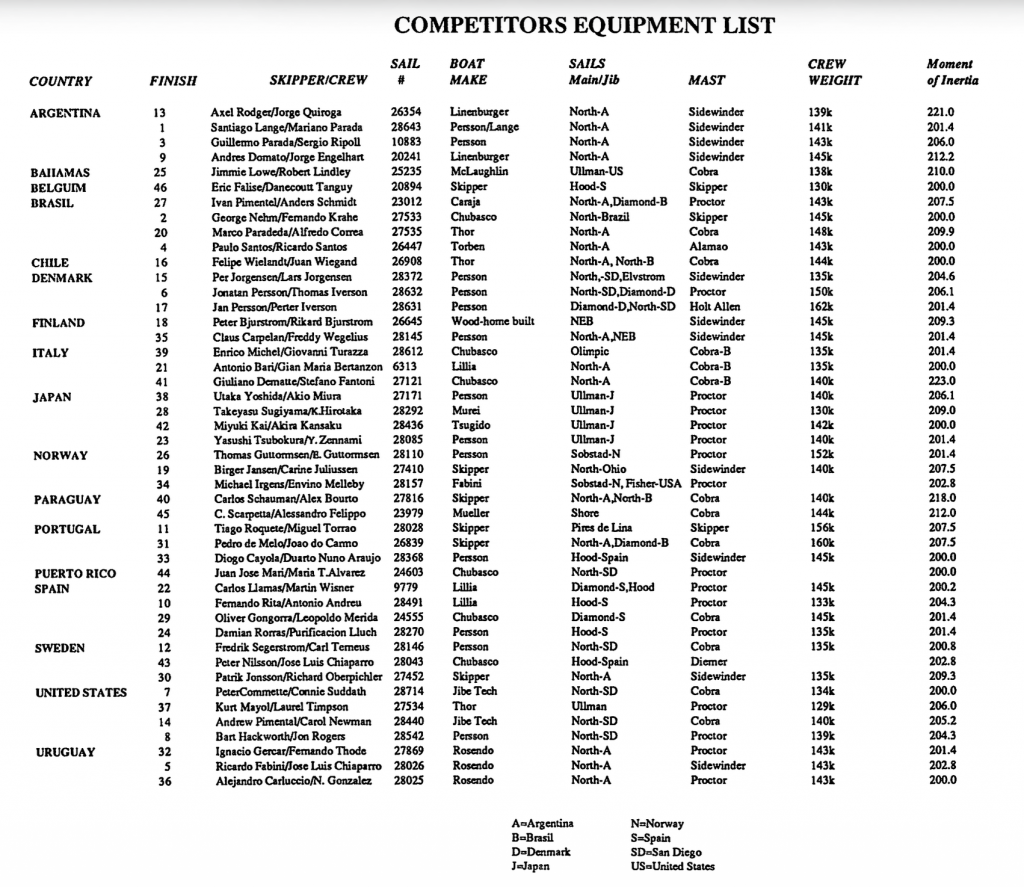
On the equipment front, evolution rather than revolution seemed to be the order of the day. From a rigging point of view the entire fleet used pole launchers and the general trend seems to be geared towards more crew involvement in sail shape adjustments. Jib lead adjustments, from Peter Commette’s floating block system to assorted other versions are making an appearance. With the new hulls and deck layouts, there was lots of talk concerning the new boats. Lange used a new Persson/Lange built in South America. The new Lillias looked very nice and appear to be quick enough as Fernando Rita proved with his tenth place. One of the more interesting quotes concerning the new boats came from Finland’s Peter Bjorstrom, “You might not need a new boat, but be intelligent with what you do with your old boat.” Mast selection consisted of the usual choices, with exception of Jan Perrson’s Holt-Allen which exhibited some beautiful finish work.
While there wasn’t much new in the daggerboard/rudder department, there were some differences in sails. The majority of main sails seemed fairly stock with the exception of the Spanish Hoods. These sails had everyone doing double takes as they were narrow at the mid-girth, allowing the top batten to be stuck out like a sailboard or catamaran sail. This was fun for the old Snipers who were present for the last Porto Alegre Worlds as Paul Elvstrom had used a similar sail in winning his World Championship. As the regatta wind increased thoughout the regatta the fleet saw less and less of these Hood Mains, implying they might be better in the light stuff. A bigger difference was noted in the jibs used. With the exception of the U.S sailors, the rest of the world is leaning towards heavier cloth in their jibs. The North Argentinian Jibs used by 4 of the top 5 boats were built of a combination of 100 and 130 grams per meter squared polyant with sewn leeches, and according to the Argentinian contingent, are just as quick as the “sleazy” jibs in light air and last significantly longer. Some of the Europeans used 3.7 oz. polyant which they claimed were up to two years old. Some of the sailors thought the stiffer jibs were actually quicker in light air as they held their shape and “didn’t bounce around a bunch”.
The 1991 World Championship marked the beginning of a new era characterized by Snipes designed and built by Denmark’s Jan Persson, which were innovative in their deck design and bow volume.
Read also:
1995 Snipe Worlds – XXXVII – Rimini, Italy, July 1-9, 1995
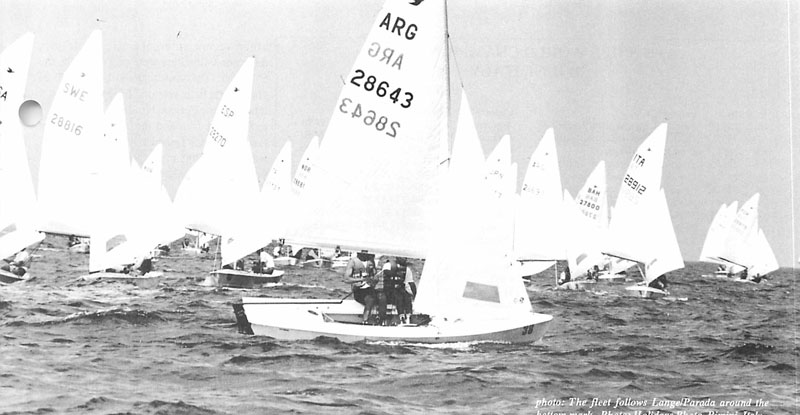
First Snipe Worlds held in Italy and third victory for the Argentine superstar Santiago Lange.
37th WORLD CHAMPIONSHIP – Snipe Bulletin August 1995
LANGE/PARADA TWOPEAT WORLD CHAMPIONSHIPS
In conditions covering the entire spectrum of wind speed possibilities, Santiago Lange and crew Mariano Parada of Argentina utilized superior boat speed, excellent shift hitting and a fair amount of gear shifting to win the 36th Snipe World Championships by 17 1/4 points. It was not necessary for them to sail the last race.
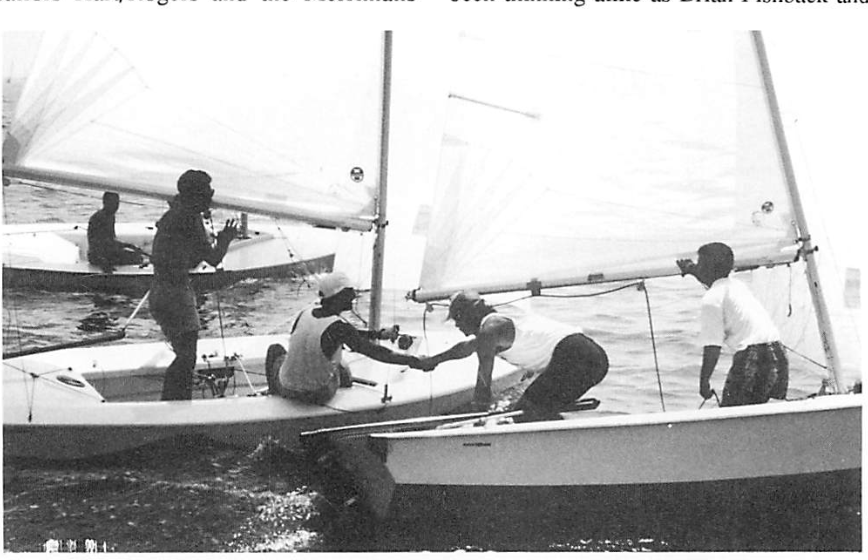
In conditions under 12 knots, Santiago Lange and crew Mariano Parada of Argentina utilized superior shift hitting and excellent boat speed to win the 37th Snipe World Championships by 10 1/4 points. Although they competed, it was not necessary for them to sail the last race. This was Santiago’s 3rd World Championship, his other victory in 1985 with Miguel Saubidet in the front of the boat.
Guillermo Parada and Gonzalo Martinez provided the Argentine Team with 1-2 punch by finishing second with 24.5 points. United States sailors Doug Hart and Jon Rogers finished 3rd with 30 points. The rest of the top ten was rounded out by sailors from Sweden, Spain, Portugal, Japan, and Norway. Johnny MacCall and Palmo Merayo finished 7th giving Argentina 3 of the top 10 places. Rick and Carol Merriman of the US finished 10th to give the US 2 of the top 10 places.
“Rimini is where they invented fun!” – Italian Star crew during the 1994 Star World Championships
The 1995 Championships were held in Rimini, Italy on the Adriatic. Rimini is one of Europe’s biggest summer resorts with all the associated trappings. Club Nautico Rimini is located on a narrow channel, providing a short sail to the race track and some lively boathandling (and mandatory Italian discussion…) on the crowded weekends. The club hosts an excellent restaurant and the bar staff was kept busy. The beach, with an huge array of colored umbrellas, lounges, and changing rooms, is five minutes away. Traveling sailors knew they were getting closer to the club by the increasing number of posters displayed advertising the event. A small artists’ bazaar set up across from the club every evening and where the daily trophies were handed out publicly.
Opening ceremonies consisted of a bus ride and a short parade through the old section of Rimini. The mayor of Rimini welcomed the competitors under the Arco d’Augusto, built in 27 BC, making it the oldest Roman arch in existence. SCIRA Commodore Jimmy Lowe welcomed everyone in Italian (with a Bahamian accent!) and then everyone enjoyed a buffet dinner at the old fish market.
The first day provided one race to allow competitors a chance to make last minute changes before the bulk of the racing began. In a dying 8 knots, Parada/Martinez finished first with Lange/Parada second. The Spanish team of Saura/Manent took third and the US sailors Hart/Rogers and the Merrimans rounded out the top five. Lange/Parada were disappointed to discover shoreside that they were scored PMS. They were reinstated when witnesses said they had properly rerounded the starting line end.
The second day proved more frustrating for everyone involved. After a long postponement due to light shifty winds, race 2 was started in 6 knots with the left end of the line looking favored. The lone French team of Frebault/Boisaubert led at the first mark followed by Lima/Pedrosa of Portugal, and two Japanese teams, Iwase/Kamiya and Shiga/Marayama. By the jibe mark, the Portuguese had pulled into the lead with Shiga on their transom. With the wind backing, the second reach turned into almost a beat and the committee abandoned the race. The second race was started again in 6 to 8 knots with the pin end again looking favored. Shiga/Marayama led at the first mark with former-World Champion Ricardo Fabini and his brother Roberto in 2nd. The Cuban team of Manzo/Lorenzo rounded 3rd, Danish in 4th, and the Brazilians Paradeda/Fernandez in 5th. The US team must have been thinking alike as Brian Fishback and Lorie Stout rounded 7th with Hart, the Merrimans, and Argyle Campbell and Rod Graham rounding 11th through 13th. Shiga showed everyone a light air gear as he stretched out, leading the fleet by 1 minute and 45 seconds at the second weather mark. Unfortunately, the wind began dying and shifting 180 degrees, turning the last run into a beat and the last beat into a run. With no wind on the horizon and dusk looming the committee was forced to throw the flag.
Day 3 began more promising with the fleet scurrying around, hoping to stretch hiking muscles in what looked like a perfect 15 knots. Unfortunately by the 1:00 PM start the breeze had died to 8 to 10 knots, with a heavy lump left over from the morning breeze. Parada/Martinez rounded first, followed by the Japanese Shiga/Marayama, Lange/Parada, the Merrimans, and then Lima/Pedrosa. By the second weather mark the eventual regatta winners were leading Parada/Martinez. Johnny MacCall and Palmo vaulted from 12th to 3rd. The final results in similar breeze were Lange/Parada, Parada/Martinez, MacCall/Merayo, and the Merrimans. Segerstrom/Terneus from Sweden cracked the top five followed by Hart/Rogers in 6th.
The breeze for the second race of the day started in lighter air than the first although with a smoother sea. The Spanish team of Borras/Magro won this one followed by Johnny and Palmo with Doug Hart and Jon Rogers finishing 3rd. Unfortunately, the PMS raised its flag this race, catching 6 teams. US teams the Merrimans and Campbell/Graham, Japanese Kai/Ikeda, Brazilians Paradeda/Fernandez, Santa Cruz/Florencio, and Denmark’s Iversen/Hansen were all caught on the wrong side of the starting line. Santiago sailed his throw out in this race with an 11th only to discover once again shoreside he had been called over early. He was subsequently reinstated when the Race Committee realized a bow number mix-up. After three races Parada/Martinez with a 1, 2, 5 combo were leading Hart/Rogers with a 4, 6, 3.
On day 4, Santiago and Mariano began their push for the World Championships with a pair of bullets. Conditions again were light and shoreside info had Mariano losing 20 pounds in preparation for this regatta. Rick and Carol Merriman also had a stellar day with a 2nd and a 5th. It is interesting to note that 3 of the eventual top 5 finishers sailed their throw outs this day.
Santiago and Mariano finished 6th and when asked why they sailed the last race the response was “to show we could have won with the PMS…”
The final day of sailing started off in 5 to 8 knots and smooth water. After a general recall, the fleet got off into a right hand drag race. The top mark had Spain’s Carlos Llamas and Javier Gutierrez rounding in the lead followed by the Merrimans. Parada rounded 3rd with the Danish brothers Per and Lars Jorgensen in fourth. Lange and Parada, with the Championship on the line, rounded sixth. On the second weather leg Guillermo snuck out and caught a rare lefty to round ahead of Llamas and the Merrimans. Santiago had sailed his way into fourth. The finish order on the water was Parada/Martinez, Llamas/Gutierrez, Santa Cruz/Florencio from Brazil, Lange, Segerstrom/Terneus, and the Merrimans. Unfortunately, this race was to prove pivotal as 12 out of the 48 teams were called PMS. Prominent among those were Rick and Carol. With one PMS already to their credit they had no recourse but to take their case to the room and face the consequences of SCIRA’s DND rule. On a more positive note, Doug Hart and Jon Rogers found themselves in leeward mark log jam and when the feathers had cleared, someone had popped their rudder off. In an amazing display of seamanship, Doug was able to get the rudder back in and sail to a finish of 13th. They were later awarded YMP points.
The last race was started in 6 knots and the Japanese team of Shiga/Marayama sprung out and never looked back. The French team rounded the top mark in 2nd followed by Norway’s Kristoffer Spone and Janett Krefting and Portugal’s Tiago Roquette and Francisco Lino. Regatta leaders Lange/Parada rounded a conservative 10th. Shiga continued to stretch his lead as the wind continued to lighten. Top five final finishes were Shiga, Hart, Roquette, Spone, and Parada. Santiago and Mariano finished 6th and when asked why they sailed the last race the response was “to show we could have won with the PMS…”
EQUIPMENT
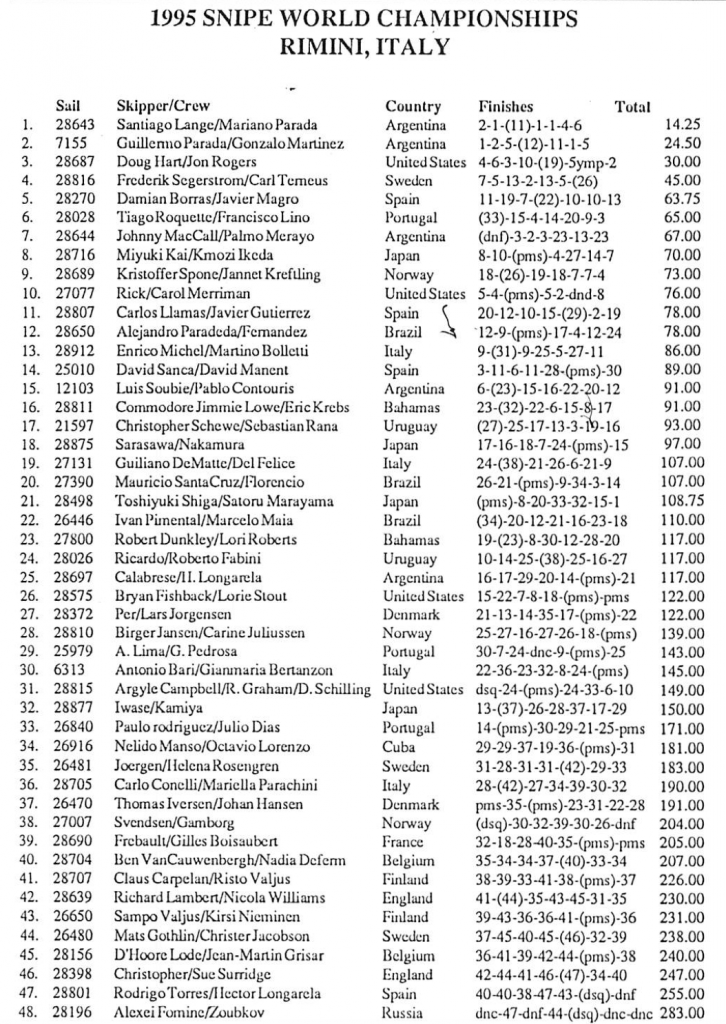
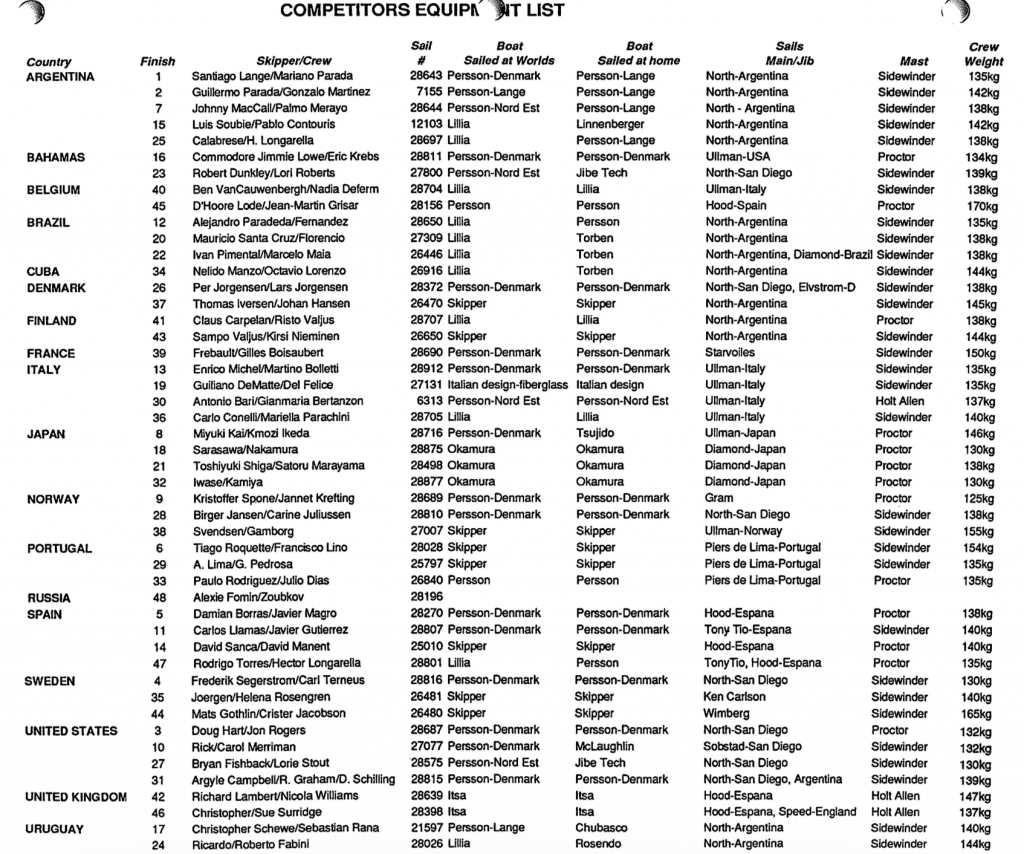
Snipe equipment at the top end of competition still seems more evolutionary than revolutionary. More sails from different sailmakers were seen at this regatta than other recent international events. Six different sailmakers were present in the top ten alone. Perssons seem to be the hull of choice and there was one Skipper in the top ten. The new Persson NordEst (built in Italy) looked just fine and the new Lillias seem faster than their finishes show. Ivan Pimental was in the hunt many times in his Ferrari yellow Lillia until a missed shift slowed him down.
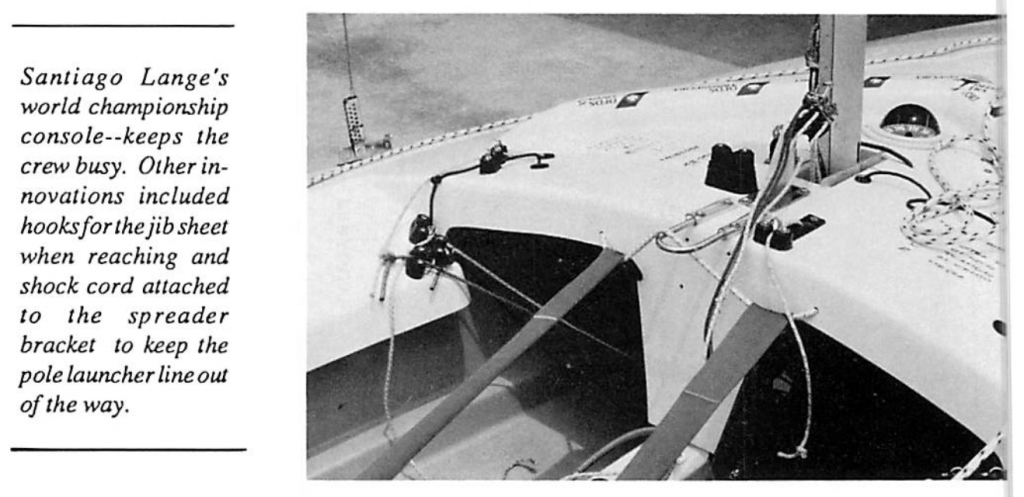
Hardware wise, the general trend is to keep the crew busy with adjustments, allowing the skipper to focus on steering and mainsheet. Almost the entire fleet had launchers, with the notable exception of a couple of the Japanese boats. Johnny MacCall had a very clean, simple method of adjusting the jib lead from the weather side as did the Japanese. Santiago Lange is still using a hook to hold the daggerboard up and it doesn’t sound like he plans on changing anytime soon. We should note that he sets the board with the hook and then uses a bridle to hold it back. Many people were using shock cord loaded blocks ala the Old Man’s to hold up their boards. Sidewinder and Proctor masts are still popular. See the competitors equipment list for details.
The Swedish team of Joergen and Helena Rosengren were allowed to sail with an extra crew member (to-be), as Helena was competing 6 months pregnant! The youngest sailors were skippers Thomas Iversen from Denmark and Mauricio Santa Cruz from Brazil. Brazil had the distinction of posting the youngest and oldest. The oldest admitted to be 56 years old, but only after half way through the trophy dinner. And no, we don’t name names.
SOCIAL
The final prize giving was held on the grand terrace of the Grand Hotel, historic in Rimini and Italy as the backdrop for numerous Federico Fellini movies. After a delicious meal (as only the Italians can offer) the presentation began. Local officials were congratulated and Vice Commodore and Italian National Secretary Giorgio Brezich was given a standing ovation for his efforts for the 37th World Championships. The Hub E Isaacs trophy was once again presented to Santiago Lange and Mariano Parada for a tremendous regatta.
–Sean Biehl
Read also:
1997 Snipe Worlds – XXXVIII – San Diego, California, USA, September 13-19, 1997
Santa Cruz, after winning the 1996 Western Hemisphere & Orient Championship, moved to So. California to “train for the Worlds and learn English.” Slipping into the Southern California lifestyle was easy, and Mauricio admitted that he only trained for 3 months to capture the World Championship.
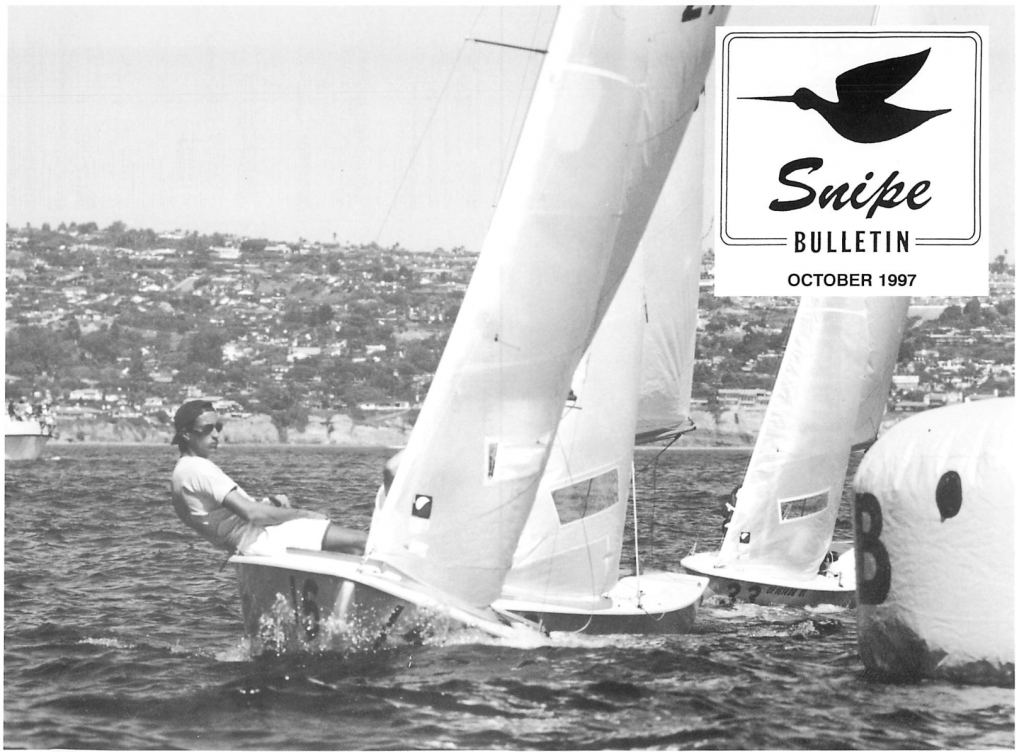
Above: Ricardo Fabini and Juan Esterovich of Uruguay on their way to winning race 3 of the World Championships. Geri Conser photo
Brazilians Give a One-Two Punch to Win the World – Snipe Bulletin October 1997
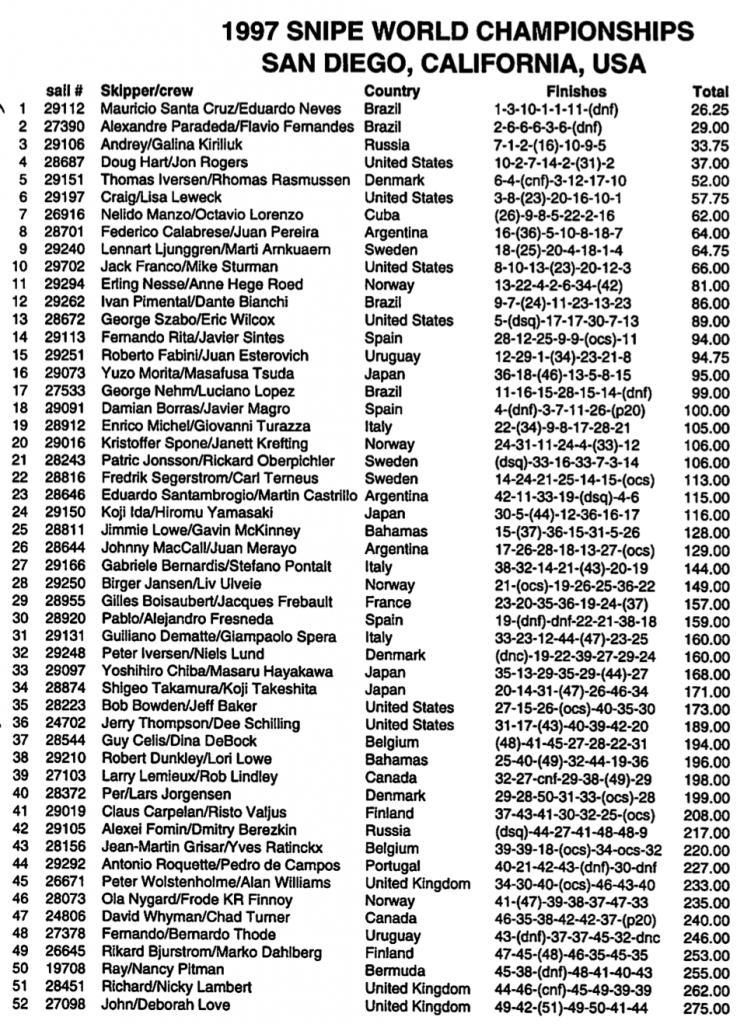
In typical Southern California light breezes, Brazilians Mauricio Santa Cruz with Eduardo Neves as crew and Alexandre Paradeda with Flavio Fernandes in front, held off the rest of the world’s best Snipe sailors to win the 38th Snipe World Championship.
Santa Cruz, after winning the 1996 Western Hemisphere & Orient Championship, moved to So. California to “train for the Worlds and learn English.” Slipping into the Southern California lifestyle was easy, and Mauricio admitted that he only trained for 3 months to capture the World Championship. Teammate Paradeda arrived fresh from the 470 Worlds ready to sail. The two Brazilians were given a run for their money early on when new Snipe sailors Andrey and Galina Kiriliuk of Russia held a slight lead. The fluky winds off Mission Bay and the threat of Hurricane Linda from the South produced conditions that had even the locals baffled.
The first day’s conditions of 8-10 knots had Paradeda/Fernandes leading the entire race until the finish when Santa Cruz/Neves passed for the win. Paradeda choose to cover local sailors Craig and Lisa Leweck up the last beat, letting Santa Cruz get off to the left. Paradeda/Fernandes and the Lewecks ending up over standing the finish, allowing Mauricio and Eduardo enough space to get both of them. Santa Cruz had rounded the first mark in 5th and had been slowly sneaking up the entire race. Former European Champion Damain Borras and Javier Magro from Spain had rounded the weather mark 2nd, but dropped back to 4th by the leeward mark and the finish.
In a perfect example of “Regatta Weather” the biggest hurricane recorded in the western Pacific, Hurricane Linda, lurked off the coast. Although expectations were for heavier wind and sea conditions, 8-12 knots, rain, and relatively smooth seas became the factor. This was the day for Russian sailors Andrey and Galina Kiriliuk. Finishing 1-2, they were leading by 4 points at the days end. Roberto Fabini and Juan Esterovich of Uruguay won race 2 from start to finish. Paradeda/Fernandes stayed consistent with a 6-6 and US sailors Doug Hart and Jon Rogers posted a 2-7 to keep them in touch.
On the third day, the aftermath of Hurricane Linda left little breeze and overcast skies. The light breeze caused problemsfor many, but Santa Cruz/Neves won both races giving them a lead 7 points going into the last day. Paradeda/Fernandes kept to a 6-3 and the only other sailors to finish in the top 10 that day were Erling Nesse and Anne Hege Roed of Norway with a 2-6 and Fernando Rita and Javier Sintes from Spain with a 9-9. Everyone else seemed to have at least one bad race.
Going into the next day, the conditions were light again, but the Hurricane clouds had passed and the sun was bright. Pan American Games winners Cubans Nelido Manzo and Octavio Lorenzo, usually known for their heavy air expertise, led the 52 boat fleet around the entire course until the finish. Newlyweds Lennart Ljungren and Marit Arnkuaern of Sweden in their new Skipper nipped the Cubans at the finish. Fellow countrymen and Skipper sailors Patrik Jonsson and Rickard Oberpichler finished 3rd followed by Eduardo Santambrogio and Martin Castrillo of Argentina and Past Commodore Jimmie Lowe and Gavin McKinney rounded out the top 5. Santa Cruz/Neves made a remarkable comeback, having rounded the weather mark in 31st, the leeward mark in 17th and finishing 11th. Paradeda/Fernandes sailed a 6th and calculations were being made to determine what combination of finishes it would take to win the World Championship.
Earl Elms Perpetual
The Mission Bay Fleet, with approval from the Board of Governors, presented a new perpetual to honor 2-time World Champion and local fleet member Earl Elms. The perpetual is awarded to the winner of the last race of the World Championship. With Earl on the course everyday using his boat for spectators, he watched as the fleet prepared to battle out for the championship and the new trophy. With the pressure off the United States team battled it out for the top 3 places in the final race. With local bragging rights on the table, Craig and Lisa Leweck led around the track. As the wind picked up during the last beat, Doug Hart and Jon Rogers extra click of speed kicked in. A serious tacking duel ensued as the two leaders approached the finish, with Jack Franco and Mike Sturman steaming up quickly. The Lewecks were able to hang on to their lead and under Earl’s eagle eye, won the Earl Elms Perpetual.
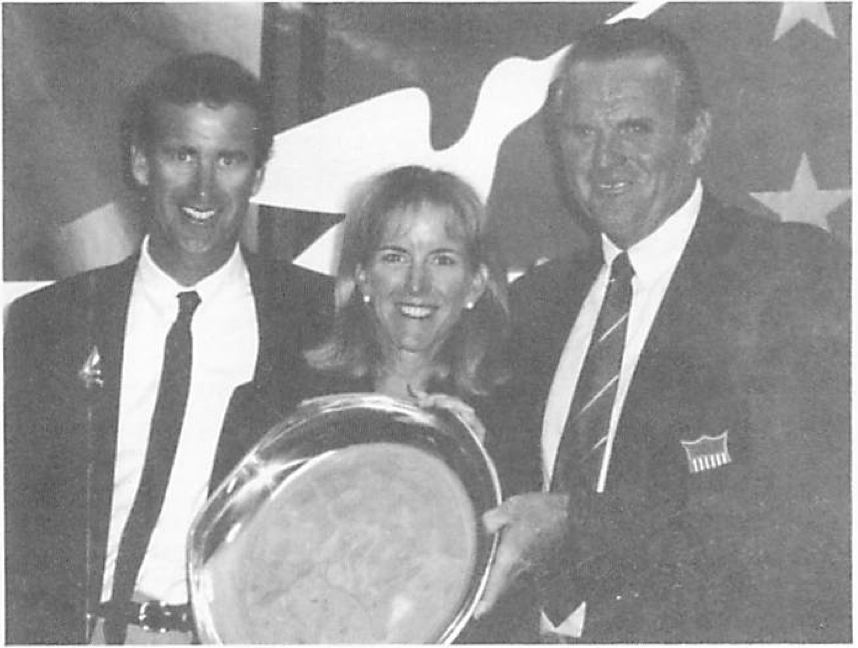
New World Champions
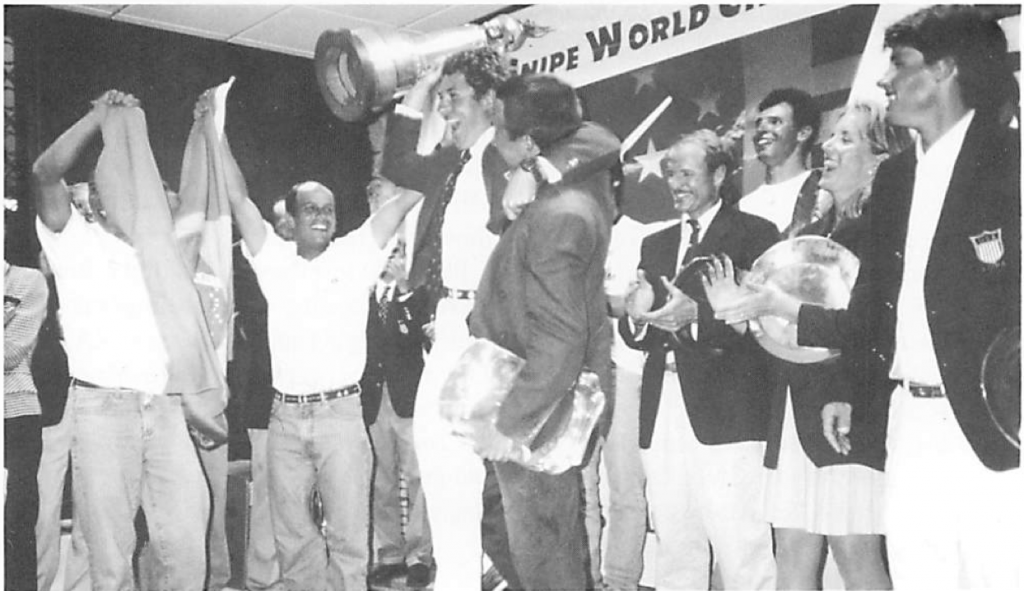
Not lost in the above excitement was the problem of who would actually win the World Championship. With Paradeda having the only chance of catching Santa Cruz match racing was the call during the prerace manuvering. Alexandre buried teammate Mauricio at the boat end, but in the process found himself in heavy traffic. Although both teams had been able to sail through traffic seemingly at will during the entire regatta, today the fleet was tougher. When Paradeda/Fernandes determined that the championship was out of their reach, they rounded up and headed for the bay. Seeing this, Mauicio and Eduardo did likewise. The two teams joined up and in an impressive display of sportsmanship and camaraderie, both teams took celebratory swims and exchanged teammates for the sail in. As the skippers of both boats sailed one boat in and the crews sailed the other, the Brazilian celebration began.
Social
From the Opening Ceremonies, with 14 Past SCIRA Commodores in attendance, to the final banquet where everyone celebrated, the motto of “Serious Sailing, Serious Fun” was never in jeopardy. Local fleet members put on a party each night with sailors seen dancing to the rhythms of a steel drum band on the beach and even on the roof of the clubhouse on the layday. Mexican night and a fish fry cooked by Elms, Persson and local fleet members made a memorable and delicious night.
Equipment
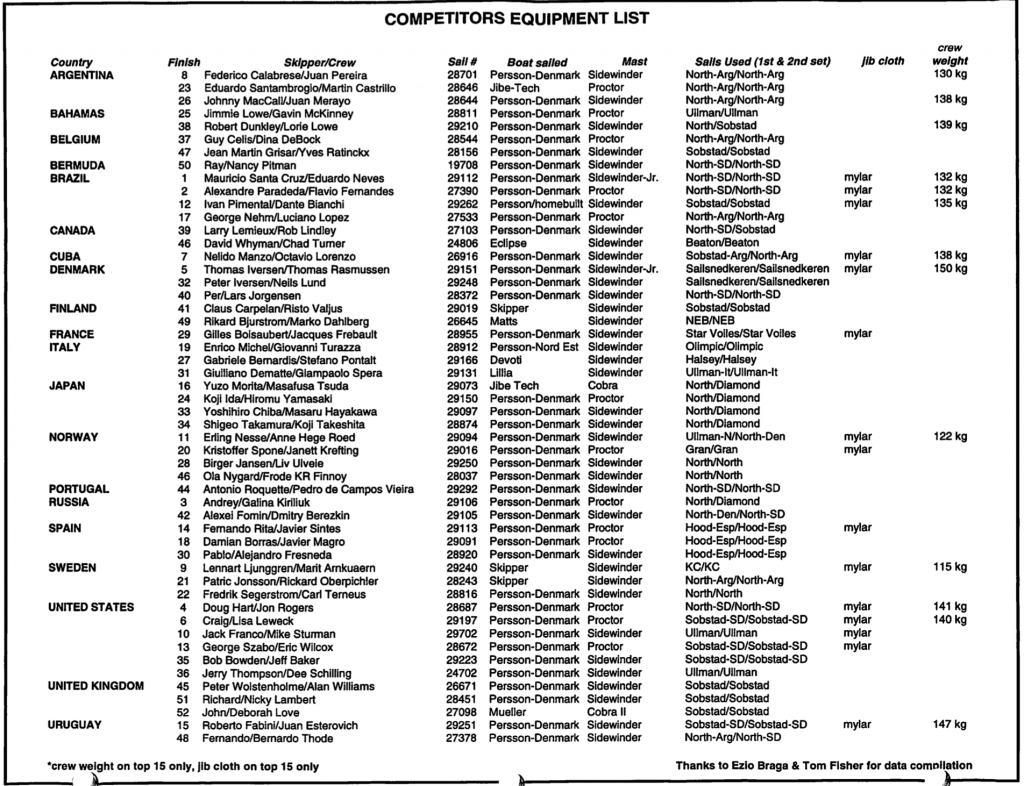
Eight different manufacturers of hulls were seen at this year’s regatta. Mast selection ranged from Cobra II models to Proctor, Sidewinder and the new Sidewinder Jr., a softer version of the Sidewinder.
- Devoti: newest design on the block making its world debut. Built by Olympic Finn builder Tim Tavinor and Luca Devoti, this new Snipe has interesting designs including a interior shelf. Rumor has it the shelf is for stability if the boat capsizes, to keep from turtling.
- Jibe Tech: The Jibe Techs used were charter boats, and an older design. The newest Jibe Tech sailed in the 1997 US Nationals.
- Lillia: Micky Costa has helped re-design the new Lillia with rounded decks and full bow. Front cockpit has curved design like the Thor.
- Mueller: Bill Buckles trailered the Mueller to San Diego for charter, his newest creation. A wide cockpit, rounded decks and easy rigging made this Snipe, complete with paint job, “best in show.”
- Persson-Denmark: 40 of the 52 competitors were using Danish Perssons, either chartered locally or shipped in. The comfortable cockpit makes it a favorite for skippers and crews.
- Persson-Nord-Est: The Nord-Est is a licensed Persson made in Italy. Same design as the Danish model.
- Skipper: The new Skipper raised eyebrows, especially winning a race and several other finishes in the top 10. The design has a full bow and higher transom corners giving the boat more “V” in the back. An invisible jib car system makes for a clean cockpit.
- Individual boats: Rikard Burjstrom flew in his Matts wood boat and Ivan Pimental modified his Persson hull with a Thor deck.
Sails
Of the 52 competitors, a wide range of sailmakers were represented including several from non-dominant sailmakers. Most of the sailors chose to use the combination of dacron mains with mylar jibs, but 2 sets of mylar mains were seen on the race course. Obviously, mylar cloth for the jibs is a popular choice, as was evident downwind with the glare reflecting off the fleet!
Optional Equipment
Equipment evolution seems to have tapered off. “Variations of the standard theme” was how one crew member put it. There were some nice arrangements where the jib sheets were led under the deck. Some people had “double barberhaulers”; one line is the standard barber (or Mollet) hauler and the other line connects to the block and goes into the deck just inboard of the shrouds. This used to tighten the jib leech downwind and pole reaching in breeze. Double ended jib halyards are becoming more prevalent. Rather that dead ending one end of the halyard, it is led to a cleat that the crew controls. The advantage is both crew members can get at the adjustment.
In anticipation of the typical kelp beds floating in the race course, So. California sailor Jack Franco retro-fitted his new Snipe to include a modernized version of Charlie Bustamante’s “weed wacker.” Franco had a tube installed through his transom deck, exiting just below the bottom gudgeon with a retracting rod with padded end that would skim the front of the rudder, removing any weeds. Jury is still out on if the concept will be standard equipment in seaweed plagued areas.
Read also:
1999 Snipe Worlds – XXXIX – Santiago de la Ribera, Spain, September 3-11, 1999
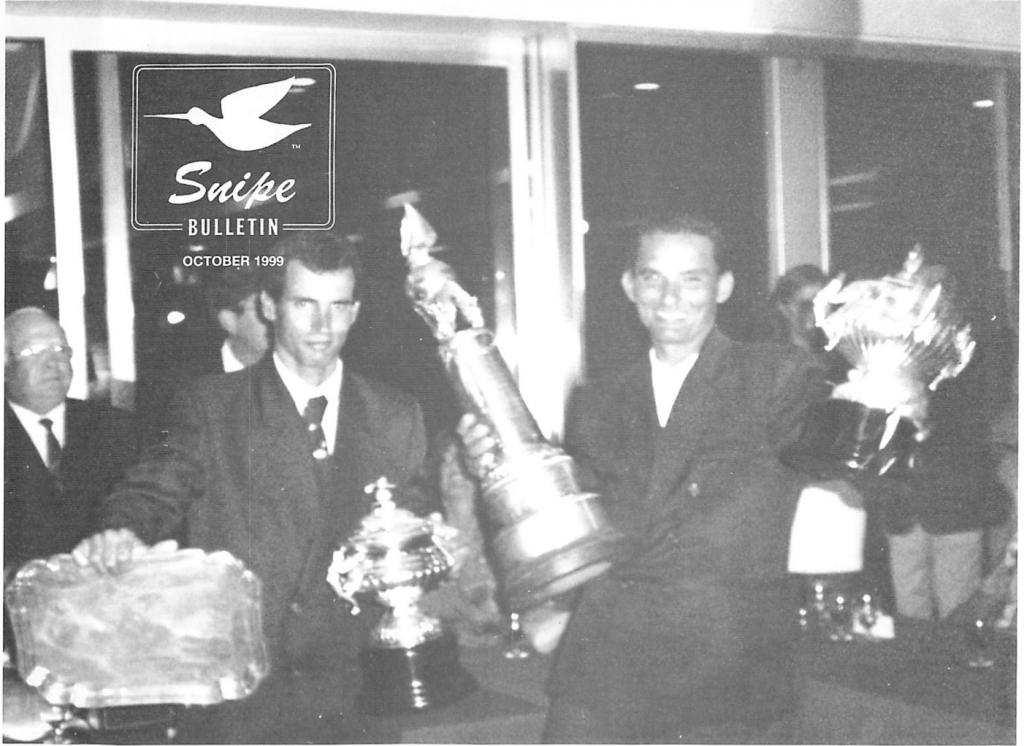
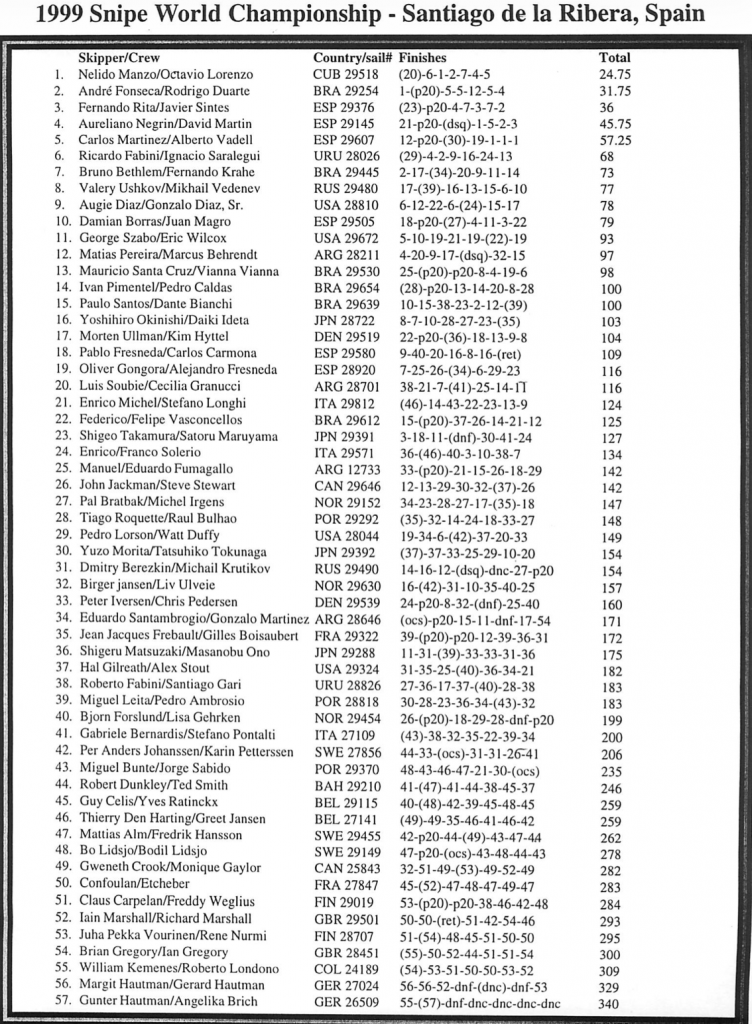
At the 1999 Snipe World Championship held in Santiago de la Ribera, Spain, the Cuban duo of Nélido Manso and Octavio Lorenzo secured a historic victory. Manso, a native of Caibarién, Cuba, guided his team through a highly competitive fleet to claim what remains the only Cuban victory in the history of the Senior Snipe World Championship. (We apologize that a race-by-race account of the event is currently unavailable).
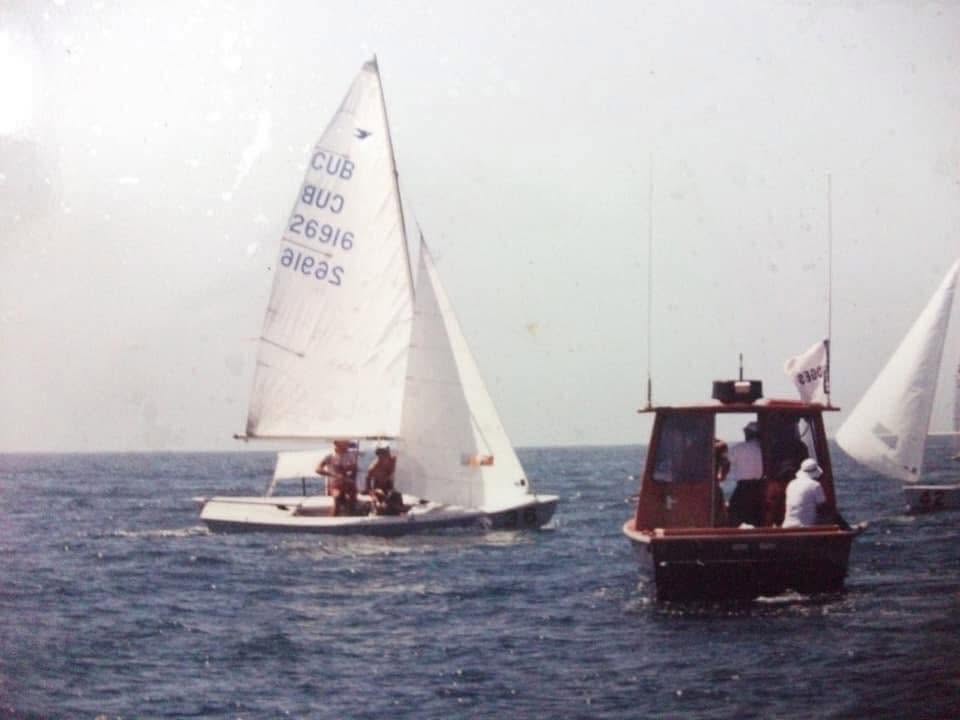
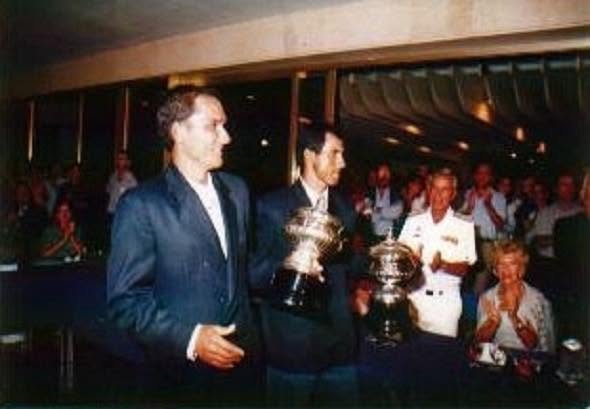
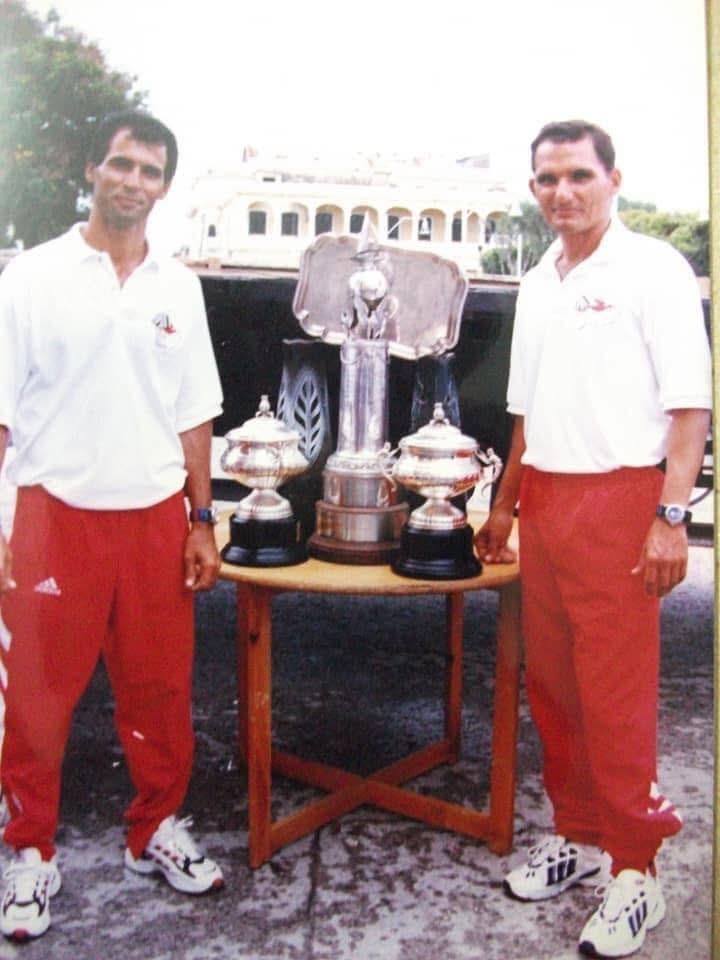
As highlighted by Commodore Lee Griffith in the Snipe Bulletin, Manso and Lorenzo arrived in Spain on the heels of another major international achievement, having won the gold medal at the 1999 Pan American Games in Winnipeg earlier that same season. This triumph capped an exceptional streak for Manso in the Snipe class, which also included back-to-back Pan Am gold medals in Havana (1991) and Mar del Plata (1995), alongside a gold medal at the 1993 Central American and Caribbean Games in Ponce, Puerto Rico.
2001 Snipe Worlds – XL – Punta del Este, Uruguay, November 24-December 2, 2001
Consistency was again the factor with cousins Alexandre & Eduardo Paradeda, and the brother duo of Federico and Felipe Vasconcellos, in retaining the top spots.
Paradeda’s Capture 40th World ChampionshipPunta del Este, Uruguay – Snipe Bulletin January 2002
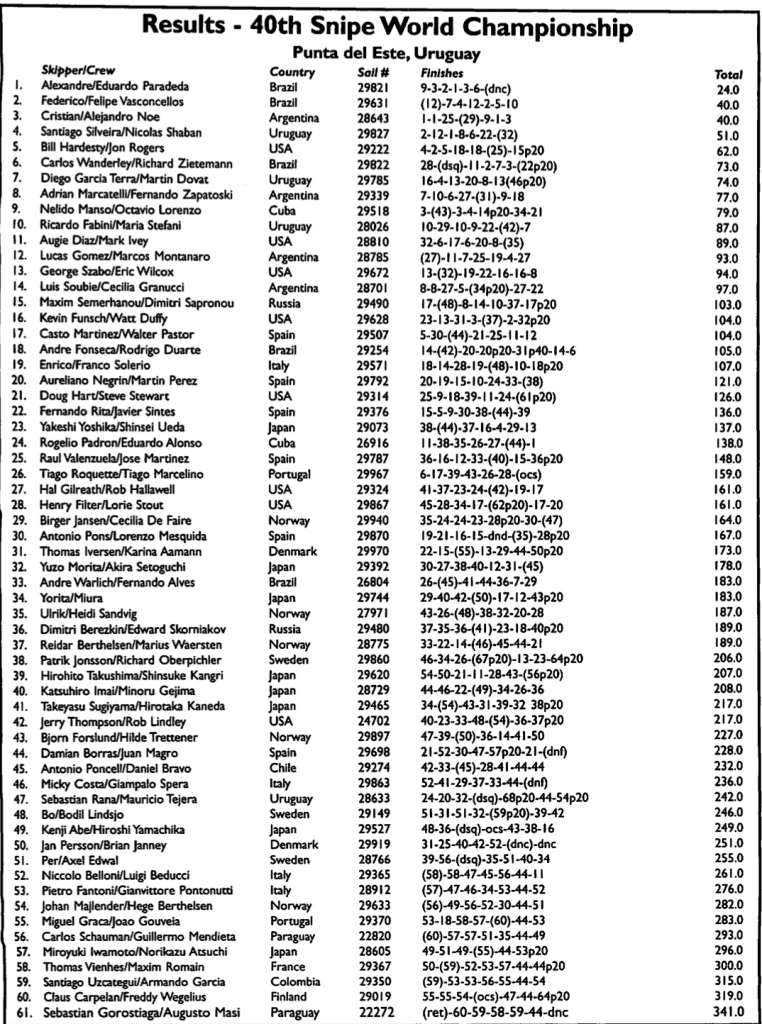
In SCIRA’s 70th year, the Brazilians came on strong to finish in the top 2 positions and capture the 40th Snipe World Championship held in beautiful Punta del Este, Uruguay, November 24-December 2, 2001.
Consistency was again the factor with cousins Alexandre & Eduardo Paradeda, and the brother duo of Federico and Felipe Vasconcellos, in retaining the top spots. Tied with the Vasconcellos were another brother duo of Cristian and Alejandro Noe of Argentina who showed consistency with 3 first place finishes, but deeper finishes dropped them back and also became the determiner of the tie breaker.
Yacht Club Punta del Este’s facilities and management were outstanding and gave all the competitors an equal footing both on and off the water. Unpredictably lighter breezes caused many of the heavier teams to be unprepared for the change in tactics, but those able to quickly adjust found themselves at the top of the leader board.
Day 1 Winds from the northeast gave the most breeze of the Championship and big chop gave the sailors an added challenge. The Noe brothers won the opening race starting the regatta with a bang, looking like they were the team to beat. Local Uruguayans Santiago Silveira/Nicolas Shaban were cheered across the finish in 2nd with defending World Champions Nelido Manso/Octavio Lorenzo of Cuba 3rd.
Day 2 An on-shore postponement started day 2 but was dropped by noon as the wind filled to get the races going. Races began in 6-8 knots out of the East-south-east with flat seas quite an opposite to the previous day. A windward-leeward with offsets and a gate at the bottom mark was signaled and the fleet spread across the entire course looking for breeze and playing the current. Jr. World champions Lucas Gomez/Marcos Montanaro of Argentina led with another former Jr. world competitor Diego Garcia/Martin Dovat 2nd followed by the Noe brothers and Paradedas. By the bottom leeward mark, many positions had changed by the leeward mark. The Paradedas were moving ahead followed closely by “the Brazilian navy” of Wanderley/Zietmann, Vasconcellos brothers and double Jr. World Champion Andre Fonseca/Rodrigo Duarte. At the finish, Manso/Lorenso crossed by 30 seconds, but had a Z-flag penalty, Vasconcellos brother, Paradedas, Japanese sailors Takeshi Yoshioka/Shinsei Ueda and Fonseca/Duarte, who were caught twice on recalled starts.
Day 4 – lay day
Day 5
Fresh breezes of 9-13 knots out of the SW gave 2 final challenging races for the 61 boats. Race 6 started in 8-10 knots with a clean start the first time around. A clearly visible current line 1/2 way up the course caused some major challenges, especially at the weather mark and offset. Many teams were unable to pass the offset and had to do several tacks just to round the mark. Wanderley/Zietmann rounded first with Funsch/Duffy 2nd and the Noe brothers 3rd. Those in the hunt for the title rounded substantially back, but some were able to crawl back through the fleet to get a nice end result. By the 2nd weather mark, the current had subsided some, but the competitors could still be seen giving the marks very wide berths! At the finish, Noe brothers added another 1st to their collection followed by Funsch/Duffy, Wanderley/Zietmann, Gomez/Montanaro and the Vasconcellos brothers. As the Paradedas crossed in 6th overall, the crown had been won and they celebrated and watched the remaining race from the sidelines.
Going into the final race, there were several teams that could finish 2nd. Unfortunately after 1 general recall, 4 more starts under a Z flag caught 21 boats over, 2 were caught twice. The breeze had increased to 12-15 and the current had subsided even more, making the course more equal. Silviera/Shaban and the Vasconcellos brothers were 1 point apart, with the Noe brothers 7 behind and Hardesty/Rogers another 10 points out. Vasconcellos and the Silviera/Shaban had a close race until the downwind leg, while Hardesty/Rogers stayed in the top 3 and managed to move into 2nd at the finish. The Noe brothers hovered around 5th until the final beat where they managed to pass the Russians and Fabini to finish behind Hardesty/Rogers for 3rd. Newcomers Cuban sailors Rogelio Padron and Eduardo Alonso won the last race to clinch the Earl Elms Perpetual.
Social
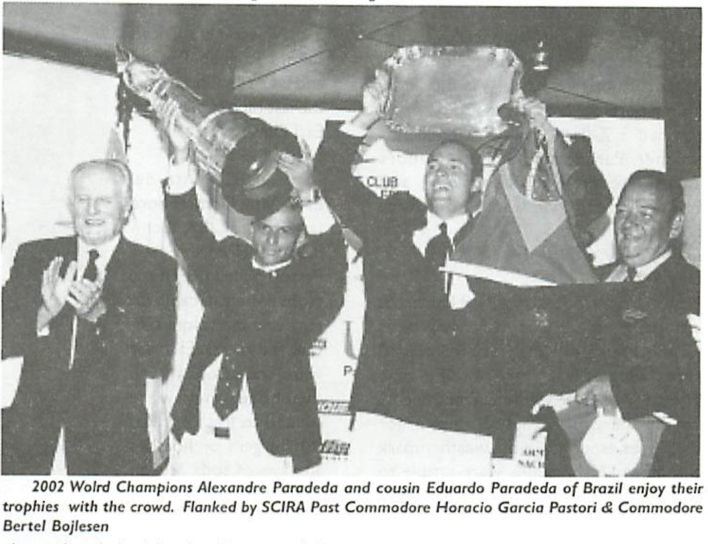
YC Punta del Este with Commodore (and past SCIRA Commodore) Horacio Garcia Pastori pulled out all the stops when it came to servicing the sailors, officials and guests. Each day when the sailors arrived on shore, they were treated to freshly grilled hamburgers or hotdogs and lots of soda & beer. The hungry sailors ate it up! The paella dinner for 200 was a site to be seen, and the South American grill night treated all to great cuts of beef. The Uruguayan hospitality was fantastic. The large boat yard had plenty of room for all the teams to rig & repair boats, and the separate regatta office provided an informal meeting area for everyone involved.
Meanwhile, the jury, headed by multi-Snipe champion Fernando Sanjurjo, was kept busy, but luckily the regatta was won cleanly on the water and not in the room. Race Committee chairman Bernt Knuppel and his band of race officials ran excellent courses and adjusted to each wind shift accordingly. All in a day’s work to run another successful Snipe World Championship.
Stories from the Boat Yard
Every once in a while you run across stories that have to be shared. Like the one about 2 brothers, current Western Hemisphere & Orient Champions, who didn’t think they would be able to make the Worlds, just one country away, due to university studies and lack of time & transportation to get their boat there. In steps Bibi Juetz, long time Snipe sailors and 1998 World Master champion. Bibi volunteered to drive the boys boat to Punta del Este (some 2000+ kilometers) and encouraged these young sailors to compete – and compete they did finishing 2nd overall!
The other is a local story. Skipper Santiago Silveira sailed with his crew, Nicolas Shaban, who had learned to sail through the YC Punta del Este community sailing program. The Worlds was Nicolas’ first major regatta, and at 17 years old, he and his skipper at age 20 sailed the regatta of their lives to claim top local rights and announce they are a force to be reckoned with!
Read also:
XXXVI – Porto Alegre, Brazil, November 1993
- Santiago Lange and Mariano Parada, Argentina
- George Nehm and Fernando Krahe, Brazil
- Guillermo Parada and Sergio Ripoll, Argentina
- Paulo Santos and Ricardo Santos, Brazil
- Ricardo Fabini and Jose Chiaparro, Uruguay
Sailed on Guaíba River, 46 starters, 17 nations
XXXVII – Rimini, Italy, July 1-9, 1995
- Santiago Lange and Mariano Parada, Argentina
- Guillermo Parada and Gonzalo Martinez, Argentina
- Doug Hart and Jon Rogers, USA
- Frederik Segerstrom and Carl Terneus, Sweden
- Damian Borras and Javier Magro, Spain
Sailed on the Adriatic Sea, 48 starters, 18 nations
XXXVIII – San Diego, California, USA, September 13-19, 1997
- Mauricio Santa Cruz and Eduardo Neves, Brazil
- Alexandre Paradeda and Flavio Fernandes, Brazil
- Andrey and Galina Kiriliuk, Russia
- Doug Hart and Jon Rogers, USA
- Thomas Iversen and Thomas Rasmussen, Denmark
Sailed on the Pacific Ocean, 52 starters, 20 nations
XXXIX – Santiago de la Ribera, Spain, September 3-11, 1999
- Nelido Manso and Octavio Lorenzo, Cuba
- André Fonseca and Rodrigo Durate, Brazil
- Fernando Rita and Javier Sintes, Spain
- Aureliano Negrin and David Martin, Spain
- Carlos Martinez and Alberto Vadell, Spain
Sailed on the Mar Menor, 56 starters, 21 nations
XL – Punta del Este, Uruguay, November 24-December 2, 2001
- Alexandre and Eduardo Paradeda, Brazil
- Federico and Felipe Vasconcellos, Brazil
- Cristian and Alejandro Noe, Argentina
- Santiago Silveira and Nicolas Shaban, Uruguay
- Bill Hardesty and Jon Rogers, USA
Sailed on Maldonado Bay, 61 starters, 19 nations
About the 2026 Snipe Worlds:
Mahon, Menorca, Spain, September 19-26, 2026
Leave a reply
Your email address will not be published. Your comment will be revised by the site if needed.

0 comments