
Understanding the Snipe Class: Decision-Making Process
To understand the Board's decision-making process, one must look at how and when they meet, how they vote, and which matters they address.

To understand the Board’s decision-making process, one must look at how and when they meet, how they vote, and which matters they address. Decisions range from quick, informal administrative tasks to long, complex procedures for amending the Constitution, By-Laws, or Class Rules, always adhering to principles of collegiality and democracy.
1. The Regulatory Framework
The SCIRA legal system is composed of the following documents:
- a) Constitution: The fundamental governing document (the “State Law”).
- b) By-Laws: Administrative and operational details (the “Operations Manual”).
- c) Class Rules: Technical specifications of the boat to ensure One-Design uniformity.
- d) Rules of Conduct (RoC): Management of championships (divided into International/National and Club/Fleet levels).
- e) Deeds of Gift (DoG): Legal documents governing specific trophies.
- f) Support Tools: Builder Certification, Measurement Handbooks, Race Templates (NoR/SI), and Rule 42 Guidelines, etc.
2. Meetings and Agendas
Board Meetings (Constitution Section 23.3 & Section 23.4):
- Bi-Annual Meeting: Held in conjunction with the Open World Championship.
- Special Meetings: Called by the Commodore via teleconference/video call with 7 days’ notice.
- Quorum: An absolute majority of the voting Board of Governors.
- Agenda Management:
- Maintained by the Executive Director.
- Items can be placed by Board members, National Secretaries, or a petition from 5 Fleet Captains.
- Proposals affecting the Constitution/By-Laws must include the specific sections being impacted.
3. Voting Procedures (Constitution Section 23.5)
- Ballots: Distributed via mail, fax, or email; members have 10 days to respond.
- Options: “Yes,” “No,” or “Table.”
- Approval: Items pass when a majority of the entire Board votes “Yes.”
- Tentative Items: Proposals from National Secretaries or Fleet Captains require a unanimous “Yes” to be enacted immediately; otherwise, they are moved to the next agenda.
4. Amending Primary Rules (Constitution Section 30)
The process for amending the Constitution, By-Laws, and Class Rules is rigorous:
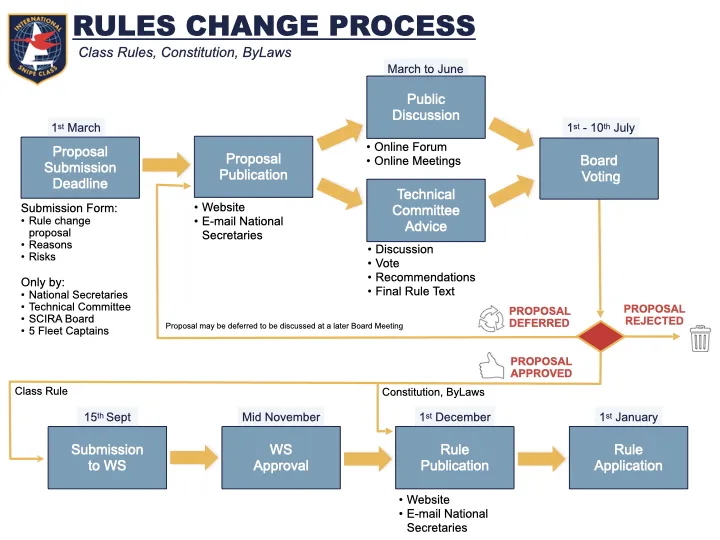
- Timeline: Proposals can be submitted by the Board, Technical Committee, National Secretaries or 5 fleet captains up to 1st March (Rule Proposal Form).
- Review: The Technical Committee (TC) reviews and posts the proposal for discussion (March–June).
- Public Discussion: from March to June
- Double Agenda Rule: Every change must appear on at least two agendas to allow for amendments and final reflection.
- Final Approval: Requires an absolute majority of the Board (July 1–10).
- Implementation:
- Class Rules: Effective January 1 of Leap Years (e.g., 2024, 2028) after World Sailing (WS)approval.
- Constitution/By-Laws: Effective January 1 of the following year.
- RoC/Deeds of Gift: Can be approved at any time, effective January 1 of the following year.
It should be emphasized that: All proposals related to the Class Rules and the Rules of Conduct must first be referred to the Technical Committee, which shall report out the proposal and its advice. This proposal shall become an item of the next agenda.
It should also be added that: Regarding the Class Rules, World Sailing approval is required to ensure that the rules comply with the standards defined in the Equipment Rules of Sailing (ERS).
Note:
The Equipment Rules of Sailing govern the equipment used in the sport; the rules are revised and published every four years by World Sailing. Revised every four years alongside the Racing Rules of Sailing (RRS), the current edition is the 2025–2028 ERS, which took effect on January 1, 2025.
The ERS is divided into three distinct parts:
Part Title Focus Part I Rules for Use of Equipment Governs how equipment is positioned and used during a race (e.g., sail limit marks, crew harnesses). Part II Equipment Definitions The “dictionary” of sailing. Defines exactly what constitutes a hull, rig, sail, or foil to ensure uniform measurement. Part III Equipment Control Sets the rules for how equipment is inspected, certified, and “measured in” for an event. The ERS is a “parent” document.
5. The Technical Committee (TC)
Composition (Section 28 & Section 29):
- Members: Chairman, Vice Chairman, Chief Measurer, 4 members, and the Chief Information Officer (CIO).
- Role: They are the technical “guardians.” They study Class Rules, RoC, and DoG.
- Urgent Actions: The TC can issue a “Circular Letter” to clarify or simplify rules. Once signed by the Chairman and posted on the website, these interpretations become part of the current rules immediately.
A reflection on the composition and expertise of the Technical Committee members: we often tend to think of them solely as technical experts on Class Rules, experienced measurers, engineers, or specialists in the ERS (Equipment Rules of Sailing). In reality, they are—or ought to be—jurists as well, or at least individuals possessed of legal knowledge. This is because they are required to advise on and take positions regarding the regulations governing the life of the Association (the Constitution), which are distinct from the purely technical standards found in the Class Rules.
6. Principles of Stability and Urgency
- The Value of Stability: Rules work best when they are stable. Frequent changes make compliance and enforcement difficult.
- The “Shortcut” Debate: Following the COVID-19 era, it was clarified that while regattas can be canceled by a simple Board vote, the Constitution and Class Rules cannot be modified via “shortcuts.”
- Addressing “Holes”: If a technical loophole is discovered, the TC uses the “Circular Letter” for immediate clarification, which is later formalized through the standard Section 30 process.
Read also:
Leave a reply
Your email address will not be published. Your comment will be revised by the site if needed.


0 comments